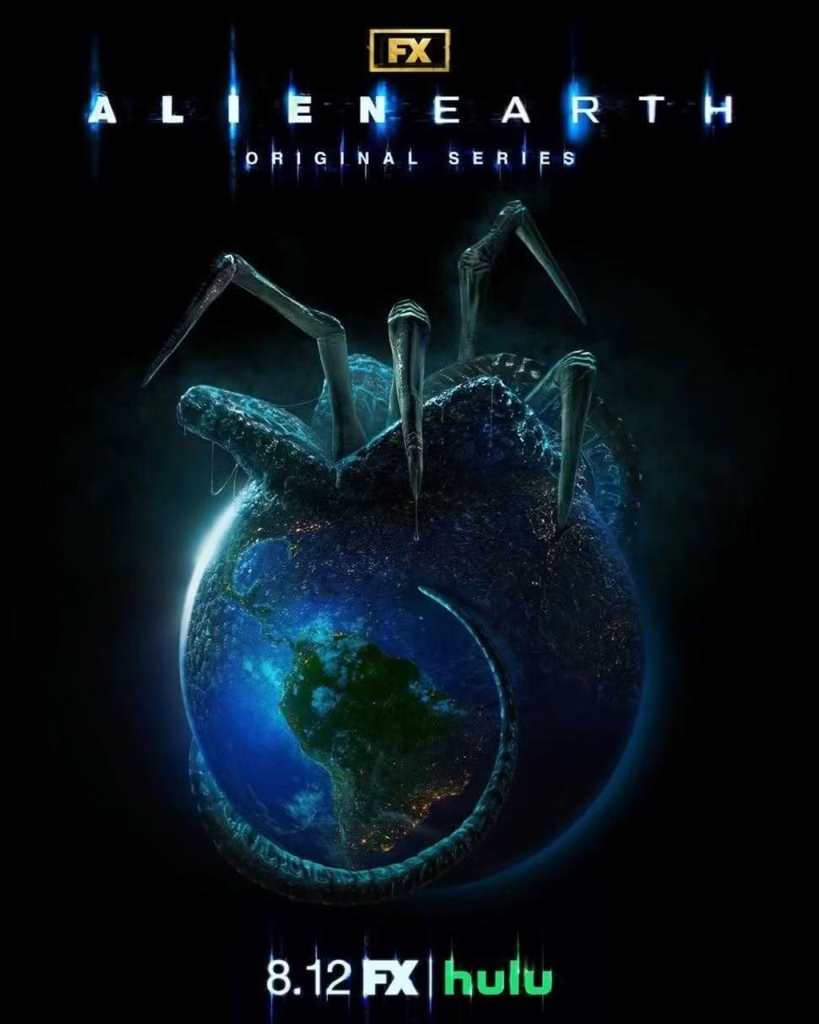
Deep Dive: Alien: Earth Season 1 – A Terrifying Evolution
When I first heard that Noah Hawley was bringing the Xenomorph to television, I’ll admit I was skeptical. How do you translate something as viscerally cinematic as Ridley Scott’s alien horror to the small screen without losing what makes it special? After binge-watching all eight episodes of Alien: Earth that dropped on Disney+ and Hulu this August, I can say with confidence: Hawley didn’t just succeed—he created something that feels both intimately familiar and utterly fresh.
The Setup That Changes Everything

Alien: Earth takes the bold step of bringing the franchise’s terror directly to our planet, decades before the events of the original 1979 film. When a mysterious space vessel crash-lands on Earth, a young woman and a ragtag group of tactical soldiers make a fateful discovery that puts them face-to-face with the planet’s greatest threat. But what struck me immediately was how this isn’t just another “monster arrives on Earth” story—it’s a meditation on what happens when humanity’s worst nightmare becomes our new reality.

The series centers around Wendy (Sydney Chandler), whose performance anchors the entire season with a perfect blend of vulnerability and steel. Watching her navigate the horror feels personal in a way that the isolated space settings of previous films couldn’t achieve. This is our world being invaded, our home being transformed into a hunting ground.
Noah Hawley’s Vision: More Than Just Monsters
Having created Fargo and Legion, Hawley brings his signature blend of psychological complexity and visual storytelling to the Alien universe. Stylistically bold and scary as hell, Noah Hawley’s Alien: Earth transplants the Xenomorph mythos into the television medium with its cinematic grandeur intact while staking out a unique identity of its own.
What fascinated me most was how Hawley uses the expanded runtime of television to explore themes the films could only hint at. Each episode feels like a short film, complete with its own arc, while building toward something larger and more existential. The xenomorphs are terrifying, yes, but they’re also a mirror reflecting humanity’s own capacity for violence and survival.
The Cast: A Perfect Ensemble
The ensemble cast feels carefully curated rather than simply assembled. The series stars Sydney Chandler, Alex Lawther, Essie Davis, Samuel Blenkin, Babou Ceesay, Adarsh Gourav, and Timothy Olyphant in main roles. Each actor brings something distinct to the table:

Sydney Chandler as Wendy becomes the emotional core of the series, delivering a performance that feels both grounded and otherworldly. Her character arc across the eight episodes is a masterclass in showing trauma and resilience.

Timothy Olyphant brings his trademark intensity, but here it’s tempered with a vulnerability that makes his character’s journey genuinely surprising. The things that wake you up in the middle of the night that you’re thinking about the next day are just scenes not involving the xenomorphs at all, as Olyphant himself noted. That’s the real horror—the human moments.
Alex Lawther continues to prove he’s one of our most underrated actors, bringing complexity to what could have been a simple military role.
The supporting cast, including Essie Davis, creates a world that feels lived-in and authentic, making the horror that much more impactful.
The Unholy Menagerie: More Than Just Xenomorphs
What truly sets Alien: Earth apart is that for the first time in 46 years, the series depicts other kinds of hostile aliens separate from the Xenomorphs. Four of these Alien: Earth aliens have never been seen in this franchise until now. They include the Blood Tick, the Octopus Eye, the Orchid, and the nest of alien flies, with the Xenomorph returning to our screens as well.

The most disturbing of these new creatures is the Trypanohyncha Ocellus (or “Eye Octopus”), which honestly kept me awake longer than the xenomorphs did. Species 64 is an especially gross entity, what I can only describe as an eyeball with multiple irises that walks around on octopus tentacles. Apparently parasitic in nature, Species 64 violently latches onto another being by ripping out its eye and embedding into the socket, essentially becoming a living replacement organ. It moves about on a gelatinous, tentacled body akin to a tiny octopus, only its “head” is a single eye, whose iris can alter from a focused singular view to multi-directional viewing like a fly.

The Blood Tick creatures are equally unsettling. Like the Eye Octopus, these bugs are shown to be intelligent and cunning; after getting loose during the crash, the bugs bide their time before striking at the most opportune moments. They demonstrate a pack intelligence that makes them particularly dangerous in the show’s urban setting.

The Orchid species and the alien flies round out this nightmare collection, each bringing their own form of body horror to the table. What’s brilliant about Hawley’s approach is that each creature represents a different kind of violation—the Eye Octopus steals your sight and identity, the Blood Ticks drain your life force, and the flies swarm and overwhelm. Together with the xenomorphs, they create a symphony of terror that attacks every human vulnerability.

Visual Storytelling and Practical Terror
One thing that immediately struck me was how the show maintains the tactile, practical feel of the original films while embracing modern television production values. All these creatures—xenomorphs and the new species alike—feel real and present, not just CGI creations. The teaser showed the Earth reflected in the head of a Xenomorph, which perfectly encapsulates the show’s approach—this is our world seen through the lens of pure predation.

The production design creates spaces that feel both futuristic and grounded. The crashed vessel and subsequent containment efforts feel believable, like something that could actually happen if we discovered alien life tomorrow. This attention to realistic detail makes the fantastic elements even more terrifying, especially when you’re watching a cat with an alien eyeball parasite stalking through familiar suburban streets.
The Three Paths to Immortality: Redefining What It Means to Be Human
Perhaps the most philosophically ambitious aspect of Alien: Earth is its exploration of what the opening text describes as “the race for immortality will come in 3 guises”—cyborgs, synthetics, and hybrids. This isn’t just science fiction window dressing; it’s a fundamental reimagining of human evolution that makes the alien threat even more complex.
The Corporate Architect of Tomorrow

Boy Kavalier, the world’s youngest trillionaire who founded Prodigy Corporation at age 10, represents a new kind of corporate visionary. What unsettles me about Samuel Blenkin’s portrayal isn’t just the character’s youth, but his complete certainty that consciousness transfer is humanity’s natural next step. His obsession with Peter Pan and “agelessness and immortality” drives him to create hybrids using terminally ill children, turning tragedy into what he sees as transcendence.
The Lost Boys: Children’s Minds in Adult Bodies

The hybrid program represents perhaps the series’ most disturbing innovation. The process involves transferring the consciousness of a child into a synthetic adult body, with children used because their minds are not as rigid as adults. Watching Sydney Chandler as Wendy—originally an 11-year-old girl named Marcy Hermit who died of terminal illness—navigate adult situations with a child’s emotional framework creates a unique kind of uncanny valley effect that’s deeply unsettling.
The other hybrids are nicknamed the “Lost Boys”—Slightly, Curly, Nibs, Smee, and Tootles—making Kavalier’s Peter Pan obsession literal. These aren’t just androids or enhanced humans; they’re children who will never grow up, trapped forever in synthetic bodies that can’t age or die. It’s immortality as horror rather than blessing.
Three Types of Post-Humanity

The series carefully distinguishes between its three forms of enhanced humanity:
- Cyborgs like Morrow (Babou Ceesay): Humans with synthetic parts, crucially maintaining their human consciousness and identity
- Synthetics like Kirsh (Timothy Olyphant): Fully artificial beings with advanced AI but no human consciousness
- Hybrids like Wendy: Human minds placed into android bodies, representing something entirely new
What makes this taxonomy fascinating is how it reframes the traditional Alien franchise questions about what makes someone human. The xenomorphs may be the perfect organism, but humanity is apparently evolving into something equally adaptable through technology.
Corporate Evolution and Its Discontents
Prodigy Corporation operates as one of five companies that effectively govern Earth, alongside Weyland-Yutani in “The Five”. This corporate oligarchy doesn’t just control resources—they’re literally reshaping human evolution. The implications are staggering when you consider that a 20-year-old CEO is making decisions about the future of human consciousness.
What struck me most is how the series presents this not as dystopian nightmare but as inevitable progress. The characters don’t question whether consciousness transfer is ethical; they debate the technical challenges. It’s a worldview where humanity’s survival depends on becoming something posthuman, making the alien threat almost secondary to our own transformation.
Themes That Hit Different in 2025

These technological themes make the traditional Alien horror even more complex. We’re not just watching humanity face an external threat—we’re watching a species already in the process of transcending its biological limitations encounter something that represents the apex of biological evolution. The xenomorphs become a mirror, forcing us to ask whether our pursuit of synthetic immortality makes us more or less human.
Watching Alien: Earth in our current moment feels particularly resonant. The series explores themes of contamination, isolation, and survival that feel uncomfortably familiar after recent global events. But Hawley doesn’t just use these themes for cheap relevance—he interrogates them, asking what it means to be human when faced with something that wants to use our bodies as breeding grounds, especially when we’re already volunteering to abandon those bodies.
The show also grapples with corporate malfeasance and military cover-ups in ways that feel both specific to the Alien universe and broadly applicable to our current trust-in-institutions moment. But here, the corporations aren’t just covering up alien threats—they’re actively rewriting the human genome and consciousness itself.
The Eight-Episode Structure: A Perfect Arc

The first episode of Alien: Earth dropped on August 12, with the eighth and final episode airing on September 23. This eight-episode structure feels exactly right for the story Hawley wanted to tell. Unlike other series that feel stretched or compressed, each episode of Alien: Earth feels essential.
The pacing builds gradually, letting us get to know the characters before the full horror begins. When the xenomorphs finally arrive in force, we care about every person they threaten. The final episodes become an almost unbearable tension between hope and horror, ending on a note that feels both conclusive and ominous.
Production Journey and Development

Development for the series was reported to have begun in early 2019, with Ridley Scott attached to executive produce for FX on Hulu. The six-year journey from conception to screen shows in the series’ polish and attention to detail. Having Scott’s involvement lends credibility while allowing Hawley to chart his own course.
The first episode of Alien: Earth was screened early at the series’ panel at the San Diego Comic-Con on July 25. That early screening created immediate buzz, and after watching the full season, I understand why. This isn’t just a good Alien story—it’s exceptional television, period.
Critical Reception and Cultural Impact
The series has been well-received both critically and commercially. ⭐ 7.4 | Horror, Sci-Fi, Thriller on IMDb reflects solid audience appreciation, while the critical consensus praises its visual style and character development.
What’s most impressive is how the show has managed to feel essential to the Alien franchise while standing completely on its own. You don’t need to have seen the films to understand and appreciate what Hawley is doing here, but longtime fans will find plenty of deep cuts and references that reward their investment.
Personal Reflections: Why This Works

As someone who’s followed the Alien franchise through its peaks and valleys, Alien: Earth represents something I didn’t think was possible—a return to what made the original film so special while expanding the mythology in meaningful ways. The series understands that the xenomorph works best as a force of nature, not just a monster to be defeated.
What kept me up after watching wasn’t just the creature feature elements—though they’re genuinely scary—but the human drama. The series asks hard questions about survival, sacrifice, and what we’re willing to do to protect the people we love. These themes resonate long after the credits roll.
The series also succeeds because it takes its time. In our current landscape of rapid-fire content consumption, Alien: Earth forces you to sit with discomfort, to really feel the weight of what’s happening to these characters. It’s horror in the truest sense—not just scary, but deeply unsettling.
Looking Forward: What This Means for the Franchise

With the season concluded and fans eagerly awaiting news of a potential second season, Alien: Earth has proven that the franchise has plenty of life left in it. The series opens up new possibilities for storytelling within this universe while respecting what came before.
The ‘Alien: Earth’ creator Noah Hawley talks about about everything that happened in the Season 1 finale, and his interviews suggest he has a clear vision for where the story could go next. Whether we get more seasons or not, this first season stands as a complete and satisfying story.
Conclusion: A New Standard for Franchise Television

Alien: Earth succeeds because it never forgets what made the original films special while refusing to simply repeat them. Noah Hawley and his team have created something that honors the franchise’s legacy while pushing it in new directions. The series proves that there are still fresh stories to tell in this universe, and new ways to make us afraid of what might be lurking in the dark.
For horror fans, sci-fi enthusiasts, and anyone who appreciates character-driven storytelling, Alien: Earth is essential viewing. It’s a reminder of what television can accomplish when ambition meets execution, and when creators are willing to trust their audience to handle something genuinely challenging.
The xenomorphs may be the ultimate predators, but in Hawley’s hands, they become a lens through which we examine our own humanity. And in 2025, that examination feels more urgent than ever.
Elsewhere in the archive: for an earlier collision of science fiction, body horror and creature design, go back to Species (1995).
Leave a Reply