
Affiliate Disclosure: This post contains affiliate links. If you click through and make a purchase, I may earn a small commission—at no additional cost to you. I only recommend products I personally find useful or relevant. Thank you for your support.
How I stumbled into one of Japan’s most profound explorations of humanity, purpose, and the weight of existence—and why going backwards through the story might have been the perfect way to experience it
How I Got Here: Starting at the End
I’ll be honest—I had no idea what I was getting into when I first watched the 2018 live-action “Inuyashiki” film. Maybe it showed up in my recommendations, or I was just browsing for something different. Whatever brought me to it, I found myself watching this quiet, strange movie about an exhausted middle-aged man who gets transformed into some kind of cyborg and starts saving people.
What struck me immediately wasn’t the sci-fi elements or the action—it was how real everything felt. Noritake Kinashi’s performance as Inuyashiki was unlike any superhero protagonist I’d ever seen. Here was a man who looked tired down to his bones, dealing with a cancer diagnosis his family barely acknowledged, working a job where nobody respected him. When he gained incredible powers, his first instinct wasn’t to put on a costume or seek revenge—it was to help people, fumbling his way through learning abilities that were as foreign to him as they were powerful.
The film hit me in ways I wasn’t expecting. It wasn’t until after I watched it that I learned I had experienced this story completely backwards—starting with the conclusion of a journey that had begun years earlier in a completely different medium.


Discovering the Deeper Story: The Manga I Couldn’t Initially Access
After watching the film, I naturally wanted more. That’s when I discovered that “Inuyashiki” originated as a manga by Hiroya Oku, running from 2014 to 2017. My initial research suggested that getting my hands on an English translation would be difficult, if not impossible. This frustrated me enormously—here was this profound story, and I felt locked out of its original form.
What I learned later was that I had been wrong about accessibility. Kodansha Comics had actually published official English translations of all 10 volumes, available both in print and digital formats through Amazon, Comixology, and other platforms. My assumption about unavailability had been based on incomplete information, but it meant I spent months thinking about this story I could only partially access.
During that time of thinking I couldn’t read the source material, I became even more curious about what I was missing. From what I could piece together, Hiroya Oku—already known for the controversial “Gantz”—had created something completely different with “Inuyashiki.” Where “Gantz” was chaotic and violent, “Inuyashiki” seemed to possess a quieter kind of darkness, rooted in social isolation and the invisibility of aging in modern Japan.
The manga was serialized in “Evening” magazine, which targets working adults rather than teenagers—immediately signaling that this wasn’t typical superhero fare. The story’s central concept remained the same as what I’d seen in the film: 58-year-old Ichiro Inuyashiki, feeling worthless and ignored, is transformed into a powerful cyborg after an alien encounter. Simultaneously, high school student Hiro Shishigami receives the same transformation. Both become beings of immense power, but choose radically different paths.
What I gathered from descriptions and reviews was that Oku’s visual style brought something unique to the story. His backgrounds, heavily processed through digital techniques, created a hyperreal Tokyo that felt both familiar and alien. The transformation sequences were rendered with clinical precision, emphasizing the technological nature of their new bodies while maintaining an unsettling organic quality.



The Missing Middle: The Anime That Bridged Everything
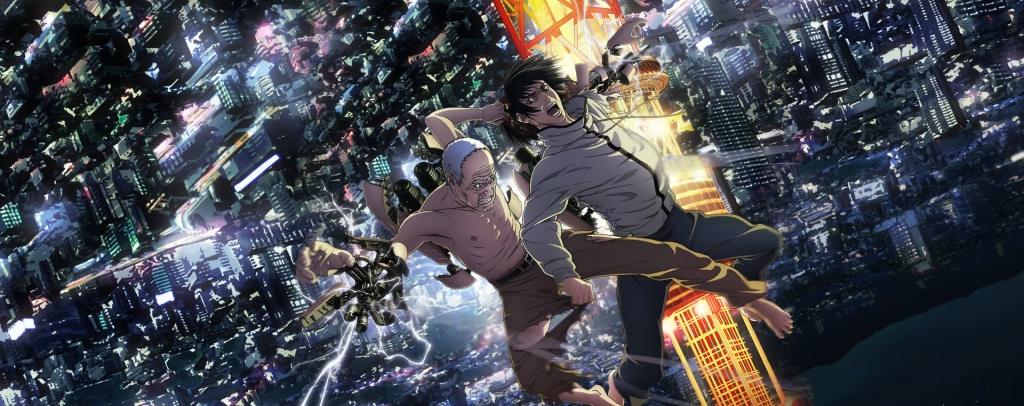
It was only later that I discovered there was an entire anime adaptation I had completely missed: “Inuyashiki: The Last Hero,” which aired in 2017. Once I found out about it, I realized I had skipped the middle chapter of this story’s evolution entirely.
The anime, produced by MAPPA and airing on Fuji TV’s prestigious “Noitamina” block, compressed the manga’s story into 11 episodes. MAPPA, known for their work on “Attack on Titan” and “Jujutsu Kaisen,” brought their signature style to the project: fluid animation, detailed character work, and a willingness to tackle mature themes without compromise.
Watching the anime after seeing the film created this strange sense of recognition mixed with discovery. I knew where the story was headed, but I was finally seeing how it developed. The anime’s pacing allowed for things the film couldn’t include—quiet moments of Inuyashiki’s discovery, his fumbling attempts to understand his new abilities, the gradual building of his confidence as a force for good.
What struck me about the anime was its restraint. While it could have leaned heavily into action elements, director Keiichi Satou chose to emphasize the emotional core of the story. The voice acting, led by Fumiyo Kohinata as Inuyashiki, brought additional depth to the character. Kohinata, primarily known for live-action roles, lent a naturalistic quality to Inuyashiki’s dialogue that made his transformation feel grounded in genuine human emotion rather than superhero fantasy.
The opening theme, “My Hero” by MAN WITH A MISSION, perfectly captured the duality of hope and despair that I now recognized as central to the entire story.




Understanding What I Had Experienced: The Film’s Achievement
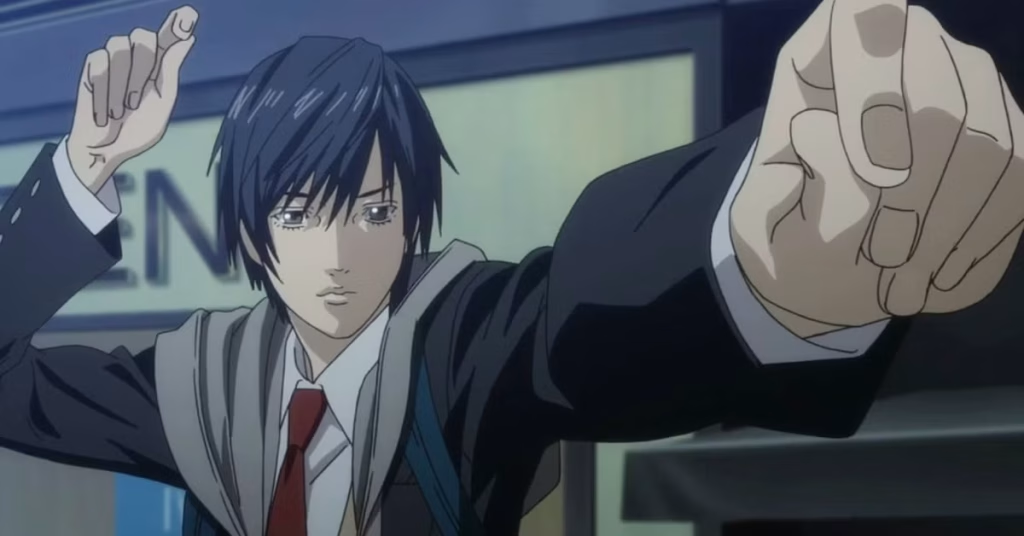
Going back to analyze the 2018 film after discovering its context, I gained a much deeper appreciation for what director Shinsuke Sato had accomplished. Condensing this complex, character-driven story into feature-length format while maintaining its emotional core was an extraordinary achievement.
Noritake Kinashi’s performance as Inuyashiki now seemed even more remarkable to me. His Inuyashiki wasn’t a traditional hero—he was tired, overlooked, dealing with a cancer diagnosis that his family barely acknowledged. When transformation came, Kinashi showed us a man discovering not just power, but purpose, in the most human way possible.
The film’s visual effects, which I later learned had won the Excellence Award at the VFX-Japan Awards 2019, served the story rather than overwhelming it. The transformation sequences were body-horror poetry, showing the mechanical precision of their new forms while never losing sight of the human consciousness trapped within.
Takeru Satoh’s Shishigami provided the perfect counterpoint—young, already alienated, he used his powers as an extension of his existing disconnection from humanity. The contrast between his casual cruelty and Inuyashiki’s deliberate kindness formed the emotional backbone of the film.
Why My Reverse Journey Made Sense
Looking back, I think experiencing “Inuyashiki” in reverse order might have been the perfect way to encounter this story. Starting with the live-action film gave me the most emotionally direct experience possible. Films must compress and focus, which meant I experienced the core emotional truth without getting lost in longer development.
The film showed me immediately what made this story special—it wasn’t about superpowers or alien technology, it was about human dignity and the search for meaning. When I discovered the anime and eventually gained access to the manga, I could appreciate how that emotional core was built, layer by layer, across different media.
The Universal Themes That Hit Me
What made “Inuyashiki” so compelling to me across all its iterations was how it used science fiction to examine fundamentally human questions. The alien technology was merely a catalyst for exploring what it means to matter, to be seen, to have purpose in a world that increasingly relegates certain populations to invisibility.
Inuyashiki’s age was crucial to the story’s impact on me. In a genre typically focused on young protagonists discovering their powers, seeing a middle-aged man—tired, dismissed by his own family, facing mortality—suddenly gifted with the ability to save lives created a completely different emotional dynamic. His heroism didn’t come from righteousness or destiny, but from a lifetime of being overlooked finally given the tools to make an undeniable difference.
The story also examined different responses to powerlessness transformed into power. While Inuyashiki chose to heal and protect, Shishigami chose to destroy, seeing his new abilities as validation for his pre-existing resentment. Neither response was presented as inevitable—they were conscious choices that revealed character.
The Cultural Context I Came to Understand
As I learned more about “Inuyashiki,” I began to understand how it reflected specific concerns in contemporary Japan. The story arrived during a period when Japan was confronting difficult realities about its aging population and social isolation. The phenomenon of “kodokushi” (lonely death), where elderly people die alone and remain undiscovered for extended periods, had become a recognized social issue. Inuyashiki himself embodied this demographic—invisible, financially struggling, health declining, family indifferent.
The story’s treatment of technology also reflected contemporary anxieties that I found universal. The alien technology that transformed both protagonists was presented as both salvation and horror. It gave them the power to act, but at the cost of their humanity in the most literal sense. This mirrored broader concerns about how advancing technology might reshape what it means to be human.
What Made the Story Stick With Me
What elevated “Inuyashiki” beyond typical superhero narratives for me was its commitment to emotional authenticity. Inuyashiki didn’t become confident overnight. He struggled with his new abilities, made mistakes, and wrestled with the moral implications of his actions. His relationship with his family remained complicated even after his transformation—power didn’t automatically solve problems of communication or understanding.
The story asked difficult questions about worth and dignity that resonated with me deeply. Was Inuyashiki only valuable after he gained the power to save lives, or was his worth always there, waiting to be recognized? The answer the story provided was both—his inherent worth was always present, but power gave him the ability to express it in a way the world couldn’t ignore.
My Current Perspective: Why This Story Matters
Now that I’ve experienced “Inuyashiki” across all its forms—albeit in unconventional order—I can see why it has left such a lasting impact on me. Each version offered something unique: the manga’s detailed exploration of internal states and social commentary (once I finally gained access to it), the anime’s careful pacing and visual poetry, and the film’s concentrated emotional impact and stellar performances.
Together, they created a complete picture of one of the most profoundly human stories I’ve ever encountered in the superhero genre. “Inuyashiki” stands as proof that superhero stories can be vehicles for exploring the deepest aspects of human experience—aging, invisibility, the search for meaning, and the different ways people respond to both powerlessness and power.
Reflecting on My Accidental Discovery
What strikes me most about my journey with “Inuyashiki” is how perfectly it mirrors the story itself. I stumbled into something extraordinary without expecting it, much like Inuyashiki stumbled into his transformation. My initial assumption about the manga’s unavailability kept me in a state of curiosity and longing that probably made me think more deeply about what I had experienced in the film.
Sometimes the most powerful transformations—whether we’re talking about fictional characters or personal discoveries—come not to those who expect them, but to those who encounter them by accident. In that way, my backward journey through Ichiro Inuyashiki’s story might have been exactly the right way to experience it: finding something extraordinary in what might have seemed like just another superhero tale, and only later understanding the full depth of what I had discovered.
The fact that I experienced this story in reverse order didn’t diminish it—it enriched it, giving me the unique perspective of seeing the destination before understanding the journey, and perhaps appreciating even more deeply how every piece of Inuyashiki’s story serves its ultimate, profoundly human truth.
Looking back, I wouldn’t change how I discovered “Inuyashiki.” Sometimes the best journeys are the ones we never planned to take.
Leave a Reply