
Spoilers: This review discusses the full film, including major plot turns and the ending.
The playground after the parents have gone
I went into Hive almost completely blind, which is still one of the better ways to meet a horror film. No trailer already filling in the gaps. No half-remembered Reddit argument already sitting in the back of my head. No YouTube thumbnail telling me the ending explained before I have even met the first character. Just a title, a genre label, and the vague expectation that something unpleasant was probably going to happen. That is sometimes enough.
With Hive, the first thing that stayed with me was not the monster, exactly. It was the location. A playground. One of those bright, over-designed suburban children’s spaces that looks harmless in daylight because we have all agreed that daylight is supposed to be safe. Slides, swings, tubes, rubber flooring, climbing frames, pastel plastic. The architecture of childhood, built to reassure adults more than children. And then the film asks what happens if this place was never quite a place of play at all. What if it was a mouth?
Felipe Vargas’ 2026 horror thriller Hive is a Tubi original written and directed by Vargas, expanded from his earlier short film of the same name. It stars Xochitl Gomez as Sasha, Aaron Dominguez as Marco, Victoria Firsova as Zaley, Tanya van Graan as Camille, Zenobia Kloppers as Frances, Jenny le Roux as Mrs. Vaux, and Thulani Nzonzo as Darius. The film premiered digitally on Tubi on April 17, 2026, with a 91-minute runtime listed on Letterboxd.
That background matters because Hive still feels like a short film idea stretched into feature form. Sometimes that works in its favour. Sometimes you can feel the seams. But the central image is strong enough: a teenage babysitter, an affluent neighbourhood, a missing child, and a playground full of children who seem less like children than extensions of something waiting underneath. A horror movie does not always need a new monster. Sometimes it just needs to make an ordinary place feel newly wrong.
A babysitting job with teeth
Sasha, played by Xochitl Gomez, is not walking into this job for fun. She is there because money matters. References matter. Class mobility matters. She is babysitting in Coral Grove, a wealthy gated neighbourhood that carries itself with the particular smugness of places designed to look peaceful while quietly reminding outsiders that they are being tolerated.
Bloody Disgusting describes Sasha as a low-income girl with ambitions connected to the affluent Coral Grove world, working for a rich family whose approval could help her future prospects. Her brother Marco reminds her that they need the gig, which gives the babysitting job a pressure that is not just about childcare but survival, reputation, and access.
That setup is important because Hive is not only about a creature hiding in a playground. It is about Sasha entering a space where she is already being watched, judged, and quietly diminished. Camille, Zaley’s mother, has the soft cruelty of polite privilege. She talks to Sasha with the kind of condescension that probably thinks of itself as friendliness. Sasha has to absorb it because the job is useful. She needs the money. She may need the recommendation. She needs to perform competence for people who will always see her as provisional.

There is something very specific in that. Anyone who has worked freelance, client-facing, or service-adjacent work will recognize the feeling. The smile you put on when someone talks down to you because pushing back would cost more than swallowing it. The strange little theatre of being agreeable when your inner monologue is already packing a chair.
Sasha is strict, anxious, careful. Not because she is naturally joyless, but because the world has given her very little margin for error. That makes her a good horror protagonist. She is not reckless in the usual way. She does not walk toward danger because the script needs her to be stupid. She keeps trying to manage the situation according to the rules she has been given. The trouble is that the rules belong to the wrong world.
At first, Zaley is the job. A child to supervise. A child to keep safe. A child whose mother has already established all the little domestic laws: what she can eat, where she can go, how she should be handled. The film understands that babysitting is already a low-level anxiety machine. You are temporarily responsible for someone else’s entire universe, and the parents have left you with instructions that feel both excessive and incomplete. Then Zaley disappears into the playground.
That is the point where Hive starts to turn childhood equipment into anatomy. A tube slide becomes a throat. The playground becomes a digestive system. The cheerful colours start to feel diseased rather than playful. The film’s short-film origin shows here, because the premise has the clarity of a compact nightmare: babysitter loses child at playground, discovers something among the children, and realizes the place is alive in some awful collective way.
Film Independent’s page for the original Hive short describes it as a real-time horror film about Sasha losing a young girl at an idyllic playground and discovering an entity hidden among the children, one that mind-controls them and threatens to absorb people into a “soul-crushing hivemind.” That phrase, “soul-crushing hivemind,” sounds almost too on the nose. But the film earns some of it.
When the children start moving together
Creepy children are a durable horror device because they disturb several social contracts at once. Children are supposed to be innocent. They are supposed to be protected. They are supposed to be uncontrolled in harmless ways: noisy, impulsive, sticky, occasionally demonic in supermarkets, but not organised. In Hive, the children are frightening because they behave like a system.
That is what makes the playground sequences work. The kids are not simply evil. They move in patterns. They chant. They gather. They react less like individuals than like signals being passed through a network. A playground full of children becomes a surveillance grid. A circle of kids staring at you in silence is already unnerving. A circle of kids staring at you because something under the ground is using them is worse. Bloody Disgusting notes that the film uses Coral Grove residents and children as a stand-in for the unseen creature, with children moving and chanting in unison, snapping into command before violent outbursts and then returning to a confused state afterward.
That detail gives the film one of its stronger ideas. The possessed children are victims too. They are not little monsters in the simple sense. They are conduits. They are being used by whatever lives beneath the playground. That makes the horror messier, because violence against them is not straightforwardly satisfying. You want Sasha to survive, but you also understand that many of the things attacking her are not fully themselves.
The best body-snatcher stories, possession stories, and hive-mind stories usually work because they create doubt around identity. Is the person in front of me still there? Am I speaking to them, or to something wearing their habits? Hive does this through children, which gives the premise a different texture. These are not adults replaced by alien pod copies. They are children turned into sleeper agents by a force they cannot understand.

There is also something oddly modern about that image. Children moving together under invisible instruction. A neighbourhood performing normalcy while everyone is being quietly processed. A community where the affluent surface hides a consuming mechanism underneath. The metaphor is not subtle, but horror does not always need subtlety. Sometimes it just needs to point at the thing we already know and give it teeth.
The film’s title does a lot of work. A hive suggests bees, insects, collective behaviour, labour, containment, sweetness, stings. It also suggests domestic order. A hive is not chaos. A hive is organised. Everyone has a function. Everyone serves the structure. Individuality is not the point.
That is where Hive becomes more interesting than its YA-horror packaging might suggest. The monster is not just a thing under the playground. It is a social arrangement.
The final girl on the payroll
Xochitl Gomez carries the film by giving Sasha a believable mix of irritation, fear, stubbornness, and moral panic. She is not written as a flawless heroine. She is anxious. She miscalculates. She tries to maintain control long after control has already left the building, climbed down the slide, and started humming underground. But that is also what makes her readable.
Sasha has been trained by circumstance to be responsible. She is the kind of teenager who understands consequences because she cannot afford to pretend they do not exist. Losing Zaley is not just a scary thing; it is an economic, social, and personal catastrophe. She will not be believed. She will be blamed. She already knows how that story goes.
In an interview with The Knockturnal, Gomez discussed Sasha’s struggle between listening to the child and listening to the mother, especially because the mother has a connection to Sasha’s dream college. Gomez also talked about adding small “final straw” moments between babysitter and child to make the dynamic more relatable.
That detail helps explain why the early scenes matter. The horror is not only that Zaley disappears. It is that Sasha has already been placed inside a power structure where every wrong move can be used against her. Camille can treat her as disposable and still call her “sweetpea.” Zaley can test boundaries because she knows, instinctively, who has power in the room. Sasha is meant to absorb it.

So when reality begins to fracture, Sasha’s fear of not being believed becomes part of the horror. The Knockturnal interview also notes that Gomez connected Sasha’s situation to the fear of explaining something terrible and not having the person who should support you believe you.
That may be the most emotionally grounded part of the film. Monsters are one thing. Being disbelieved while the monster is still chewing through the walls is another.
There is a whole tradition of horror protagonists — often women, often young, often socially vulnerable — trying to explain the impossible to people who prefer the comfortable lie. Sasha fits that lineage, but with a contemporary class angle. She is not only trying to survive. She is trying to be taken seriously in a world where her credibility is conditional.
Gomez gives her enough edge to avoid making her purely sympathetic in a bland way. Sasha is not there to be adored. She is tense, defensive, and sometimes brusque. Good. Horror protagonists should be allowed to be unpleasant under pressure. Most of us would be. People like to imagine they would be calm and strategic in a nightmare. I suspect many of us would simply repeat “what the hell” while making three bad decisions and one surprisingly useful one. Sasha’s better qualities emerge not because she is fearless, but because she keeps moving while afraid. That is more useful.
Marco and the limits of rescue
Aaron Dominguez plays Marco, Sasha’s brother, and his presence shifts the film from babysitter nightmare into sibling survival story. At first, Marco functions as the practical reminder of stakes: the family needs this job. Later, he becomes the one person who has to decide whether to believe Sasha when everything she is describing sounds insane.
The sibling relationship is one of the film’s better emotional anchors. According to The Knockturnal, Gomez and Dominguez said their real-life friendship helped them build a natural sibling chemistry, with Dominguez describing Marco as someone suppressing a lot in order to protect his sister.
That comes across in the film. Marco is not written as a superhero brother, which is a relief. He is protective but imperfect. He arrives into the nightmare already carrying the fatigue of someone who has had to be practical for too long. There is affection between him and Sasha, but it is not overly polished. They argue. They misunderstand each other. They move like siblings who know where the bruises are.

Marco also gives the film a way to expand beyond Sasha’s immediate perspective without losing the intimate scale. Once he starts entering the playground’s hidden spaces, the film becomes more openly creature-feature, more subterranean, more physical. The playground stops being only a cursed public space and becomes a system of tunnels, chambers, and pulsing threat.
There is a slightly old-fashioned adventure-horror quality to this section. The film is not operating on a massive budget, but the visual idea is clear: beneath the safe suburban surface is a biological machine. Marco’s journey into it is almost mythic in a modest genre way. Brother descends into the underworld to retrieve sister. Except the underworld is made of playground plastic, infection, and whatever horrible stuff is collecting beneath Coral Grove.
The film also uses Marco to sharpen Sasha’s moral instinct. Survival would be simple if the goal were only escape. But Sasha sees the infected children, and especially the long-missing Mabel Grace, as people who need rescuing. Marco, understandably, is more focused on getting Sasha out alive. Neither position is stupid. That tension gives the last act some human friction.

In horror, the practical person is often made to look cowardly. Here, Marco’s fear makes sense. Sasha’s compassion also makes sense. The monster thrives partly because people decide certain victims are already lost. Sasha refuses that. It may be reckless, but it is also the part of her that separates her from the system around her.
Privilege, with a polite smile
Zaley could have been written as just a spoiled child, and to some extent she is. But she also works as a small embodiment of the environment that produced her. She belongs to Coral Grove. She knows its rules even when she is too young to articulate them. She understands that Sasha is there to serve, manage, and absorb.
Victoria Firsova plays Zaley with the right combination of childlike vulnerability and eerie entitlement. Before the horror fully announces itself, Zaley is already difficult in a believable way. She tests Sasha. She pushes. She wants what she wants. That would be ordinary enough. But once the hive influence begins to seep through her, the same behaviour becomes threatening. The film blurs the line between a child being manipulative and a child being used by something manipulative. That ambiguity helps.
Camille, played by Tanya van Graan, is almost more frightening before anything supernatural happens. She represents the velvet-gloved cruelty of people who outsource care while quietly devaluing the caregiver. Her concern for Zaley is real, presumably, but her treatment of Sasha is filtered through class assumptions. She does not need to be a moustache-twirling villain. The film only needs her to be plausible. And she is.
There is a moment in films like this where the parent returns and finds the babysitter in distress. The scene usually becomes a credibility trial. Who will be believed? The child? The worker? The rich household? The outsider? We know the answer before the question is even asked.
That is where the social horror of Hive becomes most direct. The monster may live in the playground, but Coral Grove has already built a system where Sasha’s version of events can be dismissed. The hive mind is supernatural, but the social hive is already functioning.
I wish the film had given Camille a little more depth. She is effective, but she sometimes feels like a sketch of wealthy maternal hypocrisy rather than a fully observed person. Still, in a compact horror movie, a sharp sketch can do the job. We know her. Most of us have worked for some version of her.
The babysitters who disappeared
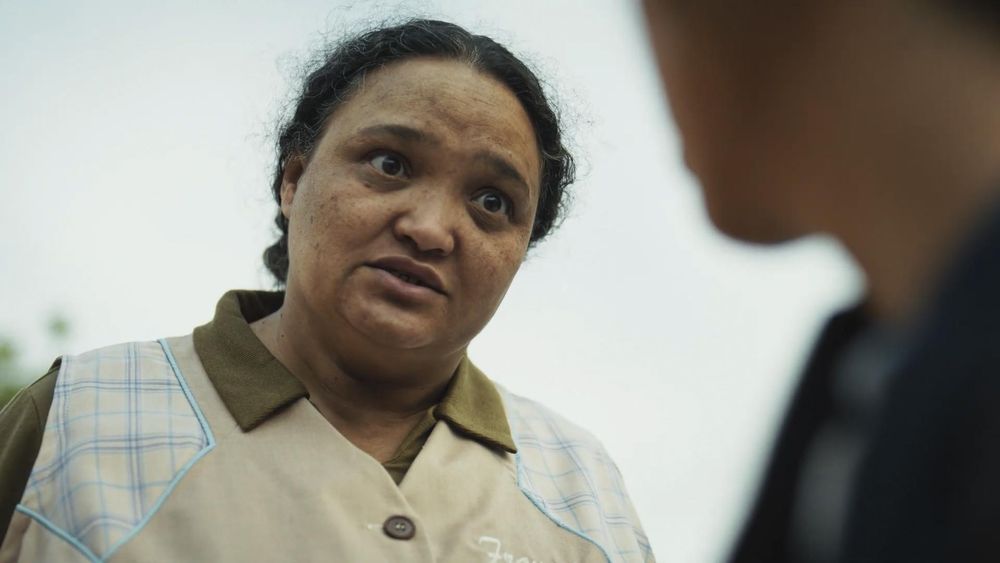
Zenobia Kloppers’ Frances gives Hive one of its more interesting supporting figures. She is the character who understands more than she initially says, the one who has seen enough to become both witness and warning. In another version of the film, Frances could have been the protagonist — the survivor who stayed too close to the site of the trauma because leaving would mean abandoning the missing.
Her connection to Mabel Grace gives the film a trace of old tragedy beneath the immediate plot. Mabel is not just backstory. She is the first disappearance, the proof that the hive has been operating longer than Sasha realizes. The missing babysitter becomes a kind of ghost in the machine, except she is not dead in the simple sense. She has been absorbed, repurposed, hidden inside the system.
That image is stronger than some of the film’s dialogue around it. A young caregiver goes missing in an affluent community. The world moves on. Another caregiver takes the job. Then another. The neighbourhood keeps functioning. The playground stays open. Children keep playing. The system consumes the replaceable and protects the appearance of normalcy. That is the part of Hive that lingers.
Horror has always been good at literalizing social neglect. The haunted house is often just a building where something terrible happened and everyone decided wallpaper was cheaper than truth. In Hive, the playground functions the same way. It is public, visible, bright, and supposedly safe. But it has swallowed people. Not metaphorically. Actually.
Frances knows this. Her role is partly exposition, yes, but she also carries the sadness of someone who has been living beside an open wound while the neighbourhood pretends it is landscaping.
The film could have spent more time with her. It could have given Mabel Grace’s story more emotional room. But even in its abbreviated form, the idea works. The hive is not just a monster. It is an archive of people the community has failed to notice.
A nine-minute nightmare stretched to feature length
One reason Hive feels so direct is that it began as a short. The original short was described by Film Independent as a real-time, visceral horror story following Sasha as she searches for a missing child at a playground and discovers an entity among the children.
That short-film DNA is still visible in the feature. The premise is clean. The location is contained. The monster logic is simple enough to grasp quickly: children are controlled, caregivers are lured, the playground is part of the organism, and the hive consumes.
The feature expansion adds class tension, sibling dynamics, mythology, and a bigger final act. Some additions work better than others. The best parts remain the simplest: Sasha alone among children who are not behaving like children; the playground becoming impossible; daylight refusing to provide comfort.
Bloody Disgusting reported before release that Vargas wrote and directed the feature, adapting his short film, and noted that Gomez also starred in the short. The same report described the feature as a socially conscious horror-thriller and identified Blue Ice Pictures among the producers.

Vargas has a good instinct for images. The film is at its strongest when it trusts visual unease: bodies moving in strange coordination, children staring too long, tunnels glowing in unnatural colour, the cheerful design language of playground equipment turning into something intestinal. A slide is already strange if you look at it long enough. Children willingly climb into a plastic tube and disappear, trusting that gravity and design will return them safely. Hive simply breaks that trust.
There are places where the writing explains more than it needs to. The social commentary can be a little blunt. The mechanics of the creature, sugar, infection, control, and release are pulpy in a way that may not work for everyone. But I did appreciate that the film has a working monster logic. It is not just “vibes in a playground.” It gives itself rules, even if those rules occasionally feel like they came out of a midnight writers’ room with too much candy on the table. That is not always a bad thing.
Horror in broad daylight
One of the more interesting choices in Hive is that much of its horror is not hidden in darkness. The playground is bright. The suburb is clean. The colours are almost cheerful. This connects back to the short film’s stated design, with early coverage noting that the story was set outdoors in bright daylight, which the filmmakers saw as a distinguishing horror element.
Daylight horror has a different kind of cruelty. Darkness gives us permission to be afraid. Daylight embarrasses us for it. We look at a sunny playground and think, no, this cannot be dangerous. Not here. Not with all this plastic and landscaping. Not with children nearby. That is exactly why it works.
The film’s colour and production design lean into that discomfort. Bloody Disgusting praised the film’s candy-coloured production design, sound design, yellow scabby makeup, and prowling camerawork as part of what makes it a solid Tubi original horror entry.
The candy-coloured look is not incidental. Sugar is part of the film’s eventual monster logic, but it is also part of the aesthetic language. Sweetness curdles. Childhood treats become weapons. The safe world of kids’ snacks, playground rhymes, dolls, and outdoor play becomes contaminated.
The sound design also matters. A playground is never truly quiet. Even when empty, it seems to hold remembered noise: swings creaking, rubber soles landing, distant shouting, little rhythmic chants. Hive uses that texture well. The children’s rhymes are silly and menacing in equal measure, which is often how childhood actually works. Kids can make anything sound like a curse if they repeat it together long enough.
There is also a certain Goosebumps quality to the premise, and Bloody Disgusting makes that comparison directly. I understand it. The concept has that middle-grade nightmare clarity: what if the playground was alive and the kids were possessed? But the film pushes into nastier body horror and social horror, so it does not feel purely juvenile. It feels like YA horror with a few adult teeth growing in at odd angles.
That tonal mix may divide viewers. Some will find it fun. Some will find it too silly. Some will want it nastier. Some will think it is already plenty weird. I landed somewhere in the middle, but leaning positive. It is not seamless. It is not subtle. But it has a personality, which is more than I can say for a lot of streaming horror that arrives looking pre-digested.
Where the film wobbles
For all its strengths, Hive does wobble. Some of the exposition is clunky. Frances has to explain enough of the hive’s rules that the mystery briefly becomes a briefing. The class commentary occasionally arrives already underlined. Certain side characters feel more functional than lived-in. Darius, for example, is present largely to widen the danger and provide another body in the machine. Mrs. Vaux and the other adults in Coral Grove could have made the neighbourhood feel more socially specific, but they remain mostly around the edges.
The film also has the classic feature-expanded-from-short problem: the core idea is strong enough for 20 minutes, maybe 30, but the feature has to keep finding new rooms in the same nightmare. Sometimes it does. Sometimes it simply makes the nightmare louder.
The sugar logic may also test viewers. I found it pulpy enough to accept, partly because the film already operates in a heightened register. But there is a fine line between fairy-tale logic and “wait, so candy is the weapon?” Hive walks that line with a straight face, which helps. Horror can survive absurd mechanics if the emotional stakes remain intact.
The final act is bigger, messier, and more openly physical than the earlier sections. I slightly preferred the contained dread of Sasha searching the playground. Once the film starts turning the hive into a more explainable enemy, some of the uncanny quality drains away. That is a familiar horror problem. Monsters are often scarier before they have rules, weaknesses, and a layout.
Still, I would rather a small horror film overcommit to a strange idea than undercook a safe one. Hive may not fully land every piece, but it does not feel anonymous. It has a concept, a visual hook, and a lead performance sturdy enough to carry the uneven patches. That counts.
The ending leaves a bitter taste
The ending gives Sasha a victory, but not a clean one. She fights the hive, helps expose and damage the system, and rescues those she can. Mabel Grace’s presence makes the ending more than just Sasha escaping. It becomes an attempted recovery of the erased.
That matters because the film’s horror is built around disappearance. Babysitters disappear. Parents disappear. Children disappear into control. Individual identity disappears into the hive. To save someone is to insist they are still a person, not just material absorbed by the system.
Sasha’s final actions are therefore both physical and moral. She uses what she has. She improvises. She refuses to leave the lost behind. The film gives her a final-girl arc, but one shaped by responsibility rather than purity or vengeance.

I also like that the ending does not make Sasha suddenly invulnerable. She is battered, frightened, and still very young. The film does not turn her into an action figure. It lets her be resourceful without erasing the cost.
The final note involving candy is cheeky and slightly ominous. It leaves a question mark hanging over the victory. Has Sasha fully escaped the hive’s influence? Has something remained? Or is the film simply refusing the neatness of total cleansing? I prefer the uncertainty. Horror endings often work best when they let survival feel contaminated.
What stayed with me
I did not go into Hive expecting much. That may have helped. Streaming horror, especially direct-to-platform horror, can feel like rummaging through a box of unlabelled cables. Sometimes you find something useful. Often you find a charger for a device you threw away in 2011.
Hive is not a masterpiece. I would not pretend it is. But it has enough oddness to be memorable. It uses the playground well. It gives Xochitl Gomez a strong central role. It turns babysitting into class horror. It understands that children acting together can be more frightening than any single child with dead eyes. It also has a certain scrappy confidence, as if it knows the idea is a little ridiculous and has decided to commit anyway. I respect that.
The film’s best image remains the playground itself: bright, cheerful, waiting. A place designed for children, transformed into a trap for caregivers. A structure that looks like play equipment but behaves like an organism. A suburban amenity with an appetite.
There is something almost too neat about that, but maybe neatness is part of the point. Horror often begins with a familiar shape. A house. A school. A mall. A church. A playground. Then it asks us to look again.
I watched Hive blind, and maybe that was the right way. No expectations. No checklist. Just a strange little horror film about labour, childhood, sugar, class, and a slide that should absolutely be condemned by whatever supernatural building authority handles these things. Not every horror film needs to change the genre. Some just need to make you side-eye an ordinary object for a few days. This one managed that.
Leave a Reply