
David Robert Mitchell drops an unhappy suburban family, their house and apparently most of their street through a wormhole and into prehistory. There are dinosaurs, family problems, temporal paradoxes and one dog whose survival I was considerably more invested in than the laws of space-time.
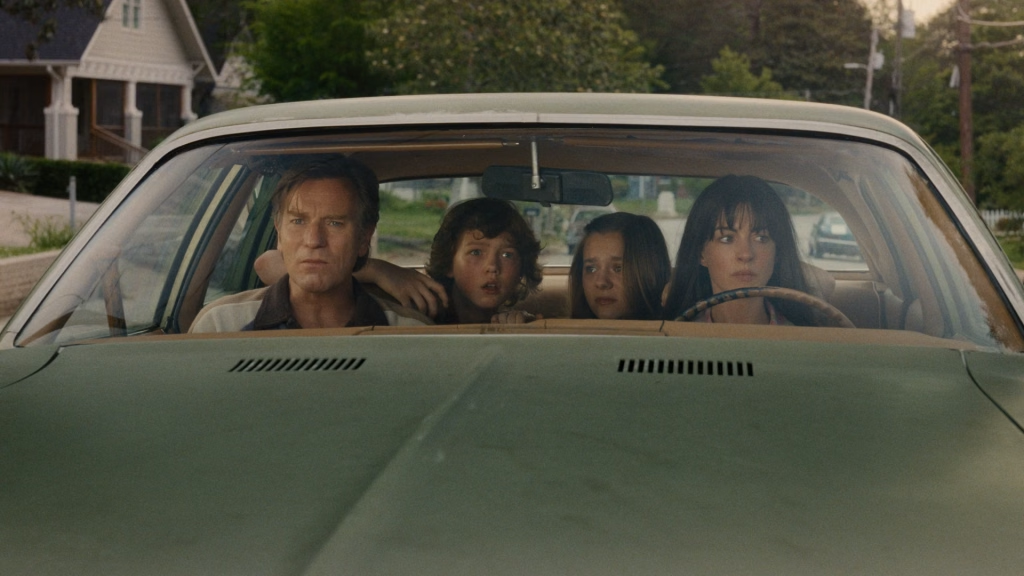
It has dinosaurs in it. Of course I was in.
That is not necessarily the most sophisticated way to choose a film, but I have reached an age where I no longer feel any particular need to apologise for it. Give me an ordinary suburban street, put an Allosaurus at the end of it and you already have my attention. Add Anne Hathaway, Ewan McGregor, wormholes, an increasingly unhappy marriage and the peculiar domestic texture of the early 1980s, and The End of Oak Street was always going to get a fair hearing from me.
What surprised me was how little the film feels the need to make itself more complicated than that. There is science in here, or at least enough wormhole-adjacent science to keep the plot moving, but this is not Primer with dinosaurs. Nobody needs a diagram afterwards. The basic arrangement is easy enough: an ordinary American neighbourhood is torn out of 1982 by a cosmic event and deposited somewhere considerably less hospitable, where electricity, running water and civic planning have all been replaced by prehistoric wildlife with rather poor boundaries.
And really, that is one of the things I liked about it. The End of Oak Street understands that if your premise already involves a suburban family being chased across their own lawns by dinosaurs, explaining every last bolt in the machinery is probably not the best use of 99 minutes.
Before the dinosaurs, there was already trouble on Oak Street

The film begins in 1982 with the Platts looking, from the pavement at least, like a perfectly ordinary family. Denise, played by Anne Hathaway, wants to be a novelist. Greg, played by Ewan McGregor, is carrying considerably more financial trouble than he is admitting. Their daughter Audrey is bright, science-minded and fascinated by Carl Sagan, while younger Brian has the usual collection of adolescent problems: neighbourhood bullies, a girl he likes and a dog called Starbuck whose priorities do not always coincide with those of the humans.
Underneath the block parties, station wagons and reasonably well-kept lawns, Denise and Greg’s marriage is already cracking. Denise is secretly writing a semi-autobiographical novel about a woman considering leaving her family, while Greg has lost his regular job and is quietly delivering pizzas rather than admitting what happened. The dinosaurs therefore arrive less as the cause of the family’s crisis than as an extremely large interruption to one already under way.
I like that arrangement because it keeps the film from becoming simply Jurassic Park Comes to the Cul-de-Sac. David Robert Mitchell has always been interested in suburbia as a place where apparent safety can feel slightly false, and here the metaphor is almost comically literal. Your marriage is failing, the money is running out, your children know more than you think they do, and now there is something enormous moving behind the neighbour’s garage.

Mitchell has said the entire film began with almost exactly that image. Walking through a Michigan neighbourhood, he passed an ordinary garage, chain-link fence and rubbish bins and suddenly imagined a dinosaur standing there. He liked the collision between something fantastical and an utterly mundane middle-class environment, and that became the seed of an original screenplay rather than an adaptation or franchise extension. His stated reference points included The Twilight Zone, Poltergeist, The Valley of Gwangi and Signs, alongside the obvious affection for the kind of character-and-spectacle filmmaking associated with 1980s Amblin.
It is 1982, although memory has softened the edges
The production design is one of the things I enjoyed most because the film does not just scatter a few Rubik’s Cubes and Walkmans around and declare victory. The Atlanta neighbourhood used for Oak Street had apparently changed remarkably little since the 1960s, which meant the crew could work with real mature trees, ranch and split-level houses and streets that already had the right bones. Modern cars and plastic wheelie bins were swapped for period vehicles, metal rubbish cans and BMX bikes, while foliage, swings and other details were added around the houses.

Costume designer Erin Benach’s work follows the same logic. She researched Sears and JCPenney catalogues and deliberately allowed late-seventies patterns, mustards, oranges, terry cloth and older clothing to linger into 1982, because ordinary families did not throw away an entire wardrobe at midnight on 31 December 1979. Denise’s later denim-heavy outfit was conceived almost as armour: practical clothing for a woman who has stopped worrying about looking like the other suburban mums because there are now several more urgent problems with teeth.
That small amount of restraint matters. The film looks nostalgic, certainly, but mostly like somebody remembering an actual neighbourhood rather than recreating the 1980s from a Spotify playlist. Mitchell has talked about drawing on childhood memories of dead-end suburban streets, woods beyond fences and the slightly unsettling feeling that something might exist just outside the familiar world.
For anyone who remembers the period, there is also the enjoyable inconvenience of seeing people solve problems without smartphones. A Polaroid photograph matters. A payphone matters. A pizza delivery matters enormously. Information has to travel physically, and that eventually becomes part of the plot rather than just set dressing.
Anne Hathaway is acting. Ewan McGregor is… also there

This is where the film never quite clicked completely for me. Anne Hathaway commits to Denise as though somebody neglected to tell her she was making a relatively straightforward dinosaur adventure. She plays the frustration, resentment, fear and eventually grief at full dramatic volume. Sometimes that works very well, particularly once Denise has to stop being the disappointed wife and become the person actually keeping everyone alive. At other moments I found myself wondering whether she was playing half a tonal register above the film around her.
Ewan McGregor approaches Greg more loosely. He is likeable, slightly rumpled and convincingly embarrassed by the fact that he has lost his job and cannot bring himself to admit it, but I never entirely believed the chemistry between Greg and Denise. They feel more like two good actors who have agreed that these people have been married for years than two people who actually have been.
Oddly, the mismatch almost becomes useful. Denise seems perpetually wound tighter than Greg because she has already started thinking about an escape from their marriage while he is still trying to keep the appearance of normal family life running. Then the universe introduces dinosaurs and renders that particular argument rather theoretical. I still would not call theirs one of the great cinematic marriages, but both actors take the emotional material seriously enough that when the story becomes nasty, the stakes do not feel entirely synthetic.
The kids are not merely dinosaur bait

Maisy Stella as Audrey and Christian Convery as Brian are among the film’s strongest elements. Audrey has enough intelligence to recognise that the strange flashes and temporal disturbances may be wormholes, helped by her interest in cosmology and Carl Sagan, while Brian is allowed to remain recognisably a kid: brave one moment, foolish the next and understandably more concerned with finding Starbuck than maintaining an academically rigorous approach to temporal displacement.
Jordan Alexa Davis also gives Jeannette more weight than the “girl from down the street who joins the adventure” role might suggest. Once the prehistoric situation strips away the adults and familiar structures around her, she is folded into the Platts’ improvised family almost by necessity. That becomes important later, because the film’s supposedly happy ending creates a rather interesting Jeannette problem that it wisely declines to investigate too closely.
What I particularly liked is that the children are allowed to contribute to survival rather than simply wait for Hathaway and McGregor to rescue them. Audrey figures things out. Brian makes several questionable choices but also keeps moving. Jeannette adapts astonishingly quickly to a situation nobody should reasonably be prepared for. The younger cast gives the film much of its uncomplicated adventure-movie energy, and Brian’s insistence on finding Starbuck gives the story a simple emotional thread that works better than it has any right to.
Dinosaurs without a corporate logo attached

It is almost refreshing now to see dinosaurs in a reasonably large studio film without having to explain which instalment of a decades-old franchise we are watching. The End of Oak Street is an original screenplay, albeit one that wears its influences openly, and Mitchell seems much more interested in what a dinosaur would look like standing beside someone’s station wagon than in building new mythology around genetically engineered super-predators.
That scale suits it. The prehistoric creatures feel enormous partly because Oak Street is deliberately so small. A dinosaur crossing a jungle is nature photography; a dinosaur squeezing between a driveway and somebody’s garage becomes a problem. One of the best ideas in the film is simply allowing familiar domestic architecture to establish scale.
There are several good creature sequences, from the first confused sightings to the neighbourhood attacks, the enormous prehistoric snake moving through the house and the Allosaurus encounter that abruptly changes the film’s emotional temperature. There is a nastier edge here than the family-adventure packaging initially suggests, but Mitchell generally keeps the momentum moving quickly enough that the film never settles into outright misery.
The visual strategy helps. Mitchell has talked about storyboarding the suspense sequences extensively and his affection for Brian De Palma-style split-diopter compositions, while also preferring carefully staged longer takes to endlessly cutting coverage together. That gives some of the dinosaur encounters an old-fashioned quality I appreciated: occasionally the pleasure is simply noticing that something is present in the frame before the characters do.
Greg’s very bad day
Full spoilers from here.

The film makes a surprisingly hard choice when Greg is killed protecting Denise from the Allosaurus. It is not initially presented as a trick or a temporary superhero death. His leg is taken, the creature finishes the job, and Denise and the children have to keep moving because prehistory is not particularly interested in allowing anyone the appropriate amount of time to process bereavement.
For a while, I thought this was where Hathaway’s heightened performance finally fitted the movie perfectly. Denise has spent much of the story wondering whether she wants to leave Greg, only to have that choice replaced by something horrifyingly final. The domestic complaints that felt enormous a day earlier suddenly sit beside an actual absence.
There is also something interesting in the fact that Greg dies behaving exactly as the family needs him to behave. Whatever else has gone wrong between him and Denise, he places himself between his family and the danger without hesitation. It does not repair the marriage, but it gives the film a more complicated emotional position than simply deciding one of them was right all along.
Wormholes: useful until you start thinking about them
The escape is where The End of Oak Street quietly changes genres again. Denise, Audrey, Brian and Jeannette eventually reach another unstable wormhole, with Starbuck reappearing at precisely the moment Brian needs rescuing from a pterosaur. The surviving Platts, Jeannette and the dog get through and land back in 1982 roughly twenty minutes before Oak Street originally disappears.
Denise realises she cannot stop the cosmic event, but she can change who is caught inside it. She warns neighbours, sends the children away from Oak Street and, beautifully, weaponises Greg’s secret pizza-delivery job against causality itself. She places an order that takes him outside the affected area. The white light comes, Oak Street disappears again, and this Greg survives because he never went through the experience that killed the other one.
As a clean emotional ending, it works. As temporal mechanics, it becomes progressively more alarming the longer you look at it. The Greg at the barbecue is not really the Greg who reconciled with Denise, fought dinosaurs and died protecting her. That man is still dead. Denise has instead rescued an earlier Greg who has no memory of any of it. Depending on which model of time travel we are using, there may also be another Denise, Audrey and Brian trapped in the prehistoric branch from which our surviving versions escaped.
Jeannette makes things stranger still because she runs back to warn her parents and, presumably, her earlier self. The film therefore seems perfectly happy to allow multiple versions of the same person to coexist. The sunny ending may consequently leave alternate versions of some characters stranded in a much less pleasant reality, which is a terrific thing to realise about ten minutes after the credits have ended.
I am fine with the film not resolving any of this. In fact, explaining it would probably ruin the ending. The End of Oak Street is sensible enough to know that its wormholes are there to give a grieving family a second chance, not to earn a doctorate in theoretical physics.
Denise writes her way out
Two years later, the world has accommodated the impossible surprisingly well. The prehistoric incursion has been contained, scientists and the military are studying what remains, and Denise has turned the experience into a book called The End of Oak Street. Greg is alive, the family is together and the photographs from the original timeline provide physical proof of a life he cannot remember.
There is something pleasantly cheeky about Denise becoming the author she wanted to be by surviving the sort of manuscript nobody would have believed if she had simply invented it. Her first book was circling the possibility of leaving her family; the eventual one becomes about losing them, saving them and then living with a rewritten version of events.
The ending is sentimental, certainly, but knowing something about Mitchell’s reasons for making the film changes its flavour. The closing dedication is to his father, Robert Allen Mitchell, who died in 2024 while the film was being made. Mitchell has said his father loved dinosaurs, worked for Chrysler and had dreamed of becoming a palaeontologist; as a child he had even made stop-motion dinosaur films with Mitchell’s uncle. Seen through that lens, the decision to bend time itself so that the dad gets to come home again feels rather less like conventional Hollywood tidying-up. Sometimes you make a dinosaur film because you love dinosaurs. Sometimes you make one because cinema lets you do something reality refuses to do.
Michael Giacchino knows what sort of film this is
Michael Giacchino’s score does not exactly creep around unnoticed, but neither should it. This is a film involving dinosaurs walking through suburban America and people jumping through holes in space-time. Subtle chamber music was probably never going to be the answer.
The score was recorded with a large orchestra and supplemented by prepared piano, synths, guitars and percussion. The soundtrack then leans into the period without turning the movie into a continuous eighties jukebox, with Pat Benatar, The Cars, The Vapors, Roxy Music, Jefferson Starship and Steve Winwood among the licensed needle drops. That mix is about right. The music remembers what kind of blockbuster The End of Oak Street wants to be, even when the family drama occasionally thinks it is auditioning for something heavier.
The people on Oak Street
| Character | Actor | What worked for me |
|---|---|---|
| Denise Platt | Anne Hathaway | The emotional and practical centre of the film. Hathaway sometimes pushes harder than I think the material needs, but once Denise takes charge she becomes compelling. |
| Greg Platt | Ewan McGregor | Warm, ashamed, slightly evasive and ultimately brave. I bought Greg more readily as a dad than as Denise’s husband. |
| Audrey Platt | Maisy Stella | Probably the most useful person to have around when your neighbourhood disappears through space-time. Smart without being written as a miniature adult. |
| Brian Platt | Christian Convery | Impulsive and convincing as a kid whose priorities include fear, pride, a girl and finding his dog. Convery is very good. |
| Jeannette Christiansen | Jordan Alexa Davis | Starts at the edge of the story and becomes part of its emotional family unit. She also accidentally creates the ending’s most interesting paradox. |
| Starbuck | A very good dog | Finds Brian, saves Brian, survives. No notes. |
What worked, and what did not
The film works best whenever the impossible is sitting directly beside the mundane. Dinosaurs among aluminium siding and garden furniture. A temporal anomaly investigated with a Polaroid camera. A desperate time-travel plan depending on a pizza delivery. A family argument interrupted by creatures that have been extinct for tens of millions of years. The production design, the young cast and Mitchell’s eye for suburban unease all make the premise feel considerably more tactile than it might have been.
Its weaknesses mostly appear when it tries to make the emotional material carry more weight than the screenplay has given it. Denise and Greg’s marriage never felt completely convincing to me, and Hathaway occasionally seems to be working harder at the tragedy than the film around her requires. McGregor is agreeable but somewhat lighter, which only exaggerates the tonal difference between them.
| What worked | What held it back |
|---|---|
| Excellent collision of ordinary suburbia and prehistoric spectacle | Denise and Greg’s romantic chemistry never completely convinces |
| Strong performances from Maisy Stella and Christian Convery | Hathaway occasionally plays the emotion heavier than the surrounding film |
| Period design avoids the usual neon-eighties shorthand | Wormhole rules become very messy if examined closely |
| Dinosaurs feel dangerous rather than merely franchise mascots | Some supporting neighbours are little more than creature-feature casualties |
| Brisk 99-minute running time | The family drama could have used another layer or two |
| An original studio-scale genre premise | Its influences are sometimes extremely visible |
| A surprisingly effective ending | Said ending creates several enormous temporal questions |
| Starbuck survives | I refuse to identify a downside to this |
The Starbuck clause

And yes, Starbuck survives. More importantly, Starbuck does not merely appear at the end so everyone can say, “Oh good, the dog is fine.” He comes back at exactly the right moment and saves Brian during the wormhole escape. I had spent enough of the film wondering what had happened to him that his return probably generated a more immediate emotional reaction from me than several of the human reconciliations.
I liked The End of Oak Street. It is fast, strange in just enough places, visually well considered and fundamentally comfortable being a dinosaur film rather than pretending it has discovered some profound new truth about human existence. There is a bit of Poltergeist, some Twilight Zone, plenty of old Amblin DNA and obviously the enormous shadow of Jurassic Park, but Mitchell gives the familiar ingredients enough of his own suburban unease to stop the whole thing feeling like pure imitation.
It does not require much brain power unless you choose to apply it, at which point the ending starts producing extra Jeannettes and dead alternate husbands at an alarming rate. I would recommend resisting that urge. There is a dinosaur at the end of the street, and the dog makes it home. Sometimes that is quite enough.
Leave a Reply