
Christopher Nolan makes Homer physically enormous and deliberately accessible. Seen on 35mm at Shaw Lido, the result left me admiring the machinery, scale and ambition while still wishing the ancient world had been allowed to feel a little stranger.
There is something faintly absurd about watching a film based on a poem nearly three thousand years old and finding yourself thinking about projection formats before you think about Homer. Then again, this is a Christopher Nolan film, and by now the machinery has become part of the ritual. You do not simply go and see one of his films. You first work out which screen is showing it, which format is available, whether the projector is analogue or digital, and whether you are receiving the experience in the manner the director would approve of or merely in one of the lesser mortal configurations.

Singapore did not get the 70mm IMAX presentation Nolan clearly regarded as the ideal version of The Odyssey, so I caught it instead on 35mm film at Shaw Lido. For the film’s July opening, Shaw restored two original 1993 projectors at Lido and said this was its first 35mm presentation in more than thirteen years; its Lumiere Grand screenings were also the only 35mm showings of The Odyssey in Southeast Asia. Nolan shot the feature entirely with IMAX film cameras, so what I watched was not the gigantic original negative format, but there was something appropriate about seeing all that modern engineering reduced back onto a strip of film running physically through a projector.
Perhaps I am increasingly susceptible to that sort of thing. I grew up when movies, music, photographs and magazines arrived as objects, and although I am hardly going to pretend that everything was better because it came with dust, scratches and inconvenient storage requirements, there is still something appealing about the physical process. A 35mm print is not automatically superior to a pristine digital presentation, but it reminds you that an image has travelled through machinery before reaching the screen. With a film so obsessed with travel, distance, material objects and the difficulty of getting home, that felt oddly fitting.

The film itself gave me a more complicated feeling. I liked The Odyssey. I admired quite a lot of it, and in places I was genuinely overwhelmed by the scale of what Nolan and cinematographer Hoyte van Hoytema had put on screen. Yet I came away with the slightly uncomfortable sense that I had admired the achievement more completely than I had surrendered to the story. It is not that the film disappointed me exactly. It may be closer to saying that I did not like it as much as I had wanted to, which is a more awkward reaction because the problem is not easy to blame on one bad performance, one clumsy sequence or one obvious creative mistake.
What kept bothering me was familiarity. Nolan has made a film that is materially obsessed with making Homer feel real: real boats, real water, real landscapes, practical sets, physical costumes, thousands of bodies and a camera system cumbersome enough to make everyone involved earn their lunch. At the same time, he deliberately fills that world with some of the most recognisable faces in contemporary cinema and lets them speak in deliberately modern, colloquial English. I understand exactly why he did it, and Nolan has explained that the familiar actors and accessible speech were intended to make the ancient story emotionally immediate for a modern audience. That accessibility is probably one reason the film has connected so broadly; it is also the thing that occasionally kept me outside it.
Making the Screen Disappear
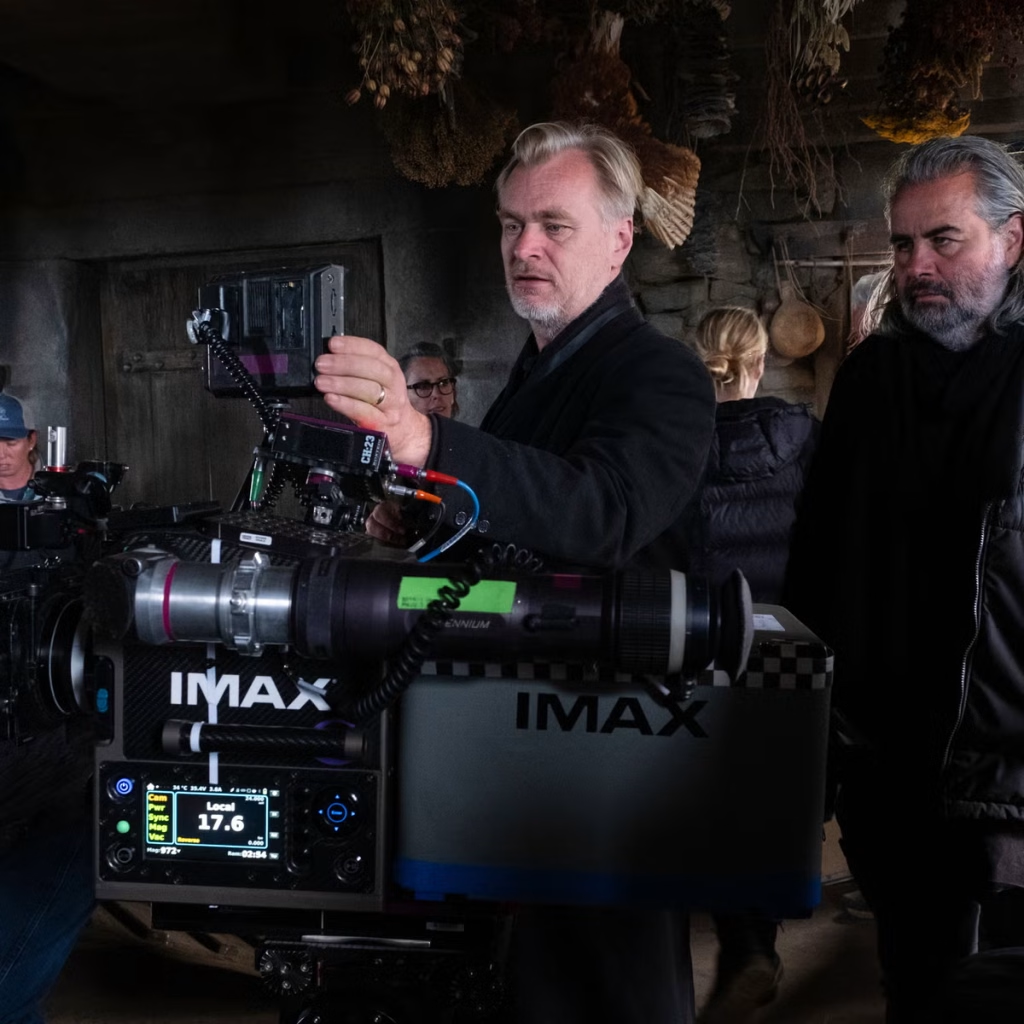
Nolan’s relationship with IMAX has been building for years, but The Odyssey represents the logical endpoint of that obsession. After gradually expanding the amount of large-format photography in films such as The Dark Knight, Dunkirk, Tenet and Oppenheimer, he made the first dramatic feature shot entirely with IMAX film cameras. Production ran for 91 shooting days across six months and six countries, with a budget widely reported at about $250 million, and the physical logistics became part of the film’s character: real locations, seaworthy ships, large practical builds, puppetry, animatronics and effects that had to survive the scrutiny of the format rather than merely suggest scale.
That physicality matters because Homer is full of geography. The Odyssey may contain gods, witches, monsters and impossible journeys, but it is also a story about how far away home can become. Nolan understands that distance visually. The sea is not decorative scenery around the characters; it is an enormous moving surface that makes their wooden ships look embarrassingly small. Coastlines feel difficult to reach. Cliffs appear genuinely dangerous. Sand, salt, mud and weather gradually strip the glamour from the men travelling through them.
Even on a 35mm reduction print rather than the full 70mm IMAX presentation, the scale registers. What impressed me most was not simply the width of landscapes or the size of the crowds, but the sense that people were physically occupying them. Nolan’s actors row boats rather than sitting in front of convenient digital horizons, and the crew repeatedly travelled to difficult locations because the landscape itself was part of what the film needed. The production exposed about 2.1 million feet of IMAX stock — roughly 640 kilometres — while Ellen Mirojnick’s costume department designed and produced 5,300 costumes, many using natural materials, hand-loomed cloth and aged bronze so that their surfaces would hold up under large-format photography.
Nolan has said that IMAX comes close to making the screen disappear, and I can understand what he means even without having seen the 70mm IMAX print. There are moments when The Odyssey stops looking like a polished contemporary fantasy film and starts feeling more elemental: people, wood, bronze, cloth and sea arranged against an environment that could not care less whether any of them get home. The irony is that while the screen often disappeared for me, some of the actors did not.
Homer Was Never a Fixed Object

It is worth being careful about the word “accuracy” when discussing The Odyssey, because Homer is not a straightforward historical source waiting to be filmed correctly. The poem emerged from an oral tradition, contains layers of language and storytelling from different periods, and tells of a world that already occupied the uncertain territory between cultural memory and myth. Nolan is adapting a story that had been changing long before anyone decided where to put a camera.
He makes plenty of substantial changes. The Trojan Horse, which belongs to the wider Trojan War tradition rather than forming a major episode of The Odyssey itself, becomes an enormous opening movement. Sinon is brought into the film from the broader mythological tradition. Nausicaa and the Phaeacians are removed, most of the gods are drastically reduced, and Calypso, Circe and Athena are pushed towards more psychological interpretations. The film also reduces some of Odysseus’s sexual adventures and makes his journey less about a brilliant trickster enjoying the pleasures and dangers of wandering than about a traumatised veteran trying to live with what he has done.
I do not object to those changes simply because they are changes. Adaptation would become a fairly pointless exercise if the job were merely to produce illustrated footnotes to a source text. Some of Nolan’s deviations are among the things I like most about the film, particularly his decision to make Troy remain morally present throughout the journey rather than allowing it to become a finished war left conveniently behind.
This version of Odysseus is haunted not only because war was terrible, but because he was exceptionally good at it. The Trojan Horse is his great intellectual victory, the proof that he can solve an impossible strategic problem through cunning rather than brute force, yet Nolan gradually reframes that achievement as the first wound in the homecoming. Odysseus wins by exploiting hospitality itself, delivering a gift that contains armed men and turning trust into a weapon.
That idea resonates throughout the rest of the story because hospitality, or xenia, sits at the heart of Homer’s world. Hosts and strangers are bound by obligations precisely because travel is dangerous and civilisation depends upon agreements made between people who do not know one another. Nolan’s Odysseus breaks that agreement on a monumental scale, and then spends years travelling through a world where hospitality has become unstable, deceptive or dangerous.
There is something very Nolan about a brilliant man solving a problem and then discovering that the solution has become the larger moral problem. It is difficult not to see a line from Oppenheimer to this Odysseus. One invents the mechanism that ends a war and spends the rest of his life inside its implications; the other invents a wooden deception that ends a war and discovers that he cannot simply sail away from the consequences.
The Horse on the Beach
The Trojan Horse sequence is probably where the film most completely earns its enormous scale. Nolan has apparently carried the image with him since he was briefly in consideration to direct Troy more than twenty years ago: the horse tilted in the sand, almost like some gigantic object unearthed from another civilisation rather than the polished icon we already know from illustrations and schoolbooks.

What makes the sequence work is the refusal to treat the trick as elegant. Inside the horse, men are cramped into darkness, sweating and waiting while Trojan soldiers probe the structure with blades. Odysseus’s famous intelligence suddenly has a bodily cost. The strategy may be clever from a distance, but from inside the machine it requires terrified men to remain silent while spears and swords enter the wood around them.
When Troy finally falls, Nolan avoids making victory feel clean. Fire, confusion and killing overwhelm the neat historical shorthand of “the Greeks took Troy”, while Odysseus increasingly becomes implicated in the violence he has unleashed. The horse is therefore more than a spectacular prologue. It is the object that defines him: brilliant, effective, morally compromised and impossible to leave behind.
It also creates one of the film’s more interesting visual ideas. A civilisation can construct something enormous and ingenious, celebrate it as victory, and still be planting the seed of its own destruction. Nolan’s later interest in the collapse surrounding the end of the Bronze Age grows naturally from that image. The story becomes less about one king delayed on the way home and more about men returning from war into a world that may already be coming apart.
Matt Damon, Odysseus and the Problem of Recognition

Matt Damon gives a committed performance as Odysseus, and I do not want my reservations about the casting to sound like criticism of the work he actually does. Damon carries the physical side of the role convincingly. He looks exhausted, battered and increasingly stripped of whatever certainty he possessed at Troy, while his natural accessibility helps Nolan keep the audience connected to a man whose choices become progressively harder to defend.
Nolan has said that he chose Damon partly because of that connection with audiences. In his view, Odysseus is both ordinary man and mythic hero, and Damon can move between those registers without making the character feel remote. Nolan also argues that Damon does not carry distracting movie-star baggage and can disappear into parts. I understand the argument intellectually, but this is one of those cases where my viewing experience simply diverged from the director’s intention: I saw Matt Damon quite often.
That is not necessarily Damon’s fault. Celebrity now accumulates differently from the way it did when a film might be your first or second encounter with an actor. Damon arrives carrying Good Will Hunting, Bourne, The Martian, Interstellar, Oppenheimer and several decades of interviews, awards, memes and general cultural familiarity. Tom Holland arrives with Spider-Man following behind him. Zendaya arrives with an equally substantial visual identity. Robert Pattinson, Anne Hathaway, Charlize Theron, Lupita Nyong’o, Jon Bernthal and the rest each bring their own archive.
The cast is extraordinary on paper: Damon as Odysseus, Hathaway as Penelope, Holland as Telemachus, Pattinson as Antinous, Zendaya as Athena, Theron as Calypso, Samantha Morton as Circe, Himesh Patel as Eurylochus, John Leguizamo as Eumaeus, Nyong’o as Helen and Clytemnestra, Bernthal as Menelaus, Benny Safdie as Agamemnon and Elliot Page as Sinon, among others. There are so many recognisable people that the film can occasionally feel less like discovering a lost mythological world than attending a very expensive gathering of people one has already met elsewhere.
Again, Nolan did this deliberately. He has said that these mythological figures are already iconic and that famous actors give contemporary viewers a familiar point of entry into an ancient narrative. That makes sense commercially and probably dramatically for a large audience, but it made me wonder how the film might have felt if the scale of the production had remained exactly the same while the faces had been less familiar.
The Film Nolan Could Probably Have Got Away With
Christopher Nolan is now one of the rare directors whose own name can sell a film on a scale that once required a franchise. The marketing for The Odyssey itself seemed to acknowledge this, with early material leaning heavily on Nolan’s name and IMAX rather than needing to explain every member of the cast. The success of Oppenheimer gave him extraordinary leverage, and he has openly described that success as creating the opportunity to make The Odyssey.
That is what makes me wonder whether this was precisely the moment when he could have taken a larger casting risk. I would have been fascinated by a predominantly Greek cast, perhaps made up largely of performers unfamiliar to international audiences, surrounded by the same immense ships, landscapes, sets and technical resources. Not because being Greek would somehow grant magical access to Bronze Age authenticity, and certainly not because modern Greek identity can simply be projected backwards through three thousand years of history, but because the unfamiliar faces might have removed one layer of Hollywood mediation.
Unknown actors can sometimes restore uncertainty to familiar stories. If I do not already know how a performer moves, what kind of characters they usually play or what their public persona suggests, I have fewer ready-made associations standing between me and the role. With a myth whose characters have already survived thousands of years of reinterpretation, that could have been useful.
Several performers in The Odyssey demonstrate the effect in miniature. Samantha Morton is hardly obscure, but her screen presence as Circe feels less tethered to contemporary celebrity machinery, and Nolan considered the role important enough to schedule a massive production around her availability. He described Circe as a kind of fulcrum for the film, and Morton’s unsettling stillness proves the point. John Leguizamo is transformed sufficiently as Eumaeus that Nolan has joked about failing to recognise him away from the production despite having spent days looking at his footage in the edit.
Those performances made me imagine what a less familiar ensemble might have done to the entire film. Nolan spends extraordinary effort making the physical world strange and tangible, then repeatedly reassures us with faces we know.
The Return and the Drama After Adventure

The film I kept comparing it with was Uberto Pasolini’s The Return, which is almost unfair because the two productions are trying to do nearly opposite things. Pasolini removes most of what people think of when they hear The Odyssey. There are no Sirens, no Cyclops, no Circe and no enormous journey through increasingly strange islands. Ralph Fiennes’s Odysseus simply arrives home damaged by war, while Juliette Binoche’s Penelope has been living inside the consequences of his absence.
That reduction is precisely why the film affected me. The Return concentrates on the uncomfortable human problem waiting underneath the mythology: what happens when the legendary warrior finally walks back into the house? Fiennes looks like a man who has survived something rather than a man who has completed an adventure. His body carries history, his silences have weight, and the relationship with Penelope is defined as much by what cannot easily be said as by what can. Contemporary discussion of the film has similarly emphasised its stripping away of gods and monsters in favour of war trauma and the psychological difficulty of homecoming.
Nolan attempts something harder in another direction. He restores the voyage, the monsters, the seas, the kingdoms and the spectacle while trying to carry that damaged man through all of it. There are sequences where he succeeds beautifully, particularly when the film allows Odysseus to stop performing leadership long enough for exhaustion or guilt to surface. At other times, the size of the machinery becomes a distraction from the quieter drama I wanted to feel underneath it.
Neither approach is inherently more faithful to Homer. The Return discards enormous parts of the poem in order to expose one emotional layer, while Nolan rearranges Homer and surrounding mythology to create a vast modern epic. Yet the smaller film reminded me that scale and weight are not the same thing. Sometimes one room containing two people who no longer know how to speak to one another can feel heavier than an entire coastline full of ships.
Modern English and the Distance I Wanted
The dialogue created a similar tension for me. Nolan deliberately rejected artificially elevated “ancient” speech and instead wrote contemporary, colloquial English because he wanted the words to have immediate emotional meaning rather than forcing audiences to decode a theatrical approximation of antiquity. I am sympathetic to that instinct, particularly because the alternative could easily have been three hours of actors sounding as though Shakespeare had somehow been issued bronze armour.
Still, there is quite a large territory between faux-Shakespeare and language that sounds entirely comfortable in a modern Hollywood film. Occasionally I wanted the dialogue itself to resist me slightly. These people supposedly inhabit a culture profoundly different from ours, with ideas about gods, kingship, honour, family, hospitality, slavery, warfare and obligation that cannot simply be translated into modern behaviour without something being lost.
That does not mean I wanted the screenplay to become an academic exercise, but I found myself thinking about how different the film might have felt in Greek. A production using Greek throughout, perhaps with an adaptation of Homeric language or a consciously constructed linguistic approach, would not automatically have been more historically correct. Homeric Greek itself is a poetic language formed through oral tradition rather than a convenient recording of everyday Bronze Age conversation.
Yet subtitles would have created useful distance. Language would have become part of the journey rather than another mechanism for smoothing it out. Nolan wants Homer to come towards us; part of me wanted the audience to have to travel a little further towards Homer.
The irony is that the film is perfectly willing to demand effort from us elsewhere. It expects viewers to sit for nearly three hours, accept a dense mythological world and seek out specialised projection formats. Nolan has spent decades teaching audiences to follow fractured timelines, nested dreams and dialogue buried under enormous sound mixes. I suspect we could have coped with a little linguistic estrangement.
Bronze Age Strangeness and the Safety of “Timeless”

Costume designer Ellen Mirojnick approached the film with considerable thought. Rather than reproduce a single archaeological period, she and Nolan wanted a “timeless” visual language that would avoid the familiar polished sword-and-sandal look. Linen, leather and bronze dominate, but surfaces are weathered, salt-stained and distressed. Odysseus’s clothing deteriorates as he does, while the suitors wear brighter metal and more decorative forms that make their vanity visible. Penelope’s costumes change more subtly because she remains physically rooted while Odysseus is being worn down by travel.
As a piece of costume storytelling, it works. The film has excellent texture, and the clothes seem to belong to bodies rather than looking like expensive outfits that were unpacked five minutes before a take. My reservation is with the choice of “timelessness” itself, because timeless antiquity can become another kind of familiarity.
The actual archaeology of the Late Bronze Age can be wonderfully odd. The Dendra panoply, with its huge overlapping bronze plates, looks far stranger than the standard cinematic idea of a Greek warrior. Boar-tusk helmets similarly possess a visual specificity that can seem almost alien if most of your historical vocabulary comes from later classical sculpture and twentieth-century sword-and-sandal films.
That strangeness is precisely what I would have liked more of. Not because every costume needed to become an archaeological reconstruction, and not because Homer provides a clean production manual for thirteenth-century BCE Ithaca, but because specificity can be more visually exciting than timelessness.
As a designer, I notice the temptation to make unfamiliar historical material instantly readable. A warrior should look like our shared picture of “warrior”. A king should look sufficiently king-like. A goddess should communicate goddess before anyone has time to become confused. Those decisions make images efficient, but sometimes the unfamiliar object is the thing that gives a world its identity. I wanted the costumes to make me look twice a little more often.
Penelope and the Weight of Staying Still

Anne Hathaway’s Penelope becomes increasingly important because her story provides the film with the kind of pressure that the voyage cannot. Odysseus moves constantly while Penelope remains in Ithaca, but staying in one place does not mean nothing has happened to her. She has spent twenty years living with uncertainty while her house fills with men who consume its resources, pressure her to remarry, threaten Telemachus and treat the absence of a king as a vacancy waiting to be filled.
Hathaway is particularly effective when Penelope’s patience stops reading as saintly endurance and begins to reveal anger. Her waiting is political as much as romantic. Every day she does not choose another husband is another day she prevents someone from converting Odysseus’s disappearance into a transfer of power.
The production design and costumes reinforce that difference between husband and wife. Odysseus’s body and clothing visibly deteriorate through movement, while Penelope’s visual changes are subtler because her struggle is one of holding position. He has had monsters, storms and islands. She has had the same rooms becoming steadily less hers.
This is where The Return continued to hover in my mind. Binoche’s Penelope has more room for ambiguity because the entire film is built around the emotional consequences of reunion. Nolan’s Hathaway has to carry that material inside a film also occupied by Cyclopes, Sirens, shipwrecks and the fall of Troy. She does it well, but I occasionally wished the film trusted those quiet rooms as much as it trusts the sea.
Telemachus and Inheriting a Story Instead of a Father

Tom Holland’s Telemachus represents another side of Odysseus’s absence. He has grown up with a father who is simultaneously missing and everywhere, because reputation can become its own form of presence. Everyone already knows who Odysseus is supposed to be: king, warrior, strategist, hero, husband, survivor. Telemachus has inherited the story before he has had a chance to know the man.
That makes the eventual reunion more interesting than a simple emotional payoff. The real Odysseus has to compete with the version his son has spent a lifetime imagining. Holland’s familiarity as an actor sometimes works against that uncertainty for me, but the character idea remains strong.
Nolan also gives Telemachus a more decisive role in the film’s altered ending. Rather than restoring Odysseus neatly to the throne and returning the household to its previous arrangement, the film ultimately allows the son to inherit Ithaca while Odysseus and Penelope leave again. It is a significant departure, but one that fits Nolan’s interest in inheritance. Telemachus does not simply become a younger copy of his father. He receives the kingdom his father’s generation has damaged and must decide what kind of story comes next.
The most effective bridge between father and son, however, is not a speech at all but Argos. The dog recognises Odysseus without needing the history explained, and that simple animal certainty gives Telemachus something more immediate than the legend he has inherited.
Argos and the Simplest Form of Recognition

Argos is one of those small pieces of The Odyssey that has endured because Homer understands how to place an ordinary emotional detail inside a gigantic story. Odysseus has survived war, monsters, shipwrecks, gods and years of wandering, yet when he finally returns to Ithaca disguised as a beggar, his ageing dog recognises him almost immediately. Argos has been neglected in his master’s absence and dies shortly after seeing him again.
Nolan expands the practical function of the scene. In the film, Odysseus does not simply conceal his emotion and move on. He comforts the abandoned, dying Argos, and that tenderness is what allows Telemachus to recognise that the stranger in front of him is his father. The dog recognises Odysseus first, then becomes the bridge through which the son recognises him.
It may be one of the film’s most successful changes because it does not require spectacle. Argos has no interest in Odysseus’s reputation, victory at Troy or divine significance. He does not need a bow, an identifying object or an explanation of where Odysseus has been. He simply knows him.
There is something rather beautiful about placing that scene inside a film otherwise fascinated by gigantic images and famous faces. For much of The Odyssey, I was conscious of the distance between recognising Matt Damon and believing completely in Odysseus. Argos collapses that distinction inside the story. Recognition becomes instinctive rather than intellectual, and for a few minutes the film stops asking whether Odysseus deserves to be called a hero and simply allows him to be someone who has finally come back to an animal that remembers him.
Argos also embodies what has happened to Ithaca during those lost years. The dog has aged, the household has decayed, the old order has been neglected and loyalty has survived without being rewarded. Odysseus has spent much of the film thinking of home as a destination fixed in memory. Argos quietly demonstrates the obvious truth that home has been ageing without him.
Circe, Calypso, Athena and the Gods Made Human

Samantha Morton’s Circe is one of the film’s strongest performances because Morton does not need to announce mystery. Her stillness supplies it. Nolan has spoken about the character as unexpectedly central to the film’s balance, and one can see why: the Circe sequence briefly changes the rhythm from physical endurance to psychological uncertainty, allowing Odysseus to encounter a form of power he cannot solve simply through strategy.
Charlize Theron’s Calypso operates differently. Nolan expands and alters the material, moving away from the sexual relationship of Homer and towards a more psychological form of captivity. The changes fit his broader effort to reduce the gods and supernatural characters into forms that can be interpreted through trauma, memory and human motivation. Theron has the screen presence required for a figure outside ordinary time, although she is also another example of the celebrity recognition problem: Calypso arrives and Charlize Theron arrives with her.
Zendaya’s Athena is perhaps the most interesting case because Nolan makes the instability of recognition part of the character. Rather than presenting the gods as straightforward supernatural beings repeatedly interfering in human affairs, the film makes Athena increasingly ambiguous, connected to Odysseus’s memory of Troy and his guilt over the women and civilians caught inside the destruction.
I understand why Nolan reduces the divine machinery. Literal gods appearing throughout the film could easily have pushed the material into a very different tonal register, and The Odyssey is trying to keep one foot planted in psychological realism even when monsters arrive. Yet I also think something is lost when the gods become too comfortably explainable.
Ancient stories often contain beliefs that refuse to fit our modern psychological categories, and that resistance is part of their power. Nolan frequently asks what the gods might mean to us now. I occasionally wanted the film to let them remain gods.
Sounding Ancient Without Pretending to Be Ancient
Ludwig Göransson’s score is where the collision between ancient material and modern technique becomes more adventurous. Rather than rely on a conventional symphonic vocabulary for historical epic, the music draws upon reconstructed ancient instruments such as the aulos and lyre, bronze percussion, voices and electronic manipulation. The approach is not pretending to recover the actual soundtrack of the Bronze Age. It is taking fragments of historical possibility and turning them into something new.
That seems to me a much more productive form of adaptation than simply smoothing the past into familiarity. Göransson is not afraid to let old and new materials scrape against each other. The music can sound physical, metallic, breath-driven and slightly unstable, which suits a film full of people travelling between civilisations that feel as though they may be coming apart.
The score therefore achieves something I wanted more often from the dialogue and costumes. It acknowledges the historical distance without becoming a museum demonstration. It feels constructed from the past rather than merely decorated to resemble it.
There are moments when the sound itself seems to carry the weight that the images are already suggesting: bronze vibrating, voices emerging out of darkness, rhythm turning rowing and marching into something almost ritualistic. Nolan’s cinema has always treated sound as architecture, sometimes to the irritation of anyone hoping to understand every line of dialogue, but here that physicality is particularly appropriate.
The Bow, the Suitors and the Return of Violence
The return to Ithaca is necessarily where all of Nolan’s ideas about homecoming collide. Odysseus has spent the film longing to get back, but the place he reaches is not the place he left. Penelope has changed, Telemachus has grown up, the household has deteriorated and the suitors have turned absence into entitlement.
Robert Pattinson’s Antinous works particularly well in this part of the film because there is something performative about the character’s confidence. He is living inside another man’s house while behaving as though possession has already become ownership. Pattinson’s recognisability bothers me less here because Antinous himself is playing a role, effectively auditioning for power while waiting for everyone to agree that Odysseus is never coming back.

The bow sequence gives Nolan a perfect physical test because it turns memory, skill and identity into one object. The suitors see a weapon they cannot properly use; Odysseus sees something connected to his own body and past. When the violence begins, the film deliberately denies us the uncomplicated pleasure of heroic restoration.

Odysseus is reclaiming his house, but he is also doing what he has spent most of the film doing: solving a problem through violence. Nolan has already made Troy impossible to forget, so the massacre cannot simply feel like justice arriving on schedule. The man who comes home has learned very little about killing efficiently because he never needed to. What he has learned, perhaps, is that victory does not automatically restore what existed before it, a distinction that becomes especially important when the film finally reaches Penelope.
A Dog, a Pin and an Olive-Tree Bed

One of Homer’s most beautiful ideas comes very near the end. Penelope does not immediately accept that the returned stranger is her husband simply because the plot requires a reunion. She tests him by ordering their marriage bed moved.
Odysseus reacts because the bed cannot simply be moved. He built it around a living olive tree, incorporating the rooted tree into the structure of the room, so only the real Odysseus understands the construction because the bed, the house and the marriage are literally joined. It is an extraordinary image: a man who has spent years wandering and being blown from one place to another has built the most intimate object in his home around something that cannot move.
Nolan replaces that recognition test with the golden Athena pin Penelope gave Odysseus before Troy. The pin connects Penelope to Odysseus’s memories, Athena and the guilt that has followed him home, so I understand its structural usefulness. It can travel through the film in a way the bed obviously cannot, becoming a visual motif that accumulates meaning.
I still prefer the bed, not because Homer must automatically win every comparison, but because it expresses homecoming with almost ridiculous perfection. Nolan’s pin is portable, which suits a film about movement and memory; Homer’s bed is rooted, which suits a story about a man who has spent twenty years trying to return to the one place where part of his identity cannot be carried away.
The Argos scene makes Nolan’s altered recognition sequence even more interesting. First the dog recognises Odysseus instinctively. Then Telemachus recognises him through the dog’s response. Penelope requires another form of proof altogether. The last movement of the film therefore becomes a series of people asking what makes this battered stranger the man who left decades earlier.
That is really the central question of any homecoming story. Returning to the same coordinates is easy compared with proving that the person who returns still belongs there.
Leaving Again

Nolan takes another substantial liberty by refusing to restore Odysseus permanently to the throne. After the slaughter of the suitors and reunion with Penelope, Telemachus becomes king while Odysseus and Penelope eventually travel west together. The film also connects the end of their world to ideas around the Late Bronze Age collapse, the mysterious “Sea Peoples” and the movement into an era in which oral tradition preserves stories through cultural disruption.
Historically, that is speculative material rather than something Homer is straightforwardly describing, but dramatically it allows Nolan to expand the meaning of return. Odysseus has spent the entire film treating Ithaca as an endpoint, only to discover that no endpoint can reverse time.
The man who returns is not the king who left. Penelope is not the woman frozen in his memory. Telemachus is no longer the child he abandoned. Ithaca itself belongs increasingly to another generation.
I can see why Nolan chooses departure rather than restoration. His Odysseus has become too implicated in the destruction of his age simply to sit down on the throne and resume administrative duties. There is also something unexpectedly tender in allowing Penelope and Odysseus to travel together, turning the final journey away from exile and towards a different kind of marriage.
Even so, I think the ending becomes slightly tidier emotionally than some of the material deserves. Nolan has spent nearly three hours insisting that war damages everything around it, then finds a relatively hopeful exit for the central couple. Homer’s ending is hardly uncomplicated either, but the rootedness of the marriage bed leaves me with something stronger than the idea of sailing west towards another horizon. Perhaps I am simply more interested in the difficult business of staying.
What The Odyssey Gets Right
My reservations should not obscure how much is genuinely impressive here. The physical production is extraordinary, and not merely because it is large. The sea has weight, the ships look vulnerable, Troy feels dangerous, and the Trojan Horse turns one of the most overfamiliar images in Western culture back into something strange and threatening.
Damon carries Odysseus through enormous physical demands while giving the character enough accessibility to keep Nolan’s darker interpretation from becoming cold. Hathaway gives Penelope the anger and accumulated fatigue necessary to prevent her from functioning merely as a reward waiting at the end of the voyage. Morton is superb as Circe, Patel gives Eurylochus the useful presence of a man increasingly doubtful about following a commander whose clever ideas keep getting people killed, and Pattinson finds the right poisonous self-confidence for Antinous.
Van Hoytema’s cinematography is often astonishing because it does not treat landscape as decoration. The environment dwarfs the people, which is exactly what a story about human beings wandering through a mythological world requires. Göransson’s score is similarly willing to make antiquity sound strange rather than simply grand.
Most importantly, Nolan finds a coherent personal interpretation of Odysseus. This is not a film about a clever hero collecting famous adventures on the way home. It is about a brilliant man discovering that intelligence is not moral wisdom, and that getting out of a disastrous situation is not the same thing as escaping its consequences. That is a worthwhile Odyssey, even when I kept wishing its world would resist me a little more.
What Kept Me Outside It
My problems all seem to return to the same underlying choice: Nolan wants to make Homer accessible, while I wanted the film to preserve more of the distance between Homer’s world and ours.
The famous cast makes entry easier. The contemporary English makes entry easier. The “timeless” costume design makes entry easier. The psychological treatment of the gods makes entry easier. Individually, each decision is entirely defensible, and some of them work beautifully; taken together, however, they occasionally made a world photographed with obsessive physical authenticity feel culturally safer than I expected.
That contradiction fascinated me more than anything else about the film. Nolan will put actors into real boats, haul IMAX cameras into difficult locations, build enormous physical sets and use materials designed to survive the scrutiny of giant-format photography. He clearly wants the audience to feel that people actually stood in these places.
Yet when those people speak and reveal their faces, the film frequently moves back towards familiarity. It has gone to extraordinary lengths to eliminate the artificiality of the environment while deliberately preserving the reassurance of Hollywood celebrity.
The commercial logic is difficult to argue with. By 26 September, Box Office Mojo listed The Odyssey at about $1.726 billion worldwide. Along the way it had passed Deadpool & Wolverine to become the highest-grossing R-rated film worldwide before inflation, overtaken Jurassic World as Universal’s highest-grossing release, and become Nolan’s biggest film. Whatever theoretical risk there might have been in adapting Homer for a mass audience, the result has emphatically demonstrated that people will turn up for it, which only makes me more curious about the film Nolan might have made had he pushed that risk further.
The Strange Pleasure of Film in 2026
There is another reason I am glad I saw The Odyssey the way I did. The 35mm print at Shaw Lido was not Nolan’s ultimate format, and I am not going to retroactively upgrade it to 70mm IMAX because that sounds better in an article. Singapore simply did not have that presentation.
What we did have was an increasingly rare opportunity to see a brand-new blockbuster projected from actual film, in a cinema that had restored equipment it had not used for mainstream releases in more than a decade. That has its own meaning.
There is a small irony in needing one of the most technologically ambitious filmmakers working today to bring an old projector back into use. Cinema keeps doing this strange circular thing where technological progress occasionally reminds us what we liked about the thing it replaced.
I am not interested in claiming that celluloid automatically produces truth or that digital cinema represents some cultural decline. That argument becomes tedious very quickly. What interested me was simply being conscious of the medium again. There was a print in the booth. Light was passing through it. The film had texture partly because the delivery mechanism had texture.
For a story that survived for centuries through people retelling it before it became fixed on a page, there is something appealing about that material chain. Homer becomes oral performance, manuscript, print, translation, screenplay, IMAX negative, 35mm release print and light on a wall in Singapore. Stories survive by changing format, and perhaps that is also the best defence of Nolan’s choices.
The Version I Wanted and the Film That Exists
I can imagine my ideal version of this film easily enough. I would keep Nolan’s scale and Van Hoytema’s landscapes, the physical ships, the enormous horse, the weather, the dirt and Göransson’s strange mixture of ancient instruments and modern sound. Then I would make the people less familiar, not as a claim to some impossible archaeological purity, but simply to give the world another layer of distance.
I would cast performers whose faces do not arrive carrying decades of cultural baggage. I would use Greek far more extensively, perhaps throughout. I would push the costumes towards more archaeological specificity and allow the Bronze Age to look genuinely peculiar. I would let the gods remain slightly less explainable and give Penelope’s olive-tree bed the final word on recognition.
That version might have been less commercially accessible. It might also have been unbearably mannered, historically confused or simply worse. Imaginary films have the considerable advantage of never having to survive production.
The film Nolan actually made is more complicated and probably more interesting to argue with. He has taken one of the foundational stories of Western literature and turned it into a gigantic contemporary blockbuster without reducing it entirely to spectacle. He has also made a film about the damage of war, the instability of identity, the fragility of home and the uncomfortable difference between surviving and returning.
I do not think my disappointment comes from believing the film failed. If anything, it comes from seeing how close it gets to something I would have loved more completely.
The Return gave me more of the damaged man and damaged marriage by throwing most of the adventure away. Nolan gives me the adventure in all its impossible size and keeps trying to find the damaged man inside it. There are moments when the two things meet, particularly with Penelope, Argos and the memories of Troy, when the film becomes exactly what I hoped it might be; there are others when Matt Damon walks into the frame and I remain aware that Matt Damon has walked into the frame.
Maybe that is simply the bargain Nolan chose. Homer survives because every generation makes him familiar enough to recognise and strange enough to return to. Nolan has weighted the balance towards recognition, while I kept wanting more strangeness.
I still came out of Shaw Lido glad I had gone, glad I had seen a new film run through a 35mm projector, and glad that something this old could still occupy a cinema on this scale. I found myself thinking less about whether Nolan had successfully brought Homer into the present than about whether the present had been allowed to intrude a little too comfortably into Homer. The print had travelled a long way to reach that screen; I think I wanted the film itself to make me travel a little further.
Affiliate Disclosure: This post contains affiliate links. If you click through and make a purchase, I may earn a small commission—at no additional cost to you. I only recommend products I personally find useful or relevant. Thank you for your support.
Leave a Reply