
Spoiler note: this is a full-film deep dive.
I went into Project Hail Mary as a complete non-reader of Andy Weir’s novel, which turned out to be the right way for me to meet this story. I had no checklist in my head, no page-by-page expectations, no internal alarm going off every time a scene was compressed or a character was tweaked. What I had instead was the cleanest possible encounter with the film on its own terms. And what surprised me most was not the science, not the scale, not even the end-of-the-world premise. It was the film’s refusal to become grim. For a movie built around cosmic extinction, isolation, and a one-way mission, it is oddly, stubbornly warm.
That warmth is not accidental. Project Hail Mary adapts Andy Weir’s 2021 novel, with Phil Lord and Christopher Miller directing from a screenplay by Drew Goddard. Ryan Gosling plays Ryland Grace, alongside Sandra Hüller, Lionel Boyce, Ken Leung, Milana Vayntrub and James Ortiz. Greig Fraser handles the cinematography and Daniel Pemberton the score. It is a large, expensive piece of studio science fiction, but the machinery is rarely the thing it seems most interested in. The relationship at its centre is.
What stayed with me after watching it was how insistently human it feels, even when one of its central relationships is between a man and an alien that looks, in the bluntest description possible, like an intelligent rock-spider. A less generous movie would have played that for novelty. A colder movie would have treated first contact as terror, conquest, or philosophical abstraction. Project Hail Mary chooses something much riskier: awkwardness, curiosity, problem-solving, and eventually tenderness. In a cultural moment when so much science fiction seems obligated to arrive wearing a furrowed brow, that choice feels almost radical.
A cosmic disaster movie that keeps making room for delight

The premise, on paper, sounds severe. Ryland Grace wakes up alone on a spacecraft light years from Earth with no memory of who he is or why he is there, and as his memory gradually returns, he realizes he has been sent on a desperate mission to investigate the force causing the sun to dim. That basic framework comes from Weir’s novel, and the film preserves its flashback structure as Grace reconstructs both the mission and his own unwilling role in it. Lord and Miller have said that Drew Goddard found the structure that let them honor the book while making it work as a movie, keeping the relationships and the emotional spine even as some mechanics had to be compressed.
But what matters to me is how the film handles tone. It never pretends the stakes are small. Earth is in trouble. Time is limited. Death is built into the mission from the start. And yet the movie keeps finding places for bemusement, irritation, wonder, and nerdy excitement. It understands that panic and humor are not opposites. They are often roommates. If anything, humor becomes one of the film’s most believable survival tools. Ryland Grace jokes not because the film wants to undercut the danger, but because humor is one of the few emotional reflexes available to a man trying not to collapse under the scale of what he has been asked to carry.
That, for me, is the first thing the movie gets right. It does not treat lightness as shallowness. It treats lightness as resilience.
There is a tendency in modern blockbuster sci-fi to confuse seriousness with emotional flatness. If the visuals are monumental and the music swells hard enough, the film assumes it has achieved depth. Project Hail Mary takes a different route. It remains fundamentally a story about intelligence under pressure, but it never forgets that intelligence is lived through personality. Ryland is not a granite-jawed savior. He is scared, petty, funny, evasive, decent, and occasionally irritating. Which is to say: he feels human enough to matter.
Ryan Gosling’s Ryland Grace is not a mythic hero, and that helps the movie breathe

Ryan Gosling was involved in the project early, and Lord and Miller have said he was “the first one in,” helping shape the character well before shooting. The directors also noted that Gosling was the one who sent them Andy Weir’s manuscript in the first place, after years of talking about working together.
That early investment shows. Gosling plays Ryland Grace less as a conventional savior than as a deeply reluctant participant in history. He does not stride into this film as a born leader or a destiny figure. He wakes up confused, diminished, physically wrecked, and emotionally unsteady. Even in the flashbacks, he never seems built for myth. He seems built for classrooms, arguments, lab work, and the kind of curiosity that thrives when no one is asking him to be noble in public.
I liked that immediately.

One reason so many large-scale sci-fi films can feel emotionally remote is that their protagonists are often burdened with symbolic importance long before they are allowed to exist as people. Ryland Grace, by contrast, keeps embarrassing the heroic mold by fitting into it badly. Gosling leans into that discomfort. He gives Ryland a slightly frayed quality, as if the character is always half a beat behind what the universe is demanding from him. He can do the physical comedy, the exasperation, the low-key panic, and the flashes of genuine awe. All of that makes the film’s later emotional turns feel earned, because they do not come from a hero becoming more heroic. They come from a frightened man slowly becoming more answerable to other lives.
That distinction matters to me. I am much more moved by stories in which courage is improvised than by stories in which courage appears preinstalled.
Critics who were less taken with the film still often singled Gosling out as its anchor. RogerEbert.com praised the warmth, wit, and scene-partner energy he brings, while Rotten Tomatoes’ consensus specifically highlights “Ryan Gosling at his most winning” as part of the film’s appeal.
And that winning quality is important, because Ryland could have been unbearable. On paper, a quippy, amnesiac science teacher alone in space sounds like a role one wrong choice away from self-satisfaction. Gosling avoids that trap by giving the character softness instead of smugness. Even his competence feels scrappy. He is not presented as the smartest person in the room in that dead, flattening blockbuster way. He is a person thinking as hard as he can because not thinking is not an option.
Rocky and the joy of first contact without cynicism

The film’s lighthearted approach to first alien contact is exactly where it became more than an efficient adaptation or a well-mounted star vehicle for me. It is where it becomes distinct.
Rocky is not merely the film’s gimmick. Rocky is its argument.
In another version of this story, first contact would be framed as horror, suspicion, military procedure, or metaphysical dread. Here, it becomes a series of practical and emotional negotiations. What do you call this being? How do you communicate? How do you establish trust when you do not share a language, an atmosphere, a biology, or a history? How do you move from mutual caution to mutual dependence? The film answers all of these not through speeches but through process. It lets friendship emerge as a problem-solving method.
That is what I found so appealing. The movie does not sentimentalize difference by pretending difference is easy. Ryland and Rocky misunderstand each other. They must invent the terms of encounter from scratch. But the film’s faith is that curiosity can be stronger than fear, and that cooperation can become intimate before it becomes elegant.
That emotional credibility was helped enormously by how Rocky was realized. James Ortiz was initially brought in as the on-set puppeteer, but his chemistry with Gosling during reads led to a much larger role in shaping Rocky, including voicing him. Lord and Miller insisted on practical effects for the character, with puppetry blended with digital work rather than relying on pure CGI, and both Ortiz and Andy Weir have emphasized how central Rocky’s physical presence was to making the character feel real.
You can feel that tactility onscreen. Rocky does not read like a sleek digital invention dropped into the frame after the fact. He has weight. He has awkwardness. He has timing. He has enough physical oddness to remain genuinely alien, but enough behavioral precision to become emotionally legible. Entertainment Weekly’s behind-the-scenes reporting notes that Gosling and Ortiz improvised for hours in character, and that spirit of play survives in the finished film.
What moved me most is that the film treats the bond between Ryland and Rocky neither as a joke nor as a cheap tear-jerker. It is funny because friendship is often funny. It is moving because friendship is often the most profound thing a story can discover after stripping away every other certainty.
I think that is why Rocky works even for viewers like me who never read the book. I did not need prior affection for the character. The film builds that affection from behavior. From listening. From trust. From repeated choice.
Sandra Hüller’s Eva Stratt is the human face of ruthless necessity
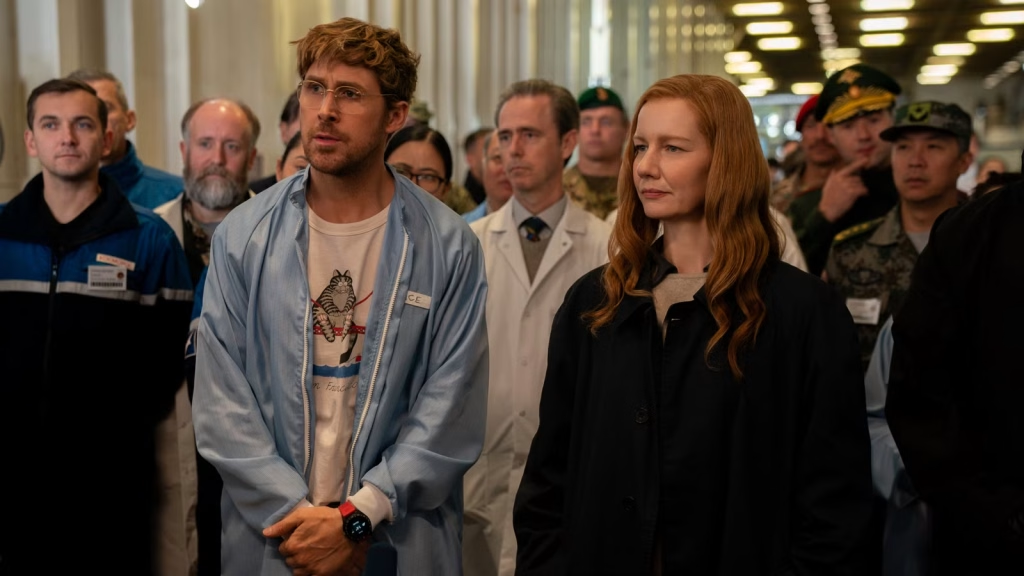
If Rocky is the movie’s heart, Eva Stratt is its conscience under pressure. Sandra Hüller plays the head of Project Hail Mary, the woman tasked with organizing the global response to catastrophe, and she gives the character exactly the force the movie needs. RT’s cast guide and multiple reviews identify Hüller’s Stratt as the one who recruits Grace and drives the mission from Earth.
What I appreciated about Hüller’s performance is that she never asks to be liked. She understands that Stratt’s job is to make intolerable decisions while everyone else still has the luxury of being horrified by them. That can turn a character into a plot device very quickly. But Hüller gives her a severity that feels inhabited, not schematic. She is not “cold” in the lazy cinematic sense. She is disciplined past the point of comfort.
That distinction matters because Project Hail Mary is, among other things, a story about the moral violence of emergency. Once extinction enters the room, every decision begins to degrade. Every decent person becomes capable of defending something morally ugly in the name of survival. The film does not fully dwell in that darkness, but Hüller carries enough of it in her face to remind us it is there.
There is also something quietly smart in how the movie places Stratt opposite Ryland. He improvises, deflects, stalls, jokes, and emotionally wiggles. She drives. She narrows. She decides. He represents human hesitation. She represents human will. The film needs both. Without Ryland, the story would become all machinery and mission logic. Without Stratt, it would drift into sentimentality.

Polygon’s coverage of Hüller’s performance notes that the filmmakers gave her freedom in shaping Stratt, with an emphasis on responsibility and enabling difficult choices. That fits the performance exactly. She plays Stratt as someone who has already accepted being misunderstood because there is no time left to manage her image.
And maybe that is one reason the film works for me despite its optimism. Its optimism is not naive. It is repeatedly dragged through hard, ugly choices first.
The supporting cast gives the film moral texture, even in brief orbit

Because Ryland spends so much of the movie in isolation, the supporting characters risk existing as mere functional memory fragments. But the film is careful enough with them that they still leave a mark.
Ken Leung and Milana Vayntrub are among the people who give the Earthbound side of the mission a little more shape, while Lionel Boyce adds another distinct presence around Grace. None of them is asked to compete with the central pairing, but together they stop the flashbacks from becoming a procession of lab coats delivering information.
These are not characters the film turns into giant mythology nodes. They are fragments of a larger effort. And yet they matter because they widen the story’s emotional field. The fate of Earth becomes less abstract when the people attached to the mission feel like specific temperaments rather than generic “scientists.”
Leung, especially, brings a firmness that hints at an entire offscreen moral universe. Vayntrub’s presence gives the mission some needed texture beyond solemn male responsibility. Mary, as a voice inside the ship, provides an eerie reminder that care can be procedural and still feel intimate. Even Boyce, in comparatively limited space, adds an earthbound pressure that helps the flashbacks avoid turning into exposition fog.
I would not say the film fully satisfies every supporting character. Some remain more like emotional vectors than complete people. But in a movie this structurally centered on one man’s isolation, that may be unavoidable. What matters is that the film gives Ryland enough human residue to remember what he is trying to save.
Lord, Miller, and Goddard understand that science fiction needs an emotional engine
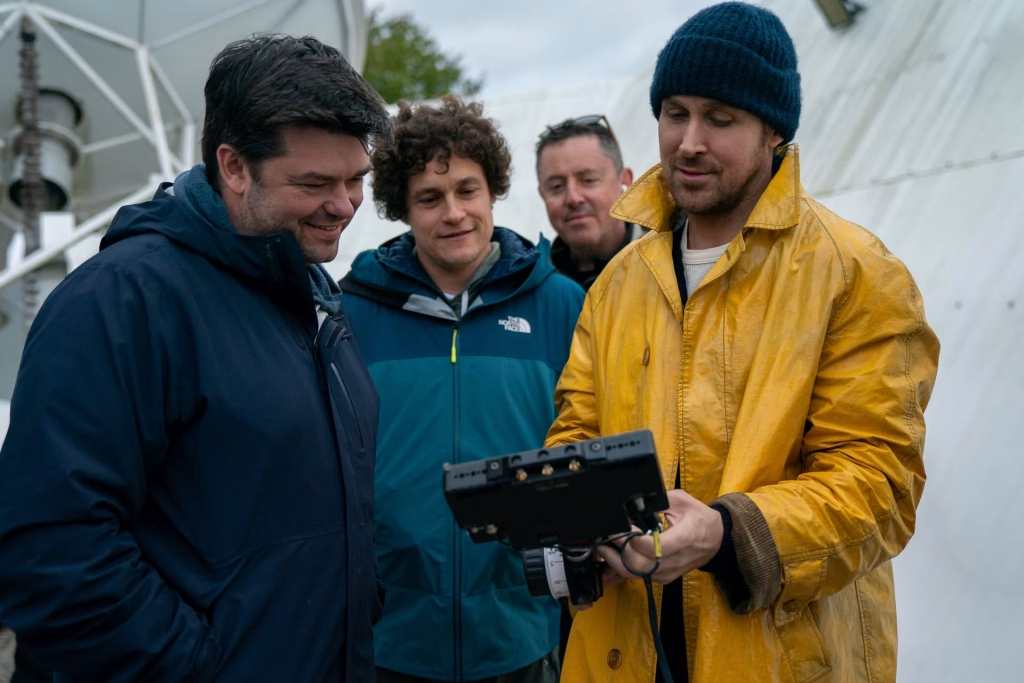
The film’s creative team is almost suspiciously well-suited to this material. Lord and Miller bring a history of tonal elasticity, while Drew Goddard already proved with The Martian that he understands how to adapt Andy Weir without losing narrative propulsion. Rotten Tomatoes’ production guide notes the combination of Lord and Miller directing, Goddard writing, Greig Fraser as cinematographer, and Daniel Pemberton scoring the film.

What interested me most, though, was hearing how explicitly Goddard talks about humanism. In an interview with Script Magazine, he said Weir’s stories appeal to him because they are fundamentally humanist, that they are not about villains so much as circumstance, and that Project Hail Mary for him was about “finding hope through compassion and empathy.”

That explains a lot.
It explains why the movie never fully curdles into dread, even when it probably could have. It explains why the central alien relationship feels emotional rather than merely clever. It explains why the film’s scientific premise, however grand, is always being pulled back toward feeling. It also explains why some viewers who love the book’s harder-science density may find the movie softer around the edges. Space.com noted that the adaptation leans more heavily into speculative, emotionally driven storytelling and removes a lot of the novel’s more detailed scientific exposition.
As someone who has not read the novel, I did not experience that as loss. I experienced it as translation.
Cinema is not prose. It cannot live on explanation alone. Even when science is central, film still runs on attention, rhythm, chemistry, and image. Lord and Miller have said they wanted the movie to feel like you were “in the guts of a machine,” and they also stressed that what mattered most was preserving the soul of the relationships.
That is exactly what comes through. The movie is not trying to out-lecture the novel. It is trying to make its emotional architecture visible.
Where the film overreaches
I liked this film a lot, but I do not think it is flawless.
Its biggest weakness is probably the same thing that makes it easy to like: it wants so badly to be generous. It wants to uplift, reassure, charm, awe, and wring out feeling. Most of the time it gets away with that because Gosling and Rocky keep the film grounded in interaction. But there are stretches where the movie starts pressing on the emotional bruise too insistently, as if it does not fully trust us to find the feeling on our own.
Some critics responded to exactly that. RogerEbert.com argued that the ending becomes overextended and too eager to cue emotion, while some Metacritic reviews praised the film’s heart but also noted its familiarity and tendency toward crowd-pleasing neatness.
I felt some of that. There are moments when the score surges and the imagery swells with such conviction that I became aware of the film’s effort. Not all uplift is equal. The best kind arrives like discovery. The weaker kind arrives like insistence.
And still, I would rather watch a movie overreach toward hope than one retreat into irony because sincerity feels embarrassing.
The other limitation is that the film’s light touch occasionally smooths over the roughest moral edges of its own setup. A mission of this magnitude should leave bruises everywhere. The movie acknowledges that, but not always with equal force. It is more interested in connection than in lingering on institutional violence, and that is both a strength and a softening.
But again, that seems to me like a choice, not a failure of understanding. This film knows what it wants to be. It wants to be a big, emotionally available science-fiction adventure about intelligence, sacrifice, and cross-species friendship. On those terms, it succeeds far more often than it stumbles.
Why it worked for me as someone who never read the book

This is maybe the most useful thing I can say: Project Hail Mary never made me feel outside it.
Some adaptations are built with an invisible side-eye toward the uninitiated. You can sense where the “real fans” are supposed to nod, where the missing detail is being politely skipped, where the movie assumes your prior loyalty will do the emotional labor. I did not feel that here. I felt invited in.
The film gives you enough science to understand the stakes, enough personality to stay engaged, and enough emotional clarity to keep the story moving even when the mechanics get dense. More importantly, it understands that first contact is not only a speculative question. It is also a social one. It is about whether intelligence automatically produces hierarchy, fear, and domination, or whether it might also produce cooperation, humility, and even affection.
That is where the movie quietly won me over.
For all its spectacle, for all its star power, for all the scale of its premise, Project Hail Mary is finally about learning how not to be alone in the universe. Not by conquering it. Not by mastering it. But by listening across the gap.
That sounds simple. On screen, it almost never is.

Final thoughts
I came away from Project Hail Mary thinking that its greatest achievement is not that it made apocalypse entertaining. It is that it made decency dramatically satisfying.
The film is funny without being glib, hopeful without being weightless, and sentimental in ways that I mostly found earned. Ryan Gosling gives it a center that is loose, humane, and pleasantly unheroic. Sandra Hüller gives it backbone. James Ortiz, through Rocky, gives it soul. And Lord, Miller, and Goddard shape all of that into a blockbuster that remembers spectacle means more when it has someone worth feeling for inside it.
Maybe that is what I liked most. In an era where big science fiction so often arrives wrapped in severity, Project Hail Mary dares to believe that intelligence can be playful, that first contact can be funny, and that the most moving answer to cosmic loneliness might be friendship.
I have not read the book. Maybe one day I will. But as a film-only viewer, I never felt shortchanged. I felt something better than that. I felt included.
Affiliate Disclosure: This post contains affiliate links. If you click through and make a purchase, I may earn a small commission—at no additional cost to you. I only recommend products I personally find useful or relevant. Thank you for your support.
Leave a Reply