DreamWorks’ Filipino fantasy is loud, neon, funny and occasionally overstuffed, but beneath the manananggal, cassette-era pop and anime detours is something quieter: the fear that growing up means misplacing the people who made us who we are.

I caught the first morning screening of Forgotten Island today at the neighbourhood cinema, which already felt strangely appropriate. There is something pleasantly pre-streaming about being inside a cinema before lunch, watching a film set in the Philippines of the 1990s and hearing music that once travelled through radios, cassette decks and mixtapes rather than recommendation algorithms.
Then the film got to the business of recording favourite songs off the radio, and that was more or less it for me. Anyone who grew up doing this remembers the small choreography involved: waiting with a finger over the record button, hoping the DJ would stop talking before the opening bars, then discovering afterwards that you had either missed the first second or captured somebody advertising a furniture sale over the final chorus. Forgotten Island knows that particular sort of memory, which is probably why Journey’s “Don’t Stop Believin’” and INXS’s “Never Tear Us Apart” land differently here than they would as random retro needle-drops.
The film is a new original story written and directed by Joel Crawford and Januel Mercado, the filmmakers who previously worked together on Puss in Boots: The Last Wish. Its basic premise is simple enough: lifelong best friends Jo and Raissa are spending their final night together before adulthood sends them in different directions, only to stumble through a portal into Nakali, an island populated by creatures taken from the Filipino stories they grew up hearing. The cost of leaving turns out to be the memories of their friendship itself.
That premise is already enough to get me interested. Put Filipino mythology, animation and a slightly battered box of Gen-X cultural references together and I am not exactly arriving as a neutral observer.
The Forgotten Generation, More or Less

Calling Generation X the “forgotten generation” has been done often enough that it has almost become its own cliché, but with a film called Forgotten Island the joke is difficult to resist. The generational maths is not quite as neat as I first assumed — Mercado, born in 1984, sits on the Millennial side of the usual divide — but the film’s cultural memory feels unmistakably adjacent to mine.
It remembers a period when music required a little more effort. Photographs were finite. A Polaroid was an object rather than a filter. You could not carry every song you had ever liked in your pocket, and a mixtape was not simply a playlist with better typography; it took time, planning and occasionally a willingness to sit beside a radio for several hours.

That analogue quality matters because Forgotten Island is fundamentally about memory. The cassette, the Polaroid, the friendship bracelet and the physical objects scattered through Jo and Raissa’s history are not there simply to shout “remember the nineties?” at the audience. They are containers. We used objects to keep pieces of ourselves because there was no cloud quietly doing it for us.
The production itself was consciously built around that period. Mercado has spoken about the importance of his visits to the Philippines during the 1990s, while old family photographs helped the filmmakers reconstruct the Manila of Jo and Raissa’s childhood. The project took roughly six years and involved hundreds of artists working across the United States and the Philippines.
That is a much better foundation for nostalgia than simply putting a Tamagotchi on a table and calling it a day.
Two Friends About to Become Two Adults

What saves the film from becoming a very expensive Filipino mythology catalogue is Jo and Raissa. H.E.R. voices Jo while Liza Soberano plays Raissa, and from the beginning their friendship has the slightly untidy intimacy of two people who became important to each other before either of them really understood who they were going to become.
Jo is the more instinctive and artistic of the pair. Raissa is organised, academically ambitious and facing a future that will physically take her away from the life they built together. The plot turns that ordinary adolescent fracture into fantasy: what if your best friend leaving did not merely feel as though your shared past was disappearing? What if the memories could literally be removed?

I liked that the film gives female friendship the emotional scale mainstream films usually reserve for romance or family reconciliation. Jo and Raissa are not treated as a warm-up relationship before their “real” adult lives begin. The friendship itself is the great love story here, complete with jealousy, betrayal, sacrifice, badly handled fear and the painful discovery that loving somebody does not give you the right to stop them changing.
That becomes particularly important once the film reveals what Jo has done.
Welcome to Nakali, Where the Bedtime Stories Have Unionised

There was another pleasure for me in watching creatures I knew by name appearing inside a major DreamWorks film without first being translated into something safer and vaguely European. There are manananggal, tiyanak, duwende and kapre-inspired figures, along with Raww, the wonderfully specific were-aspin, and Batiba, whose relationship with memories eventually becomes central to the story.
Filipino folklore has been appearing in our own comics, films, television and bedtime threats for generations, but seeing a Manananggal occupy the sort of visual space Hollywood animation normally gives dragons, trolls and vaguely Celtic forest creatures still feels unusual.

Lea Salonga’s Manang is particularly good because she begins as the looming horror figure, the creature everybody fears, before the film complicates what we think we know about her. Manny Jacinto’s Bungi, meanwhile, demonstrates the inevitable DreamWorks compromise: a tiyanak can apparently become merchandise if you make it cute enough.
That is one of the film’s compromises, but I cannot pretend I minded very much. The versions of these creatures I heard about growing up were considerably less interested in becoming plush toys, and Forgotten Island does sand down some of their nastier edges for a family audience.
Still, they remain recognisably ours. That matters more to me than strict folkloric taxonomic purity in a DreamWorks movie featuring a were-aspin.
The Island Looks Like Somebody Remembered It Wrong
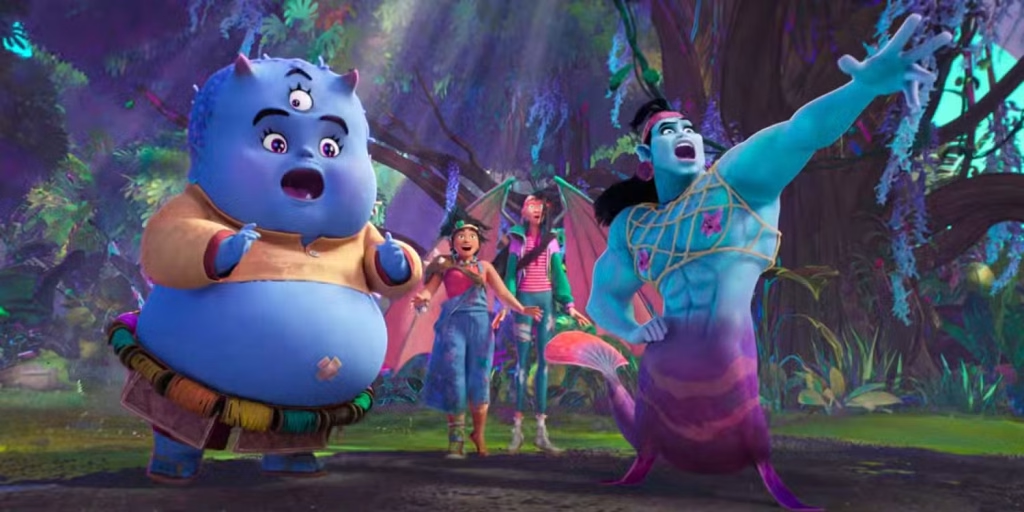
Visually, Nakali is more interesting than a straightforward fantasy reconstruction of the Philippines would have been. Crawford and Mercado did not attempt to turn folklore into a respectable heritage display; they pushed it through anime, rave colour, street art, contemporary CG and deliberately shifting animation styles.
The filmmakers travelled to places including El Nido while developing the visual language of the island. More interestingly, the hand-drawn flashbacks were created with help from Snipple Animation Studios in Quezon City, whose artists worked on the film’s 2D sequences. Raww’s version of events leans towards Dragon Ball Z, while Prince Mermahn’s memories draw from Sailor Moon, so memory itself changes the graphic language of the film depending on who is telling the story.
That seems exactly right for a film about remembering. Memory is not archival footage. We redraw it every time we retrieve it, giving ourselves better dialogue, making certain moments brighter, moving embarrassing details conveniently out of frame.
As somebody who has spent most of his working life around images, that visual idea pleased me almost as much as the folklore. The polished CG world occasionally tears open and lets drawing, linework and exaggerated 2D movement come through, as though the film itself cannot quite keep its memories inside one rendering style.

There was another, more personal reason I found the production side affecting. Knowing that my university friend Anthony Escartin was part of the enormous team that made the film gave all those credit names a little more weight for me. Animation credits can run past us as an anonymous river of departments and studios, but occasionally you know one of the people in that river and suddenly the scale of the work becomes human again.
I felt proud seeing Filipino stories on screen, certainly, but there was another kind of pride in knowing Filipino artists were part of actually building the thing.


Somewhere, Somebody Is Waiting Beside a Radio
Then there is the music, which is where Forgotten Island really starts rifling through the cupboards of my generation.
The film uses Journey, INXS, Simple Minds, Montell Jordan, DMX, Jose Mari Chan and other familiar material alongside newer Filipino and Filipino-diaspora voices. The official soundtrack also brings in BINI, SB19, Ruby Ibarra, Sophia Laforteza and H.E.R., with Nathan Matthew David providing the score.
“Don’t Stop Believin’” is almost impossible to hear innocently any more because decades of films, television programmes, weddings and karaoke machines have turned it into cultural public property. Yet using it in a film where characters once taped songs off the radio pulls it back towards something personal. It stops being merely a famous song and becomes the kind of song somebody might have waited twenty minutes for the DJ to play.
“Never Tear Us Apart” works even better because the title practically writes the emotional subtext for the film. The original INXS recording appears alongside a soundtrack version performed by Sophia Laforteza, allowing an older song to pass into another Filipino generation rather than simply being preserved under glass.
There is even Simple Minds’ “Don’t You (Forget About Me)”, which is so perfectly on the nose that resisting it would probably have been more distracting. A film called Forgotten Island about friends losing their memories was never going to leave that one sitting unused.
What I appreciated is that the soundtrack does not pretend Filipino nostalgia exists independently from everything else we listened to. We had Journey and INXS. We had Jose Mari Chan. We had whatever came through FM radio, pirated tapes, imported CDs, cousins returning from America and somebody else’s collection copied onto a blank cassette whose handwritten label was probably already wrong.
That mixture feels more authentic than a carefully curated notion of cultural purity ever could.
The Worst Thing Jo Does Is Completely Understandable
Spoilers from here.
The film’s smartest turn is revealing that Jo is not simply the victim of what happens on Nakali. When Batiba restores the missing memories of their previous night, Raissa discovers that Jo deliberately hid the magical sand dollar that could return them home. Jo knew Raissa was leaving for Caltech in America, and some frightened part of her decided that if they could not leave Nakali, then Raissa could not leave her.
It is a terrible thing to do, which is precisely why it works.
Jo’s fear is not villainous. It is adolescent and selfish and painfully familiar. Most of us have experienced some version of the moment when another person’s future feels like an accusation against our own, or when somebody moving forward appears to mean they are moving away from us.
The film does not let Jo escape the consequences simply because her motive is understandable. Raissa feels betrayed because she has been betrayed, and their friendship fractures at exactly the point where the fantasy plot starts stripping away the memories that might have allowed them to repair it.
That is a much more interesting problem than defeating a monster.
Memory Is Not the Same Thing as Love

Jo’s eventual sacrifice reverses her original mistake. Instead of trapping Raissa in order to keep her, she makes another bargain with Batiba and gives up the memories bound to their friendship bracelet so that Raissa can go home safely.
Earlier, Jo thinks preserving their friendship means preventing change. By the climax, she finally understands that loving somebody may require letting them leave even when you have no guarantee they will return.
Raissa then chooses to come back for Jo. Their connection carries her back towards Nakali, and she fights Batiba’s attempt to erase Jo not by producing a clever magical weapon but by returning to the ordinary memories that constructed their friendship in the first place.
That is where the film’s fantasy machinery and emotional argument finally become the same thing. Memories matter, but the film is not really arguing that a relationship is merely the sum of remembered incidents. It is saying that those experiences change us, and some part of the other person remains embedded in who we become.
Batiba ultimately returns what she has taken, including Manang’s stolen memories, which reframes the creature we had been trained to see simply as the monster. Manang’s fury also comes from loss.
For a film full of jokes, wings, monsters and psychedelic foliage, that is a reasonably thoughtful place to end up.
Growing Up Without Performing an Erasure
The final stretch is what pushed the film beyond merely enjoyable for me. Jo and Raissa escape, but the story does not solve its emotional problem by cancelling Raissa’s future. She still has to go away, and they still have to become adults whose lives will no longer fit together as conveniently as they did when they were children.
The later glimpse of their lives makes that explicit. Raissa moves forward with her education, Jo becomes a storyteller, and the extraordinary events of Nakali become something they can reinterpret rather than something that freezes them in the past. The portal eventually opens again, but this time they return to the island by choice rather than through fear.
That reversal is beautifully simple. Their first journey begins because Jo cannot accept that things change; their final journey happens after they have learned that change and continuity are not opposites.
There is a Gen-X reading of that which probably means more to me now than it would have twenty years ago. We are old enough to have watched entire technologies, workplaces, friendships, neighbourhoods and versions of ourselves disappear without necessarily noticing the exact day they went. We become custodians of a ridiculous amount of obsolete information: cassette etiquette, dial-up noises, television schedules, the location of record shops that are now cafés.
The trick, I suppose, is not mistaking remembering for refusing to move.
It Is Still a DreamWorks Movie
I do have reservations. Forgotten Island is often so pleased with everything it has invented that it wants to show us all of it immediately, preferably while somebody is shouting and another character is falling from somewhere.
The middle can get busy, and there are stretches where I wished the film trusted its quieter scenes as much as it trusts movement. The heart of the Jo–Raissa relationship survives the noise, but the film occasionally seems frightened that if it stops moving for too long somebody in the audience might check their phone.
The supporting cast also creates the pleasant problem of wanting more of almost everybody. Dolly de Leon and Lea Salonga have enough presence that I kept wondering what another ten minutes with their characters might have done, while some of Nakali’s population occasionally feel like extremely good character designs queueing for their own spin-offs.
And, yes, there is a degree of cultural softening. Filipino monsters capable of ruining a childhood night’s sleep have been made compatible with popcorn buckets and plush merchandise.
I can live with that. I am not sure the international family audience was ready for the full version of what Filipino relatives were willing to tell children before bedtime anyway.
Something Familiar in a Very Strange Place
What stayed with me after the screening was not merely the pleasure of recognition. Representation can become a dreary word when we reduce it to counting faces and cultural objects, as though putting a jeepney in the background earns a production a certificate of authenticity.
What Forgotten Island gets right more often than not is the texture underneath those objects. The karaoke. The music that belongs to several countries at once. The relatives telling stories. The slightly porous boundary between Catholic domestic normality and the certainty that something unspeakable might be living in the tree outside.
Most importantly, it understands friendship as something with a history rather than simply chemistry between two characters. Jo and Raissa matter because we feel the accumulated weight of years between them, including the boring bits nobody would normally put in an adventure film.
That is what makes the memory conceit work. Losing somebody is frightening, but losing the private language you built with them — the songs, objects, jokes and half-remembered afternoons that would mean nothing to anybody else — may be more frightening still.
Maybe that is why the title landed harder for me than I expected. A forgotten island populated by Filipino monsters is one thing; reaching an age when entire pieces of your own world can quietly become forgotten islands is another.
I went into the morning screening because it was a Filipino fantasy animation with a ridiculous voice cast and creatures I recognised from stories told long before Hollywood noticed them. I came out thinking about cassette tapes, old friends, people leaving, and the peculiar fact that remembering something is sometimes the only proof you have that a version of your life existed.
Forgotten Island is noisy, occasionally excessive and far more colourful than most memories actually are. But underneath all that movement, it understands something quieter: you cannot keep people by keeping them unchanged, and you cannot keep the past by refusing to enter the future.
The island is only forgotten by name. The people who mattered are another question.
Leave a Reply