
Nearly twenty-five years after Smallville first put Clark Kent in flannel instead of a cape, I went back to the beginning. The phones are smaller, the seasons are longer, the music is louder, and the future the show was inching towards has already happened. Oddly, that makes its earnest little world feel more interesting rather than less.
There is something slightly treacherous about hearing an old television theme song again. Not treacherous in the meteor-rock, exploding-barn sense, but in the ordinary way a sound can open a trapdoor under the present and drop you into a room you thought had been cleared out years ago. Remy Zero’s “Save Me” still does that to me. The guitar starts, Tom Welling appears in a cornfield looking as though destiny has already given him too much homework, and suddenly the early 2000s are sitting in the room again.
I never followed Smallville with perfect devotion when it first aired. Life, work and the usual adult clutter got in the way, so I watched in stretches, drifted out, drifted back, knew the broad shape of where everyone was going and somehow remained emotionally up to date. Clark would become Superman. Lex would become Lex. Lana would continue to make Clark miserable in exquisitely photogenic ways. Chloe would find the conspiracy. Jonathan would look worried. Martha would understand more than she said. The machinery was familiar even when I had missed a few gears.
Going back from the start is different. The whole thing is now complete, the superhero boom it helped anticipate has already risen, peaked, diversified and become part of the wallpaper, and we know things about the people involved that viewers in 2001 could not possibly have known. That creates a peculiar double exposure: I am watching the show as it was, but also through everything that happened afterwards.
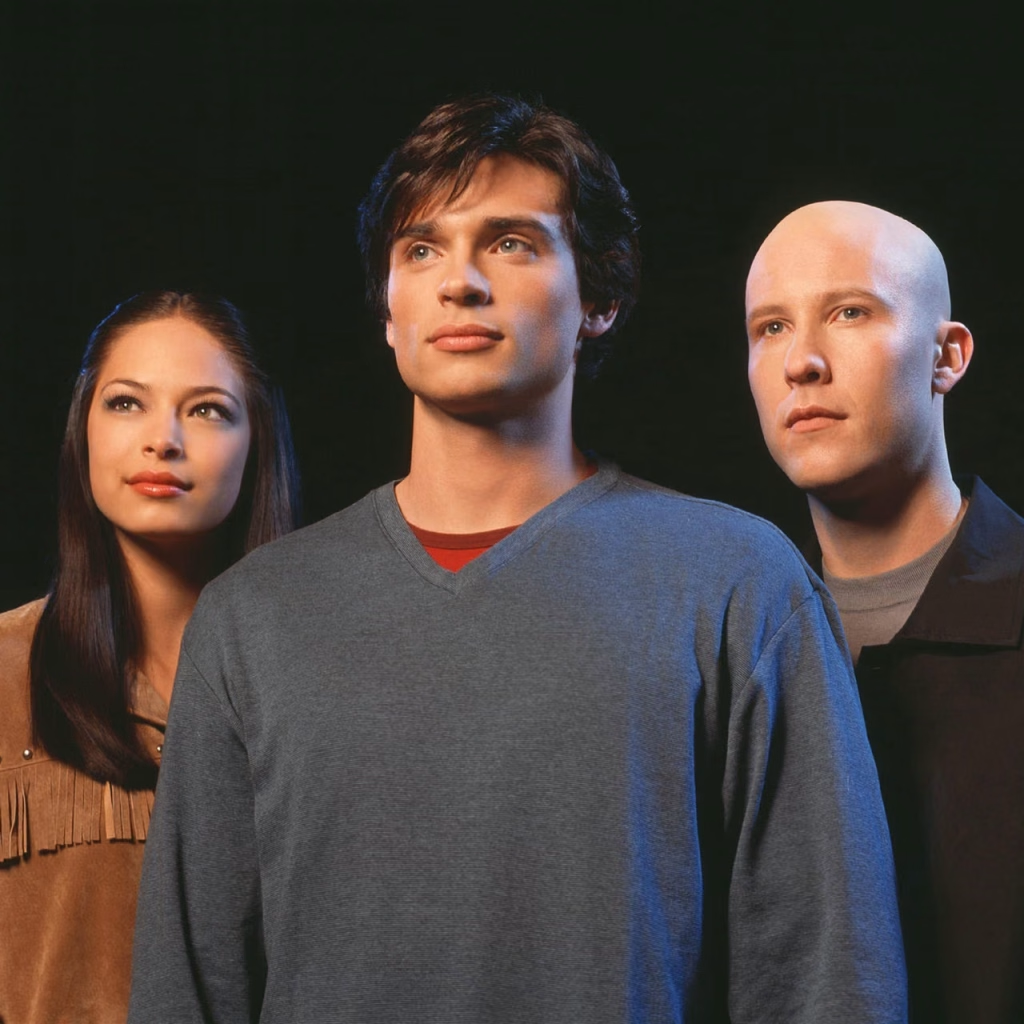
The Future Finally Caught Up With Smallville
Smallville premiered on 16 October 2001, when the idea of a weekly live-action Superman origin story still felt like a fairly large television gamble. DC’s own retrospective notes that the pilot drew 8.4 million viewers, then a record for a WB series debut. The show went on for ten seasons, long enough to move from high-school melodrama to something much closer to the sprawling comic-book universe it had originally promised not to become. Its creators, Alfred Gough and Miles Millar, began with the famous rule that has followed the series ever since: “no tights, no flights.” The attraction was not Superman fully assembled. It was Clark Kent before certainty.
That premise feels almost quaint now because the culture around it changed so completely. In 2001, superhero television still had to smuggle some of its comic-book DNA through teen drama, mystery, romance and network-friendly angst. Today the genre has spent years explaining multiverses, alternate timelines, legacy heroes, post-credit scenes and enough interconnected continuity to make a tax return look breezy. Smallville, by comparison, begins with a farm, a high school, a rich bald man in a sports car and a girl wearing a necklace that can literally make the hero collapse.
The technology is just as revealing. Chloe’s Wall of Weird once looked like a frantic local conspiracy archive; now it resembles what would happen if someone printed out a social-media feed and pinned it to a wall. The Smallville Torch matters because local information still has to be gathered, printed and physically carried around. People turn up at each other’s houses because there is no constant location sharing, no group chat quietly resolving the plot, no cloud backup of every secret. The show’s world still has dark corners because information moves slowly enough for darkness to survive.
That slowness is one of the pleasures of the rewatch. The future caught up with Smallville, but it also removed some of the conditions that made the show possible. If Clark were sixteen now, half of Smallville would have Ring cameras, every meteor incident would be on TikTok before Chloe reached the scene, and Lex would probably own the platform hosting the footage.

No Tights, No Flights, and Plenty of Time
The original “no tights, no flights” rule was not merely a cute production slogan. It forced the series to build a Superman story without leaning on the most obvious Superman imagery. Clark could be superhuman, but he could not yet be the finished emblem. The point was formation. Strength arrived before judgement. X-ray vision arrived before maturity. Speed arrived before emotional clarity. Every new ability came with the same unspoken instruction: now learn not to be an idiot with it.
Tom Welling’s casting remains central to why that works. He is physically convincing from the beginning, but his Clark is almost apologetic about the amount of space he occupies. He can stop a truck and still look as if he would rather not trouble anyone. That contradiction gives the character weight. His vulnerability is not physical; it is social, emotional and moral. Being seen is nearly as frightening to him as being hurt.
The old network-season format helps. Twenty-plus episodes can be exhausting when you are trying to finish a show before the next shiny thing drops, but Smallville was made for a different rhythm. It has room for mythology episodes, monster-of-the-week episodes, romantic stalemates, school dances, family arguments, strange detours and occasional hours that feel as though everyone involved simply had to get episode nineteen finished by Thursday. Not all of it is good, but the sprawl builds familiarity in a way an immaculate eight-episode season often cannot.
Watching those episodes in sequence makes the repetition more visible. Clark saves someone, conceals something, disappoints someone, feels terrible, stares into the middle distance and tries again. Lana senses he is holding back. Lex senses everyone is holding back. Chloe finds the pattern. Jonathan warns Clark. Martha gives the warning a human translation. A song arrives to explain whatever the actors have politely left unsaid. It is formula, certainly, but formula is not automatically failure. Sometimes it is architecture.
The Kents Look Different When You Are Older
The largest change in my own viewing is embarrassingly predictable: I pay much more attention to the parents now. When I was younger, Jonathan and Martha Kent were the sensible adults standing between Clark and the interesting part of the story. On a rewatch, they are the interesting part of the story. They have been handed a child who can bend metal, survive things that should kill him and may eventually become the most powerful person on Earth. Their job is somehow to make sure he still takes responsibility for a broken fence.
John Schneider’s Jonathan can be stern to the point of frustration, but the sternness makes more sense when you stop viewing it only from Clark’s side. He is terrified. The government, Lionel Luthor, anyone with enough money or curiosity could take his son away or turn him into an experiment, a weapon or a public object. Jonathan frequently mistakes control for protection, which is not ideal parenting, but it is recognisable parenting. His fear is not abstract. His son really is carrying a secret that could rearrange the world.
Annette O’Toole’s Martha is the counterweight. She understands that secrecy can keep Clark safe while still injuring him. She gives him emotional language when Jonathan gives him rules, and together they make the Kent farm the show’s moral centre. Superman’s goodness is often discussed as though it arrived with the rocket, but Smallville keeps insisting that it was built at the breakfast table. The boy who could dominate everyone around him is instead asked to do chores, apologise, tell the truth and think about consequences. The mythology is cosmic; the education is domestic.

Lana Lang and the Trouble With Being Everyone’s Idea
Lana is harder to watch now, although not for the simple reason usually offered. I understand why viewers became tired of the Clark-and-Lana cycle, and I understand why the show kept returning to it. Kristin Kreuk’s Lana is introduced less as a fully ordinary girl than as the shape of normality in Clark’s imagination. She represents the life he thinks he wants: intimacy without fear, romance without disclosure, the possibility of being known without the catastrophic part where he actually has to let someone know him.
The kryptonite necklace makes that metaphor hilariously literal. Clark is physically weakened by approaching his crush, which may be the most efficient summary of adolescence the show ever devised. Yet the problem with treating Lana as an ideal is that the writing sometimes starts doing the same thing Clark does. She becomes a beautiful vessel for longing, grief, innocence, danger and whatever emotional weather the episode needs. Kreuk is often better than the material because she gives Lana a quiet awareness that people are constantly projecting onto her.
With older eyes, I have less patience for Clark’s belief that withholding the truth is automatically noble. He is genuinely trying to protect her, but the show is at its best when it allows that protection and dishonesty can occupy the same space. The long romantic stalemate works when it feels tragic. It becomes tiring when the same lock is placed back on the same door. Still, the exhaustion is part of what the relationship means: Clark wants the emotional reward of being known while refusing the risk that knowledge requires.

Chloe Sullivan and the Part of a Rewatch You Cannot Unknow
Chloe Sullivan remains one of the smartest inventions of the early series. She is the plot accelerator: the school journalist, conspiracy collector, best friend, researcher and person most likely to notice that Smallville’s latest tragic teenage incident is probably not just teenage hormones. The Torch office and the Wall of Weird give the show its investigative pulse. Clark may have the powers, but Chloe is often the one who knows where to look.
There is no clean way to watch the character now without also knowing what happened in Allison Mack’s life after Smallville. Mack pleaded guilty in 2019 to racketeering and racketeering conspiracy in the NXIVM case, was sentenced to three years in federal prison in 2021 and was released in 2023. I do not think that knowledge requires pretending Chloe never worked as a character, and I do not think nostalgia requires pretending the knowledge is irrelevant. The two things simply occupy the same frame now.
The dissonance is particularly sharp because Chloe is associated with curiosity, truth-seeking and exposing what powerful people conceal. It would be easy to turn that contrast into something sensational, but that would make the rewatch narrower than it needs to be. A television character is the work of writers, directors, editors, fellow actors and the audience as much as it is the person playing the role. The real harm connected with NXIVM should not be blurred into fandom, but neither does it erase everyone else’s work on the series.
This is one of the less comfortable things ageing does to pop culture. The past does not remain sealed in its original packaging. Information leaks back into it. Some old favourites survive intact; others develop hairline fractures you cannot stop seeing. The honest response, for me, is not to repair the crack with nostalgia or smash the whole object. It is simply to acknowledge that it is there.

Lex Is Where the Tragedy Still Lives
If Clark is the moral centre of Smallville, Michael Rosenbaum’s Lex is the dramatic voltage. He arrives with the advantage of being the character whose destination everybody already knows, but the show refuses to make that destination simple. This Lex is intelligent, wounded, funny, suspicious, generous in flashes and desperate to believe he can become someone other than Lionel Luthor’s son. The important thing is that we want him to succeed even while knowing that he will not.
The Clark-and-Lex friendship works because neither man is entirely wrong about the other. Clark has good reasons to guard his secret. Lex has good reasons to distrust a friend whose life seems to generate impossible events and increasingly elaborate explanations. Clark sees Lex’s curiosity becoming obsession; Lex sees Clark’s protection becoming deception. Their tragedy does not need destiny because the ordinary human logic is already enough to destroy them.
John Glover’s Lionel gives that tragedy its inherited shape. The Luthors turn fatherhood into corporate warfare. Lionel teaches Lex that affection is leverage, vulnerability is weakness and information is ownership. Put that beside the Kent household and the series becomes a fairly elegant argument about upbringing. Clark is taught that power creates responsibility. Lex is taught that power prevents humiliation. One home produces Superman; the other produces someone who cannot believe love unless it arrives with evidence.
Rosenbaum’s performance has aged especially well because he does not play the villain waiting underneath. He plays the person who keeps making choices that eventually make the villain inevitable. The result is sadder than a simple fall from grace. At times, you can see the better version of Lex standing only a few decisions away, which is exactly why the darker version matters.

When Lois Walks In, the Air Changes
The early seasons are so thoroughly built around Lana that it is easy, on a return to the beginning, to forget how much Erica Durance eventually changes the balance of the show. Lois brings a different kind of energy. She does not arrive as Clark’s dream of normality; she arrives as an irritation, a challenge and eventually an equal. The banter helps, but the deeper difference is that Clark behaves differently around her. He is less reverent, less paralysed and, gradually, more himself.
That matters because Smallville is always negotiating the distance between Clark Kent the boy and Clark Kent the person we recognise from the larger mythology. Lois becomes part of that transition. By the later seasons, the Daily Planet, Metropolis, other heroes and increasingly familiar pieces of DC history are all crowding into a premise that once insisted it was not really going to do any of this. The rule bends because Clark has changed enough for the world around him to change too.
The expansion is not always graceful. Ten seasons is a long runway, and there are points where the series is visibly inventing new reasons not to arrive at Superman yet. But that delay has its own pleasure. We know the destination, so the story becomes about the accumulation of choices that make the destination meaningful.

Comfort Television Before Television Became Content
Calling Smallville comfort viewing sounds slightly perverse when you remember how many people are mutated, hospitalised, blackmailed, possessed, concussed or thrown through furniture. The comfort comes from pattern rather than safety. There is the strange cold open, Clark’s concern, Chloe’s research, Lex’s suspicion, Lana’s ache, Jonathan’s warning, Martha’s empathy, the rescue, the lie, the closing song and, quite often, the barn. Once you know the machinery, there is pleasure in hearing it run.
Streaming changes that machinery. When episodes aired weekly, repetition was separated by seven days of ordinary life. Watched back-to-back, the formula can become hilariously obvious. It also reveals how much patient accumulation the old format allowed. Not every episode has to move the central mythology three squares forward. Some simply let you live in the place for forty-two minutes. A modern algorithm might classify that as inefficiency. Television used to call it Tuesday night.
The music is inseparable from that memory. “Save Me” is the obvious anchor, but the entire series belongs to an era when a pop-rock song could arrive near the end of an episode and carry half the emotional workload. Characters would stand in a doorway, stare through a window or fail to say the important thing, and the soundtrack would politely say it for them. It can be easy to mock now, particularly when the needle drop lands with the subtlety of a meteor shower, but I miss the lack of embarrassment.
Smallville is earnest in a way a lot of contemporary genre television seems frightened to be. It will let Clark feel bad without immediately giving someone a joke to puncture the mood. It will let Lex brood in an expensive room. It will let Lana be sad in soft focus. It will let Jonathan and Martha worry in the kitchen, then trust that a song and a look are enough. The sincerity occasionally tips into corn, but corn is not fatal. Cynicism can be much harder to reheat.
What Creaks, and What Still Holds
A rewatch does not require pretending the series was better than it was. Some effects have dated. Some villains barely survive the episode they appear in. Some dialogue lands with the soft thud of a motivational poster sliding off a bedroom wall. Pete Ross is underused. Lana is periodically written as a weather system rather than a person. The gender politics sometimes reveal the era too clearly, and the series can stretch one secret far beyond the point where ordinary human patience should have expired.
The prequel problem also becomes more visible the longer the show runs. Everyone is always almost becoming who we already know they will be. Clark is almost ready. Lex is almost gone. Lois and Clark are almost there. The cape is always somewhere just beyond the frame. At its weakest, that becomes delay for the sake of delay. At its best, it turns inevitability into suspense: not what will happen, but what it will cost these people to become the names we already know.
What holds is the moral argument beneath the melodrama. Smallville understands that power is not virtue and that goodness is not automatic. Clark has to be raised into decency. He has to choose restraint when he could dominate, honesty when dishonesty is easier, service when entitlement would be understandable. He fails often enough to make the choices matter. Superman is not interesting because he can lift a truck. He is interesting because he can lift a truck and still has to decide what kind of man he wants to be afterwards.
That is also why the series lands differently with age. The teenage question is “Who am I supposed to become?” The adult version is less tidy: “What am I still becoming, and what do I do with the things I did not become?” Clark’s story is built around destiny, but the show is surprisingly good at showing how destiny is made from repetition, correction, disappointment and ordinary daily choices. Reinvention looks less like a grand unveiling when you are older and more like maintenance with occasional better lighting.
Somebody Save Me, Again
I went back to Smallville expecting nostalgia to do most of the work. I assumed I would enjoy the theme song, smile at the phones, admire the astonishing commitment to flannel and gradually drift away once the novelty wore off. Instead, the show still has a pulse. Not every episode, not every subplot, and certainly not every romantic misunderstanding, but enough of it.
The attraction is no longer exactly the same. I used to watch Clark because he was moving towards Superman. Now I watch the people around him as much as I watch him: parents trying to raise someone they cannot completely protect, a friend becoming an enemy one compromised decision at a time, a girl suffocating beneath everyone else’s idea of her, a reporter building meaning out of scraps, a future partner who eventually makes Clark sound less like a martyr and more like a person.
DC’s later superhero television owes Smallville an obvious debt, and DC itself has described the series as paving the way for the live-action superhero boom that followed. Yet what I like about it now is almost the opposite of scale. Before the shared universes, the crossover events and the endless need for the next thing to connect to something else, there was a boy in a barn looking across a field and wondering what he was supposed to do with the fact that he was different.
The future caught up with the show a long time ago. We have smarter phones, faster networks, bigger superhero universes and fewer reasons to wait a week for anything. Smallville looks slower from here, occasionally clumsier and far more innocent about what television would become. That slowness turns out to be part of what I wanted from it. The old machinery creaks, but when the guitar starts and someone looks out across the Kent farm as though the answer might be somewhere beyond the horizon, I still understand why I stayed.

Affiliate Disclosure: This post contains affiliate links. If you click through and make a purchase, I may earn a small commission—at no additional cost to you. I only recommend products I personally find useful or relevant. Thank you for your support.
Leave a Reply