
There is something almost indecently efficient about the phrase “Spanish Civil War zombie movie”. It arrives already carrying its own poster, trailer and late-night viewing logic, which was more than enough to get me through the door. I did not expect Valley of the Dead — or Malnazidos, its better and nastier Spanish title — to reinvent the undead, but I liked the idea of moving them somewhere with actual historical weight: Spain in 1938, late in the Civil War, where Nationalist and Republican fighters already have perfectly good reasons to distrust one another before Nazi experimentation gives everybody a worse problem.
The zombie genre has been worked hard enough to qualify for overtime. We have had slow zombies, fast zombies, infected zombies, fungal zombies, Nazi zombies, romantic zombies, found-footage zombies and prestige-TV zombies who mostly stand around while exhausted survivors explain that humanity was the real monster all along. Valley of the Dead is not interested in adding a grand new theory to that pile. It wants rifles, bickering soldiers, bad science, practical gore, an armoured train and the old pleasure of watching people who would rather shoot one another realise that, for the next few hours at least, they should probably aim in the same direction.
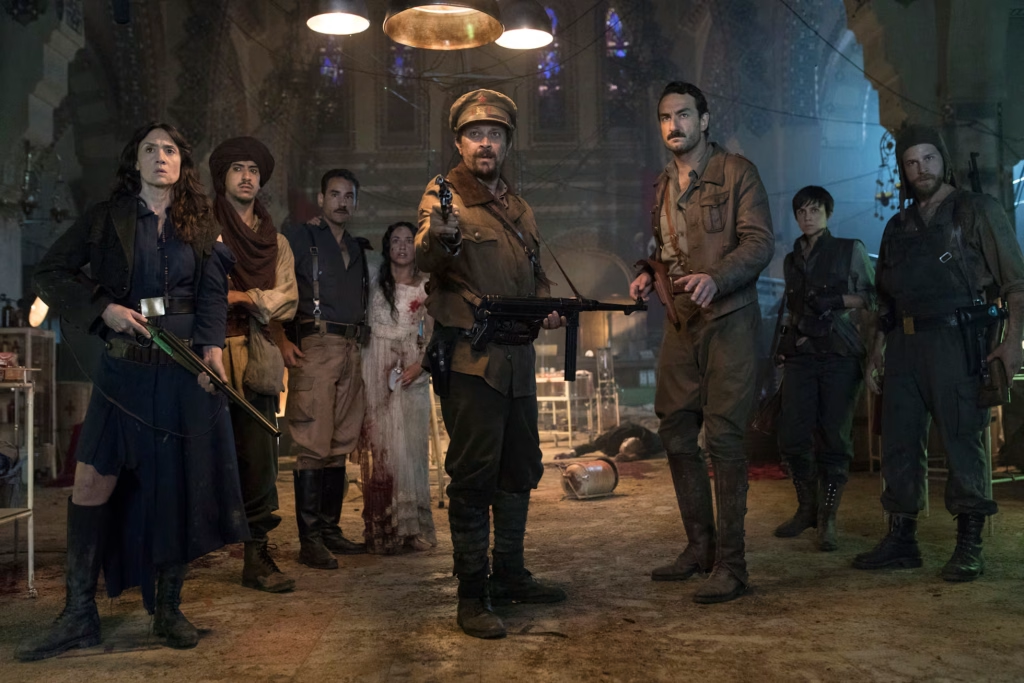
A zombie film with a better-than-usual map
Netflix reduces the hook to its cleanest form: during the Spanish Civil War, sworn enemies are forced to work together after encountering flesh-eating zombies created by a Nazi experiment. That is basically the whole machine, and the reason it works is that the distrust is already present before the horror arrives. These are not strangers from an apartment block learning who can be trusted with the last tin of beans; they are combatants from opposing sides of a civil war, carrying military loyalties, losses and assumptions into every temporary agreement.
The source material makes the date more specific. Manuel Martín Ferreras’s novel Noche de difuntos del 38, first published in 2012, begins in October 1938 after months of fighting around the Ebro, and the film keeps that late-war exhaustion even when it loosens the details for pulp momentum. This is not a history lesson, and it would be a mistake to treat it as one, but the setting gives familiar zombie beats a sharper edge because every act of cooperation has to push through an existing political and military divide.

That is the distinction I kept coming back to. “A group of survivors trapped together” is one thing; “a group of people who were already at war five minutes ago sharing ammunition because the dead have become indiscriminate” is quite another. Valley of the Dead never explores that idea as deeply as it could, but it understands that the premise needs more than uniforms and vintage rifles to justify the setting.

The title sounds better in Spanish
The international title Valley of the Dead is perfectly serviceable streaming-menu language. It tells you there is a valley and there are dead people, then politely gets out of the way. Malnazidos has more personality: it is an ugly, punning word that suggests the malformed, badly born or cursed, which suits a film in which war and experimentation produce something even more ruined than the battlefield already has.
The adaptation is credited to screenwriters Jaime Marqués, Cristian Conti and Alberto Fernández Arregui, with Javier Ruiz Caldera and Alberto de Toro directing. The film was completed in 2020 and opened that year’s Sitges Film Festival, but its Spanish theatrical release did not arrive until 11 March 2022. That slightly displaced history explains why it sometimes feels like a film from one moment arriving in another, but the original novel’s structure is still visible underneath the genre polish: opposing sides are forced into the same space, old loyalties become awkward, and the dead reduce every argument to the question of who gets out alive.

Jan Lozano and the old reluctant-hero machinery
Miki Esparbé plays Jan Lozano, a Nationalist captain who begins the story facing a firing squad before being sent on a mission that soon becomes considerably worse than the punishment it replaced. Jan is built from recognisable genre parts: the capable but compromised officer, the man who can function inside a uniform without being entirely defined by it, and the reluctant leader whose survival depends on treating an enemy as a person rather than a target. None of that is especially new, but Esparbé gives him enough dry weariness to stop the machinery showing too badly.
What I like is that the film does not turn Jan into a grand moral symbol. He argues, improvises, gets things wrong and gradually becomes useful to people who had every reason not to trust him. His movement towards cooperation is a piece of movie logic rather than a theory of political reconciliation, and the film is better whenever it leaves the idea at that practical level: there are dead people coming through the trees, so perhaps the ideological reckoning can wait until after somebody finds more bullets.

Jan also feels pleasingly old-fashioned, like the lead from a war adventure that has been infected by a horror film halfway through. He can carry a serious scene, but the film never asks him to become a tortured prestige character staring into the middle distance while the soundtrack tells us history is complicated. He is there to keep the truck moving, work out who is about to betray whom and occasionally discover that the person covering his back is wearing the wrong uniform.
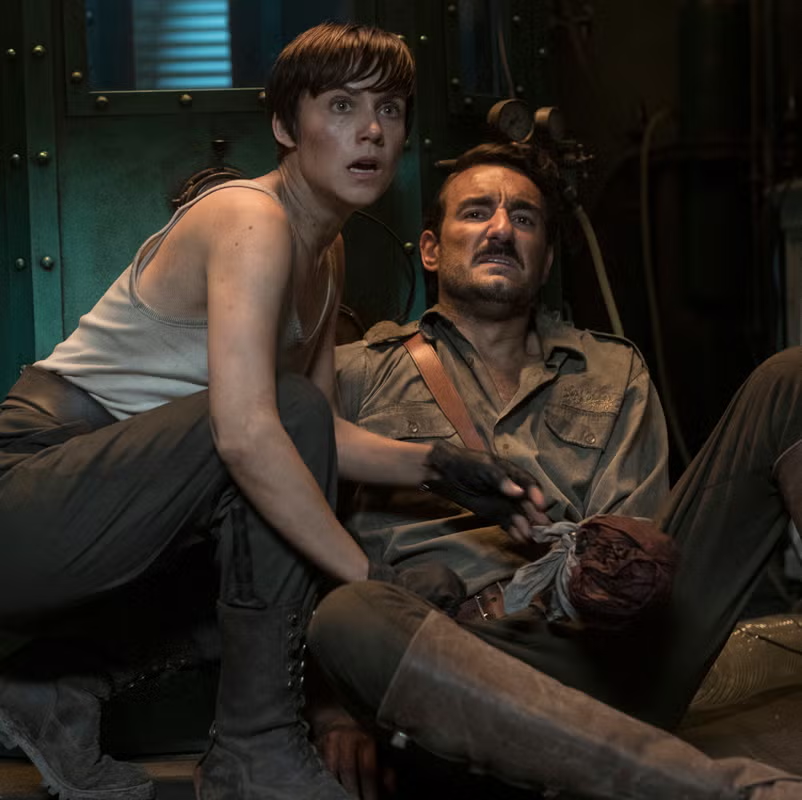
Matacuras, and the character the film clearly enjoys most
Aura Garrido’s Matacuras — usually translated as “Priest-Killer” — has the advantage of arriving with a nickname that does half the work before she speaks. She is a Republican fighter, practical with a weapon and understandably slow to trust Jan, but Garrido keeps her from becoming merely the designated tough woman in the group. There is alertness in the performance, a sense that Matacuras is constantly measuring the room and deciding which problem deserves the machete first.
The film eventually nudges Jan and Matacuras towards the familiar enemies-to-allies chemistry, but it works best before the relationship becomes tidy. Their exchanges have friction because the story gives that friction a real basis, and Garrido resists softening the character merely to make the pairing easier. I would have liked more interior life for her — that is true of almost everyone here — but she is one of those genre characters who becomes larger than the page because the actor seems to understand exactly what kind of film she has wandered into.

The Sergeant, the nun, the explosives man and everybody else in the truck
The ensemble is where the film earns much of its momentum. Luis Callejo’s Sargento gives the Republican group a tired authority; Manel Llunell’s Decruz brings nervous, younger energy; Álvaro Cervantes’s Mecha has the useful presence of a man you want nearby when machinery or explosives become part of the problem; Jesús Carroza’s Jurel, Sergio Torrico’s Brodsky, Dafnis Balduz’s political commissar and Mouad Ghazouan’s Rafir fill out the shifting lines of loyalty and comic irritation. Nobody gets an enormous amount of room, but the group has enough texture that the deaths and separations do not feel completely interchangeable.

María Botto’s Sor Flor is one of the stranger pieces in that mixture, and the film knows it. Religion was not neutral scenery in the Spanish Civil War, so putting a nun with a firearm among rival fighters brings another layer of tension without requiring a speech to announce it. The character could easily have become a one-joke image, but Botto plays her straight enough that the absurdity belongs to the situation rather than to her.

This is also where the film’s humour tends to work best. It is funnier when it comes from people with incompatible backgrounds trying to solve a practical problem than when it reaches for a written punchline. The dead are outside, the door needs boarding up and somebody has to drive; politics has not disappeared, but the immediate agenda has become brutally simple.


Nazis, bad science and zombies that look properly used
The Nazi-experiment angle is one of horror cinema’s most durable shortcuts. Once German officers start handling secret compounds and laboratory equipment, the film does not need to spend twenty minutes explaining that the research programme has wandered off the ethical map. Valley of the Dead uses that familiarity efficiently: the experiment creates the outbreak, the infected turn the valley into a sealed problem, and the plot can get back to movement rather than burying itself in pseudo-scientific lore.
That means the zombies themselves are more battlefield hazard than metaphysical nightmare. They swarm, bite, reanimate and disrupt plans; they are not there to deliver a new rulebook for the undead. I did not find the film particularly frightening, but I did find the creatures tactile enough to keep the action from becoming sterile, especially when the make-up and physical effects are allowed to do the work.

The production work behind them is more elaborate than the breezy tone suggests. Contemporary production notes describe a three-stage transformation for the infected, with make-up, prosthetics, contact lenses and different treatments for fresh, coagulated and dried blood; on some days the team had to process more than 150 extras. A dedicated zombie coach, Óscar Valsecchi, worked on the movement of the infected, which helps explain why the horde scenes feel organised rather than like a crowd of people independently remembering how zombies are supposed to walk.

One visual idea I quite liked is the film’s treatment of blood as the infection progresses. The make-up team designed distinct stages of conversion, and the film gives its undead a dried, almost spent quality rather than coating everybody in the same glossy red syrup. It is a small thing, but after enough zombie films small things start to matter.

Comedy in a mass grave
The tone is the part that could have gone badly wrong. A Civil War setting carries real historical trauma, while the film is also trying to deliver gags, explosions and reanimated corpses, and those ingredients do not automatically become tasteful simply because the editing is fast. What saves the film for me is that most of the comedy is aimed at friction, bravado and absurd circumstance rather than at the suffering itself.
That does not remove the underlying problem. By turning Nationalist and Republican combatants into an adventure ensemble, the film necessarily compresses a complicated conflict into character types and a temporary truce. It knows enough not to present the truce as a magical solution to history, but it also rarely stops long enough to examine what these characters actually believe beyond the traits needed for the next argument.
I can live with that because the film is quite clear about its weight class. It is not pretending to be a sober account of the Civil War, and it is not using zombies as a back door into a grand thesis about Spain. It is pulp adventure laid over historical wreckage, which still deserves care, but at least the film does not mistake its own clever premise for scholarship.

The production has more machinery than the premise strictly requires
The physical production is one of the reasons the film gets away with being this silly. Kiko de la Rica’s cinematography gives the period setting texture without embalming it, Martí Roca’s editing keeps the action readable, and Javier Rodero’s score leans into adventure rather than solemn historical drama. The result looks more expensive and considered than the words “Spanish Civil War zombie comedy” might lead you to expect.
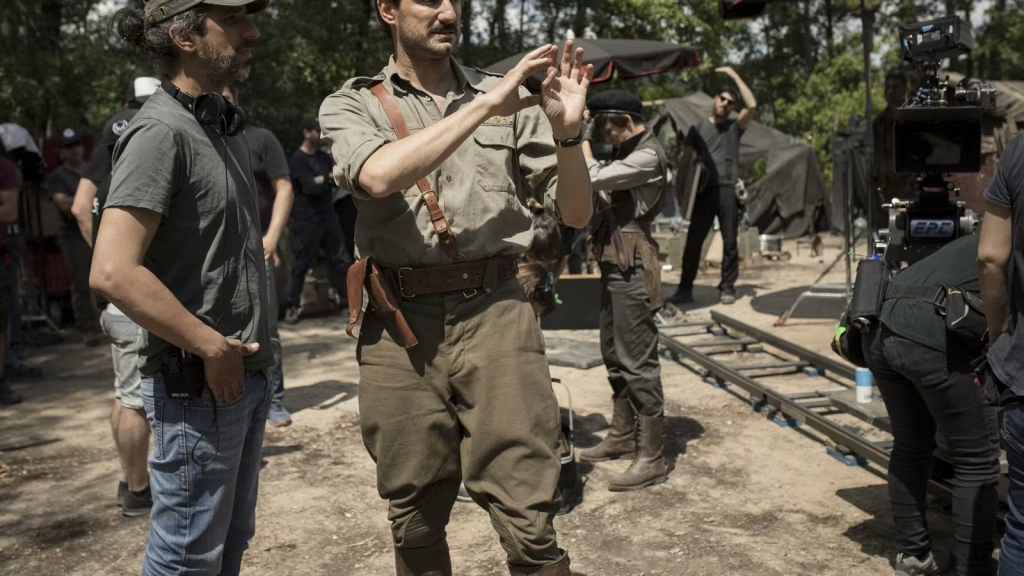
The production design was doing some fairly serious lifting. The crew constructed more than 200 metres of railway track so that two armoured period trains could be moved and manipulated for the film, and the vehicle fleet included more than twenty functioning period military vehicles. Those are the sorts of details I like discovering after watching something that initially looked as though everybody had simply agreed to meet in a forest with rifles and fake blood.
That care matters because horror-comedy curdles quickly when the world around the jokes looks disposable. Here the grime, uniforms, vehicles, woodland locations and heavy mechanical objects give the actors something solid to push against. Even when the story is being cheerfully ridiculous, the frame has weight.

What the temporary truce gets right — and what it avoids
The strongest idea in Valley of the Dead remains the temporary truce. Zombie stories have always been useful pressure cookers because they remove ordinary options and make social arrangements visible under stress. Here that structure has a ready-made tension: the survivors are not merely people with different personalities, but combatants whose sides have been killing one another.
The film is best when it expresses the change through behaviour rather than speeches. Somebody covers a person they would have abandoned earlier; a weapon is handed across a line of distrust; an argument is cut short because something dead has started moving again. The moral imagination is simple, but the dramatic logic is clean: hatred may remain intact, yet survival keeps imposing temporary acts of cooperation.
What the film avoids is equally obvious. It does not spend much time on the asymmetries, institutions and social forces behind the conflict, and therefore the story can drift towards a broad “both sides must stop fighting” simplicity. I do not need a zombie comedy to become a seminar, but once a film chooses a setting this loaded, the simplification becomes part of what I am watching rather than something I can pretend is not there.

Where it falls short
For all its energy, the film’s characters often remain one strong adjective away from becoming types. Jan is the reluctant officer, Matacuras the fierce Republican fighter, Sargento the grizzled commander, Decruz the nervous young driver, Sor Flor the armed religious complication and Mecha the man whose job description might as well read “something will explode shortly”. The actors make the shorthand enjoyable, but the script is usually already moving to the next set-piece before anyone acquires much more depth.
The horror is similarly more fun than frightening. The infected are effective in crowds, the make-up has texture and the action knows how to use confined spaces, but dread is not really what the directors are chasing. This is closer to an adventure film that has caught zombie fever than a horror film that happens to be wearing a military uniform.
The Nazi experiment is also familiar enough to feel like a pre-installed genre component. It works because it gives the outbreak an immediate origin and a clear external threat, but there is not much surprise in “secret Nazi programme goes catastrophically wrong”. The novelty lies in where the formula has been dropped: late-Civil-War Spain, among people whose existing conflict makes even a sensible truce feel unstable.

Why it still worked for me
Despite the reservations, I had a good time with Valley of the Dead, largely because it seems to understand what it is and stops short of demanding that I call it more important than it is. It has a clean hook, a likeable ensemble, tactile production design, enough blood to keep the undead honest and enough humour to stop the whole thing becoming another brown-grey march through misery.
Its release history gives it an odd little afterlife as well. The production was completed in 2020 and opened Sitges that year, while the Spanish theatrical release eventually arrived in March 2022 before the film reached Netflix internationally later that year. Watching it now, the delay is mostly trivia, but it does add to the sense of a scrappy genre object that had to wait around for the world to become receptive to fictional contagion again.
I also appreciate that the film’s craft is better than its disposable premise requires. The large-scale practical work, period vehicles, railway construction, costume design and staged transformations of the infected mean the movie has physical detail to fall back on whenever the jokes or character beats thin out. It is easy to make “Nazis made zombies” sound like a lazy pitch; it takes considerably more work to build trains, dress a valley and make the dead look as though they have actually been lying in it.
A small note on the ending
The final stretch does what this kind of film usually does: sacrifices arrive in roughly the order the screenplay has been preparing, the action moves towards the laboratory and railway material, and Jan and Matacuras have to decide how much of the uneasy alliance survives the immediate crisis. It is not a startling ending, but it has the right pulp satisfaction, and the mid-credits sting leaves a little undead movement in the wreckage without turning the whole film into a franchise application form.
I do not particularly need another one. What I wanted was this one odd thing: a Spanish Civil War zombie adventure with bad science, temporary alliances, a machete-wielding Republican, a Nationalist officer who learns to improvise, a nun with a gun and enough old machinery to make the production accountant nervous. The zombie genre is a crowded cemetery, but Valley of the Dead at least chooses a more interesting graveyard and remembers to have some fun while digging.
Affiliate Disclosure: This post contains affiliate links. If you click through and make a purchase, I may earn a small commission—at no additional cost to you. I only recommend products I personally find useful or relevant. Thank you for your support.
Leave a Reply