
There are films I remember by their endings, films I remember by a line of dialogue, and films where the music comes back before I can remember exactly what happened in the third act. Then there are films and television shows that seem to have lodged themselves in my head through a single object, as if the entire production could be compressed into something that fits in a hand, hangs from a belt or, in one particularly inconvenient case, straps to your back.
Deckard’s blaster does it. So does a Ghostbusters proton pack, the little gold-and-silver communicator badge from Star Trek: The Next Generation, Darth Vader’s lightsabre and the Lament Configuration from Hellraiser. I do not have to be watching any of those films or shows to know what world the object belongs to. The silhouette is enough, and sometimes the sound is enough before the thing has even properly appeared.

I have succumbed within reason. I was lucky enough to get my hands on a Hasbro Force FX Darth Vader Signature Series lightsabre, and I ordered a knock-off Lament Configuration from Shopee because apparently middle age is when some of us begin importing fictional gateways to Hell. I still want a proper Next Generation comm badge that makes the communicator chirp, and yes, as silly as it sounds when written down, I would quite happily own a proton pack with all the lights and sounds if our house had the square footage required to accommodate an unlicensed nuclear accelerator.
That last part is where collecting stops being a purely emotional exercise and runs into the tedious adult world of space, money, dust and practicality. When I was younger the main problem was that I could not afford these things; now there are replicas at almost every price level, but adulthood has introduced a different question, which is where on earth I would actually put them. Owning the object is one thing. Living with it is another.

Image-use note: the links below are collected as editorial reference and download sources. Copyright and reuse conditions vary by source, so I would check the originating page before publishing any image.
The prop that survives the plot
What interests me is not simply that these objects are famous. Plenty of films contain recognisable things that nobody particularly wants to own. The props that become desirable usually do something more complicated: they carry character, world-building and sound design all at once, and they often look as though they existed before the camera found them.
That is why I think of them less as souvenirs and more as compressed pieces of production design. A good prop does not merely decorate a scene. It tells you who built it, who uses it, what kind of world allows it to exist and how much punishment it has already taken before the story begins.
Deckard’s blaster: a future that already looks old
The Blade Runner blaster is perhaps the cleanest example. Ridley Scott’s Los Angeles is full of enormous electronic advertisements, flying cars and synthetic humans, yet Rick Deckard carries something that looks like it has spent years in a police armoury drawer. It is heavy, complicated and slightly ungainly, with two triggers, visible screws, dark metal and that translucent amber grip that somehow makes the whole thing look both futuristic and faintly Victorian.

The reason it feels convincing is that much of it really did begin as existing machinery. The original hero prop combined components from a Charter Arms Bulldog revolver with parts from a Steyr-Mannlicher .222 Model SL rifle, then added covers, hardware and six LEDs to push it just far enough into the future. Contemporary photographs of the hero blaster are particularly revealing because the seams between ordinary manufacturing and film fabrication are still visible.
That is exactly right for Deckard. Harrison Ford does not play him like a science-fiction hero receiving a sacred weapon. He carries the blaster like occupational equipment, something issued for an unpleasant job involving replicants, paperwork, bruises and bad decisions. When Deckard pursues Zhora through the crowded streets or later tries to survive Roy Batty’s hunt through the Bradbury Building, the weapon never turns him into an action hero. It remains a tool attached to somebody increasingly unsure what his job means.

Vangelis supplies the city with its melancholy dream state, but the props keep dragging it back towards something tactile. That tension is part of why the film has aged so well for me. The future is not clean; it has fingerprints, scratches and bits that look as if somebody scavenged them from another machine, which is very close to how the production itself made the thing.

The cultural life of the prop has long since detached itself from the film’s immediate needs. A hero blaster sold at auction in 2009 for US$265,500, while stunt versions and later replicas have developed their own collecting hierarchies. There are now debates over finishes, screw heads, grip colours and production variations that would have sounded absurd while the crew were simply trying to get a convincing weapon in front of the camera.

The proton pack: plumbing the supernatural
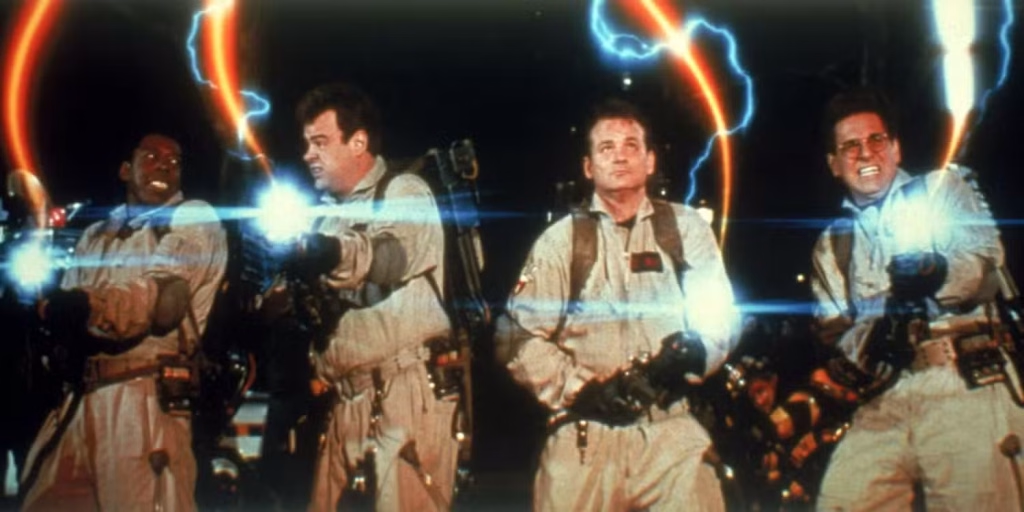
The proton pack works for almost the opposite reason. Deckard’s blaster looks like a police weapon from a future that has already gone shabby; the Ghostbusters equipment looks as though three scientists built it in a basement with surplus hardware, a modest budget and no patience for industrial design committees. That is precisely why it works.
Hardware consultant Stephen Dane was responsible for much of the first film’s equipment, including the packs, traps and Ecto-1. He drew inspiration from military flamethrowers, and the production eventually built the hero packs around fibreglass shells, aluminium backplates and military-style backpack frames. The finished packs were roughly thirty pounds with batteries installed, which explains why the actors sometimes look as if paranormal research has unexpectedly become manual labour.

Peter Venkman, Ray Stantz, Egon Spengler and Winston Zeddemore become visually complete when the packs go on. Before that, they are four men in practical jumpsuits. With the equipment attached they acquire the silhouette that has been copied in toys, games, Halloween costumes and fan builds for more than forty years, yet the genius of the design is that it never quite looks heroic. It looks heavy, improvised and faintly dangerous.

The film helps by treating the technology like trade equipment. Ray and Egon explain things with total seriousness while Venkman reacts like somebody who has agreed to a business plan without reading the safety section. By the time the team crosses the streams in the climax, the packs have become inseparable from the joke and the danger: homemade science, reckless confidence and one glorious decision to ignore the operating instructions.
The sound matters as much as the hardware. The rising electronic whine of a pack powering up, the particle stream and the alarm-like noises make the prop feel active before anything supernatural happens. Add Elmer Bernstein’s score and the impossible cultural afterlife of Ray Parker Jr.’s theme song, and the equipment acquires a sonic identity almost as strong as its visual one.

This is also where my practical side begins shouting. A good full-size pack wants a wall mount or a stand, enough clearance for the wand, space around the hoses and the sort of household tolerance normally reserved for bicycles or musical instruments. A lightsabre can disappear into a corner. A proton pack announces that the room now has a proton pack in it.

Modern replicas make the temptation worse because they can reproduce the lights, sounds and sequences that older display pieces only suggested. Once the cyclotron starts glowing and the electronics begin their little performance, the object stops feeling like a static replica and starts pretending, briefly and persuasively, that it has a job to do.

The comm badge: the smallest dangerous purchase
The Star Trek: The Next Generation communicator badge is the opposite sort of temptation because it barely takes up any room. This makes it far more dangerous to somebody trying to practise restraint. A proton pack requires a domestic summit meeting; a comm badge can arrive in a padded envelope and disappear into a drawer before anybody has had time to object.

Rick Sternbach’s own production notes contain the story I like best. His early communicator concept was still a separate piece of hardware until Gene Roddenberry looked at it and asked, in effect, why the Starfleet insignia itself could not simply be the communicator. Sternbach’s surviving sketch and note show how a single question removed most of the object and produced a much stronger design.
The actual badges used on the series were straightforward props, generally cast resin and painted rather than functioning electronics. That simplicity is almost perfect because the performance supplies the technology. Picard touches the badge, we hear the chirp, he says “Picard to Enterprise”, and the scene moves on. Nobody unlocks anything, waits for Bluetooth pairing or discovers that a software update has rendered Starfleet temporarily unavailable.

That interaction says something rather appealing about The Next Generation. Its technology is frequently sophisticated but not constantly demanding attention. Picard, Riker, Data, Geordi and Crusher use it as naturally as a door handle, which feels increasingly futuristic now that ordinary life involves devices begging to be charged, updated, authenticated and allowed to send notifications.

The communicator chirp is effectively a tiny piece of sound design functioning as a logo. It does not have the operatic force of John Williams or the dreamy pull of Vangelis, but it is enough to trigger the entire Enterprise-D in the head. That is one reason a replica that makes the correct noise is more attractive to me than a perfectly accurate silent one.
Researching this piece finally turned up the sort of version I have been looking for: Fametek currently makes an officially licensed chirping TNG ComBadge, and the official Star Trek Shop listing says it ships internationally to most countries. I would still check Singapore delivery at checkout rather than assuming anything, but this is dangerously close to becoming useful information rather than historical research.

There is even a Bluetooth version, which is funny in a very twenty-first-century way. We have spent decades trying to make the replica behave more like the fictional object, only to achieve it using the same wireless standard that sometimes refuses to reconnect a pair of headphones after lunch.


The lightsabre: a camera accessory becomes mythology
The lightsabre is the obvious example, but obvious does not mean uninteresting. One of the enduring pleasures of the original Star Wars production is how much supposedly advanced technology was assembled from ordinary twentieth-century material. Roger Christian has described finding the Graflex camera flash handle that became the basis of Luke’s original lightsabre and immediately recognising that its weight, buttons and proportions already felt right. A few grips, bits from calculators and a D-ring later, a photographic accessory had become mythology.
Vader’s hilts came from the same found-object philosophy, with a British M.P.P. Microflash forming the core of the famous black-and-silver weapon. The 2025 Propstore auction documentation for a screen-matched Vader duelling lightsabre details the M.P.P. flash, plastic T-track grips, magnification bubbles, decorative wiring and the modifications needed to attach a practical blade for fight choreography.

That wear is important. Vader’s lightsabre is usually remembered as an immaculate graphic object — black, silver, red — but the genuine duelling prop looks like something that has survived work. It has cracks, filed edges, missing material and damage from repeated fight scenes, all of which makes the distance between screen icon and production tool suddenly very small.

Character and object are unusually fused here. Luke’s weapons change as his story changes, while Vader’s hilt feels settled, severe and completely at home on the black silhouette. The Cloud City duel in The Empire Strikes Back is where that association becomes permanent for me: the red blade, the industrial setting, John Williams pushing the mythology forward and Ben Burtt’s sound design giving every movement physical weight.
My Hasbro Force FX Darth Vader Signature Series sits on the safer side of this obsession. It is not a screen-used object and does not need to be. When it ignites, the blade brightens and that hum starts, the replica performs enough of the memory that the distinction briefly stops mattering. A silent hilt can be beautifully made, but sound is what turns the thing from sculpture into theatre.

There is a collector hierarchy here too, naturally. Replica hilts lead to screen-accurate replicas, then vintage parts, then production pieces, and eventually the sort of auction where everybody quietly accepts that an object from a science-fiction film can cost more than a very substantial house. Vader’s screen-matched hero duelling lightsabre from The Empire Strikes Back and Return of the Jedi sold through Propstore in September 2025 for US$3.654 million.

The irony is difficult to miss. Star Wars made its future persuasive by recycling bits of the present, and decades later collectors pay extraordinary sums for the exact vintage components that the prop department once treated as useful junk. The found object has become the holy relic.


The Lament Configuration: the object that is the plot
The Lament Configuration may be the purest example because the object is not merely associated with the story; it causes it. Clive Barker’s The Hellbound Heart introduced the LeMarchand Configuration as an intricate mechanical puzzle connected to pleasure, curiosity and consequences. When Barker adapted his own novella into Hellraiser, the film needed that idea to become something immediately legible on screen.
Simon Sayce designed and made the box that became iconic: black and warm wood tones beneath ornate brass-etched geometry, small enough to fit in two hands and attractive enough that a person might plausibly keep touching it despite the growing body of evidence that this is a terrible idea. Propstore records one of the eight boxes made for the 1987 film as solid oak covered with brass-etched panels and varnish, with the sort of scratches and tarnish that now make collectors lean closer rather than recoil.

Frank Cotton’s entire catastrophe begins with the desire to know what is on the other side of the mechanism. Kirsty later inherits the consequences, and Pinhead and the Cenobites become the faces of what the box opens. That makes the prop a remarkably efficient piece of narrative design: you can remove every monster from the frame and leave the cube on a table, and the threat is still present.

The end of the first film reinforces that circular quality. Kirsty closes the configuration and drives the Cenobites back, only for the box to survive and return to circulation. The characters escape or die, but the object persists. It is the neatest possible metaphor for a horror franchise and, as it turns out, for memorabilia collecting.
Christopher Young’s orchestral score gives Hellraiser a grandeur that the small scale of the box might otherwise resist. There is also a lovely connection back to Barker’s novella, where the mechanism is described as having a musical component as it opens. The screen version does not need to reproduce that literally because the film has an entire score available to make the act of solving the box feel ceremonial.

My Shopee version is, needless to say, not one of the eight. It is a knock-off display piece whose connection to the production is roughly the same as my connection to Leviathan, but I understand why I wanted it. A cube takes almost no space, it looks good even to somebody who has not seen the film, and the design contains the whole premise without requiring a Pinhead figure standing beside it.

The market has treated the box accordingly. A 1987 example connected to Simon Sayce’s collection sold through Propstore in 2022 for £37,800 against an estimate of £10,000 to £15,000. That is an impressive amount of money for an object whose fictional selling point is that opening it may result in eternal suffering, although collectors have always had a complicated relationship with warning labels.


When the object becomes the character
These props survive because they become proxies for the people who use them. Deckard’s blaster contains the fatigue and moral uncertainty of a detective who is never entirely comfortable with what he has been asked to do. The proton pack contains Ray and Egon’s reckless engineering, Venkman’s opportunism and Winston’s gradual acceptance that this is apparently now his profession. Picard’s badge is the quiet confidence of a future where communication technology has become nearly invisible, while Vader’s lightsabre is so bound to his silhouette and sound that the hilt alone can carry menace. The Lament Configuration goes one step further and behaves almost like a character itself, always waiting for the next curious pair of hands.
This is why the most desirable props are not necessarily the largest, prettiest or most technically elaborate. They are the ones the story teaches us how to use. We watch Ray pull the particle thrower free, Picard tap the badge, Vader ignite the blade, Deckard check his weapon and Frank begin to solve the box. The film gives us a tiny demonstration, and years later the replica lets us repeat the gesture.
The strengths and weaknesses of wanting this stuff
The strength of prop collecting is that it makes an immaterial thing physical. Films and television disappear when the screen goes black, but an object has weight, scale, texture and manufacturing decisions. As a designer, I find that almost as interesting as the nostalgia. You can look at where a screw was placed, how a surface was weathered, how an ordinary piece of hardware was disguised, or how one simple proportion makes the difference between something that looks authentic and something that looks like a toy.
The weakness is that accuracy has no natural stopping point. A decent replica becomes a screen-accurate replica, which becomes the correct vintage part, which becomes a production mould, which becomes a screen-used example and, eventually, a catalogue estimate containing more zeroes than seems medically advisable. There is always another level if the collector is determined enough.
Space creates a more democratic limit. A lightsabre can stand in a corner, a puzzle box occupies less room than a mug and a comm badge can disappear into a drawer. A proton pack, by contrast, wants an address. Then there are the boxes the collectibles arrive in, because collectors are apparently expected to preserve the packaging for objects they bought specifically because they wanted to remove them from the packaging.
Money is the other obvious limit, although I am not convinced being ultra-rich would completely solve the problem. It would give me a dedicated room and better display cases, certainly, but it would also remove the useful resistance that forces a person to decide whether he genuinely wants an object or merely likes the idea of owning it. Restraint is irritating, but it performs a useful editing function.
I still want the comm badge
That may be where I have ended up with all of this. I understand the attraction of owning the things because a good prop replica collapses distance: the fictional object that used to exist only behind glass, on a VHS tape or inside a cinema suddenly has dimensions in the same room as you. For a few seconds the trick works again, especially when there is a sound attached to it.
I also know that I do not need a room full of proof that I liked these films. I can admire a perfect Deckard blaster without buying one, and I can accept that a proton pack may remain one of those objects better enjoyed at somebody else’s house. The Lament Configuration is already sitting here, Vader’s lightsabre is accounted for, and the sensible thing would be to declare the collection sufficiently representative.
The comm badge is very small, though. That hardly counts.
Leave a Reply