Spoiler warning: This goes right through Season 4 and its finale, “Being Alive”, including what happens to Mae, Ted, Alice, Rebecca, Roy and Keeley.

I finished the fourth-season finale of Ted Lasso today, and for a while afterwards I just sat there knowing perfectly well what the programme had done to me again. Four seasons in, I can see most of the machinery now. I know when the music is going to arrive, when somebody is about to stop hiding behind a joke, and when the camera is going to stay on a face for those extra few seconds specifically designed to turn whatever moisture is gathering around my eyes into something rather more incriminating.
It still works, which is mildly irritating. Perhaps that is part of what I have always liked about Ted Lasso. It has never been particularly embarrassed about wanting its audience to feel something, even when so much modern television has become very good at irony, emotional armour and characters who would sooner lose a limb than admit that another human being matters to them. Ted Lasso has always gone the other way, and although it can be sentimental, manipulative and almost indecently sincere, the writing and performances are usually good enough to stop it collapsing into something printed on a motivational mug.
Season 4 is not flawless. There were stretches where I could practically see the writers shifting pieces around the board, and some of the new Lady Greyhounds deserved considerably more space than they received. By the time “Being Alive” ended, though, those complaints had not disappeared so much as settled back into their proper proportions, because loving a television programme does not require pretending it never puts a foot wrong.

A Show That Had Already Said Goodbye
Season 3 had ended in a way that felt remarkably complete. Ted went home to Kansas, Rebecca rediscovered the possibility of having a life that did not revolve entirely around AFC Richmond, Roy began the laborious process of becoming something approximating an emotionally functional adult, and the club itself had become the family Ted had unknowingly been constructing since the first episode.
That made bringing the series back inherently risky. Television has a distinguished history of confusing audience affection with unfinished business, and I was wary of Season 4 becoming one of those reunions where everybody returns because the property remains valuable rather than because the characters genuinely have somewhere left to go.
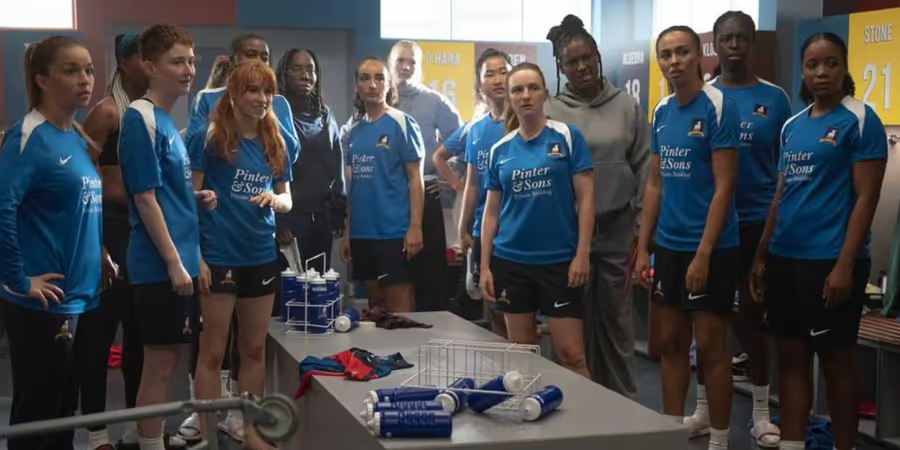
The programme found its answer by refusing to give Ted exactly the same job again. Season 4 runs for ten episodes, from 5 August to 7 October 2026, and brings him back to Richmond to coach the club’s second-division women’s side. Jason Sudeikis, Hannah Waddingham, Juno Temple, Brett Goldstein, Brendan Hunt and Jeremy Swift return, joined by Tanya Reynolds, Jude Mack, Faye Marsay, Rex Hayes, Aisling Sharkey, Abbie Hern and Grant Feely. Jack Burditt joined the fourth season as an executive producer, while Goldstein continued as both writer and executive producer.
That sounds like a fairly modest rearrangement on paper, but it gives the season a genuine reason to exist. Ted is no longer the baffled American wandering into English football with no idea what offside means, while Richmond itself is no longer quite the broken institution he inherited. The question changes from whether Ted can save the people around him to whether he knows when helping somebody sometimes means moving out of the centre.


The Lady Greyhounds Are More Than a Reset Button
Moving the programme into women’s football could easily have become a franchise trick: put different players in the same shirts, reuse the changing room and repeat the formula. The better parts of the season understand that this would be dishonest because these players enter professional sport through a different set of expectations, financial realities and cultural assumptions.
It also arrives at an interesting cultural moment. Women’s sport is considerably more visible than it was when Ted Lasso first appeared in 2020, and the creative team has spoken about attending women’s sporting events and recognising how much storytelling material existed around athletes whose experiences had rarely been treated with the same cultural weight as their male counterparts. The programme is still a warm comedy rather than a documentary about structural inequality, but the choice of a women’s team is not merely decorative.
There are glimpses of differences in budgets, facilities, career expectations and the complicated relationship between visibility and respect. The show sometimes skims across those ideas more lightly than I would have liked, but at least they exist inside the world rather than being reduced to a single earnest speech followed by everybody learning the correct lesson.

The central new character is Alice Chilton, played by Tanya Reynolds, and she quickly becomes the most convincing argument for the fourth season. Alice initially possesses the kind of emotional armour Ted Lasso has always enjoyed dismantling: intelligence sharpened into defensiveness, competence mixed with anxiety, and the suspicion that warmth is often simply a way for somebody to get close enough to disappoint you.
Reynolds never reduces her to the designated difficult woman. Alice is funny, brittle, awkward and perceptive, often within the same scene, and her developing relationship with Gemma gives the new team some of the emotional specificity the older Richmond players accumulated over several seasons.
The weakness is that I wanted much more of this across the whole squad. Gemma, Boots, Lizzie and several of the others make strong impressions, but after three seasons in which even relatively minor members of the men’s team accumulated histories, grudges, romances and peculiar little habits, some of the Lady Greyhounds remain closer to outlines than fully lived-in people. That matters because the season repeatedly argues that these women deserve the same opportunity and seriousness as the men, while the programme itself does not always give all of them the same narrative room.


Ted Lasso Learns to Stop Being Ted Lasso Quite So Much
Ted remains the gravitational centre of the programme, but one of the better choices this season makes is allowing him to drift gradually towards the edge of the frame. Jason Sudeikis has become much better at playing the gap between Ted’s public face and whatever is actually happening behind it.
The early Ted could conceal almost anything beneath chatter, film references and a level of verbal energy normally associated with morning-radio presenters. Season 4 Ted still does all of that, but Sudeikis plays him more quietly now, and you can often see him deciding whether a joke is genuinely useful or merely another convenient cupboard in which to hide.

His relationship with Henry also matters more this year, particularly once Mae’s death forces questions about Ted’s own father back into the open. Henry asks how his grandfather died, Ted initially avoids telling him the truth, and the finale eventually allows father and son to have the conversation Ted has spent years carrying around inside himself.
The smart decision is that we do not hear every word. Ted finally tells Henry the truth about his father’s suicide, but the programme leaves the conversation largely between them, which feels unusually restrained for a series that can sometimes explain an emotion twice and then add a song in case we missed it.

The larger arc becomes clear in the finale when Alice is made head coach and Ted, along with Beard, steps down into an assistant role. For a show bearing his name, it is a surprisingly generous move, because Ted has spent years preaching that leadership is not ownership and that helping people does not require standing in front of them forever. Season 4 finally makes him live by that principle.
It also makes the title Ted Lasso faintly funny again. By the end of Season 4, the bloke whose name is printed above the whole enterprise is no longer even the person running the team.

Rebecca, Keeley and the People Who No Longer Need Ted to Fix Them
Rebecca remains one of the series’ great pleasures because Hannah Waddingham can move from terrifying to ridiculous to genuinely wounded without making any of those versions of the character feel incompatible. The woman who bought AFC Richmond partly to destroy something her former husband loved has ended up protecting the club with a ferocity that is much closer to love than ownership.
Her battle over control of Richmond gives the finale one of its tidiest resolutions. Mae’s shareholding ultimately helps Rebecca regain the majority she needs, while the Crown & Anchor passes into the hands of Baz, Jeremy and Paul, three supporters who have spent years behaving as if the place belonged partly to them anyway. It is narratively convenient, perhaps suspiciously so, but there is something satisfying about both the club and the pub ending up with people who actually inhabit their worlds.

Rebecca’s decision to propose to Matthijs works for me emotionally more than it does structurally. I understand where the programme wants her to arrive: after spending years protecting herself from humiliation and loss, she finally chooses uncertainty rather than using independence as a fortress. The sequence feels slightly compressed, though, as if several emotional steps that might once have occupied most of an episode are now expected to land within a few minutes. Waddingham carries it, but I could still hear the timetable ticking underneath.

Keeley continues to be one of the show’s more useful answers to the idea that seriousness has to look serious. She can wear pink, run a business, panic, make mistakes, understand the room better than almost everybody else and still never be written as a punchline for caring about fashion. Juno Temple has always played her with an intelligence that other characters occasionally underestimate because of the packaging, and Season 4 lets Keeley feel more settled in herself without sanding away the things that made her Keeley in the first place.


Roy is more interesting to me now that his arc is not simply a question of whether he and Keeley will get back together. His move towards Chelsea makes sense because the show has spent four seasons teaching him something he particularly dislikes learning: leaving somewhere does not mean you failed there.
The impending child gives Roy and Keeley another reason to examine what being together actually means, and Brett Goldstein continues to find an impressive amount of emotional range inside a character whose basic spoken vocabulary still sounds as though it was assembled from growls, profanity and several surviving consonants.

Mae, the Pub and the People Who Seemed Permanent
Mae’s death gives the final two episodes their emotional centre, and it is also the point where Ted Lasso comes closest to daring people who dislike its sentimentality to walk out of the room. In “Mae Rides the Bus”, she finally travels with the Lady Greyhounds, shares some of her own history with women’s football, watches their comeback victory and then dies after the match.
It got me anyway. Annette Badland never needed an enormous amount of screen time to make Mae feel permanent. She was one of those characters who quietly established the architecture of the fictional world, to the point where the Crown & Anchor seemed to exist because Mae existed, rather than because somebody had built a pub set and needed a person behind the bar.

Her absence therefore means more than simply losing a recurring character. The pub has always been Richmond’s unofficial second changing room, where supporters argue, celebrate, grieve and perform the sort of highly confident football analysis usually conducted by people who have consumed several pints.
The finale’s memorial at the Crown & Anchor understands that places become meaningful through repetition. We return to the same bar, the same seats and the same faces until they stop looking like scenery and begin looking like part of our mental map of the show. The idea running underneath Mae’s death is not especially complicated, but Ted Lasso rarely benefits from pretending that simple things are therefore trivial. Jobs change, children grow, relationships alter shape, familiar places acquire new owners and people who seemed permanent turn out not to be. Being alive means living with that irritating design flaw.

A Finale That Does Not Really Care About the Score
One of the better decisions in “Being Alive” is that the Lady Greyhounds’ last match does not become a traditional last-minute-goal finale. Their promotion has already been secured, and the match at Nelson Road matters more because of who comes back to watch it than because of what appears on the scoreboard.
Keeley’s efforts help fill the stadium, former Richmond players return, Nate arrives from his new coaching life in Poland, and the Diamond Dogs briefly reform to dispense advice of varying usefulness. It is reunion-special territory, certainly, but the appearances work because they feel like people revisiting somewhere that once mattered to them rather than celebrities appearing through a door so the internet can point at the television.

The stadium itself has become something like a memory palace by this point. Four seasons of changing-room talks, humiliations, celebrations, departures and occasional actual football have accumulated inside those spaces, so seeing old characters return does not need to function as a twist. They are simply coming back to a place where part of their life happened, which is something I understand increasingly well as I get older.

The Music Knows Exactly What It Is Doing
Music has always been one of Ted Lasso’s more reliable emotional accomplices, and Season 4 continues that tradition with very little interest in subtle deniability. Tom Howe composed the fourth-season score, while the theme written by Howe and Marcus Mumford receives a new version from Brandi Carlile for the finale.
Carlile’s version opens “Being Alive” and immediately tells us that this is still recognisably Ted Lasso, but the voice has changed. That feels appropriate for a season about succession, where the club remains Richmond even as different people inherit different responsibilities. The finale also makes use of Mary Oliver’s When Death Comes, and by this stage I was well aware the show had positioned the emotional artillery and was preparing to fire it directly at the audience.
I know somebody selected exactly the right piece of music, cut it against exactly the right shot and decided exactly how long to hold before moving on. Emotional manipulation is not exactly hidden here. The awkward thing is that recognising the trick does not prevent the trick from working.

Richmond Still Looks Like Richmond
One thing I have always enjoyed about the series, especially from a design point of view, is how instantly legible its world is. Richmond’s blue and red, the yellow of the BELIEVE sign, Nelson Road’s corridors, Rebecca’s immaculate tailoring, Keeley’s more aggressive colour palette and Beard dressing as though he lost a complicated wager in a vintage shop all contribute to an environment that is heightened without becoming a cartoon.
The women’s team gives the design language room to shift slightly as well. Resources, kit, changing spaces and the visual hierarchy around the team reinforce the fact that this is the same club seen from another part of the organisation.
The original BELIEVE sign worked because it looked as though somebody had made it with whatever was lying around rather than because it looked like a brand asset. That distinction matters in a programme that became a very large brand while still trying to preserve the appearance of something handmade and personal.
The fourth season occasionally strains against that contradiction. Ted Lasso is now a global piece of intellectual property about the value of small human gestures, which is a slightly odd position to occupy, although perhaps not an impossible one.


Where Season 4 Creaks
Ten episodes should theoretically provide enough room, but the back end of Season 4 sometimes feels both leisurely and overcrowded. The ownership battle, Mae’s death, Rebecca’s relationship, Roy and Keeley, Henry, Alice’s progression and the future of the women’s side all begin demanding resolution at roughly the same time.
Zelda’s storyline is one of the places where the machinery becomes particularly visible. The takeover provides Rebecca with something concrete to fight, but the character occasionally feels broader than the rest of the programme, while Mae’s conveniently decisive shareholding solution is emotionally satisfying in the way finding the precisely correct legal document in the final drawer tends to be.
There is also Ted’s continuing football ignorance, which is becoming difficult to sustain. He has now spent rather a lot of time around professional football, and there are only so many rules he can fail to understand before ignorance stops looking like characterisation and starts looking like something negotiated into the format.
None of this ruined the season for me, but it keeps it from becoming the immaculate version of itself its emotional confidence occasionally suggests it might be. Ted Lasso remains a good programme partly because its flaws are visible rather than because it has somehow evolved past having any.

From an NBC Sports Joke to Something Strangely Durable
It remains odd to remember that Ted Lasso grew from a character originally created around NBC Sports coverage of the Premier League. The series was developed from those existing characters by Sudeikis, Bill Lawrence, Joe Kelly and Brendan Hunt, then somehow expanded a broad joke about an American coach misunderstanding football into a programme about grief, anxiety, friendship, divorce, parenthood, sexuality, masculinity, workplace culture and, every so often, football.
It should probably have run out of road much sooner than this. The original joke certainly did. What gave it durability was the decision to treat Ted’s optimism not as proof that he had escaped pain but as evidence that he had built a coping mechanism around it. Once the programme revealed the death of his father and the panic attacks beneath his cheerfulness, “be curious, not judgemental” stopped being merely something that looked good printed on a T-shirt.

Women’s Sport, Football Culture and Why the Change Matters
The switch to the Lady Greyhounds also gives the show a slightly different cultural role. Ted Lasso arrived while American interest in football was growing, and its creators have acknowledged that the sport’s American audience was considerably larger than the stereotype implied even before the programme appeared. The 2026 World Cup only made that more visible.
Season 4 now makes a similar wager on women’s sport: that the audience is already there, that the stories are already there, and that perhaps mainstream entertainment has simply not spent enough time looking. The programme does not solve that problem, naturally, but putting a women’s club at the centre of one of Apple’s most recognisable series is still culturally meaningful.


The Annoying Thing Is That I Still Believe It
What Ted Lasso continues to do unusually well is allow kindness to have consequences. Ted’s approach does not magically repair everybody, and over four seasons the programme has become better at recognising that optimism can also be avoidance, generosity can turn into self-erasure and helping other people is not necessarily the same thing as dealing with yourself.
That is why Season 4 affected me more than I expected. At its best, it is no longer a programme simply telling us to believe. It is interested in how difficult belief becomes once you have accumulated enough evidence that people leave, relationships change, parents die, jobs end and institutions you thought were permanent turn out to have shareholders and legal documents attached.
The finale title, “Being Alive”, is almost suspiciously direct, but it earns the phrase. Mae is gone, Roy is leaving Richmond, Rebecca chooses something uncertain, Alice receives a job she may not yet fully believe she is ready for, and Ted finally realises that he does not need to be the person standing at the front of the room. Even the football match does not require us to care very much about the score.
I suppose this is why Ted Lasso never quite fails to make me feel things, even when I can see it setting the emotional trap several minutes before I walk directly into it. The plots sometimes arrive more neatly wrapped than real life ever manages, a few characters need more room, and the programme occasionally squeezes the audience’s heart with both hands when one would probably have done.
But the cast remains excellent, the affection between these people feels accumulated rather than manufactured, and underneath the jokes, the football and an improbable quantity of biscuits is a fairly sensible idea: a good life is not one in which everything works out. It is one in which you keep showing up while it does not.
After four seasons, that still gets me.
Production Note
Season 4 consists of ten episodes and ran from 5 August to 7 October 2026. The premise brings Ted back to Richmond to coach a second-division women’s football team, while the production retains long-standing creative personnel including Jason Sudeikis, Brendan Hunt and Bill Lawrence and adds Jack Burditt as an executive producer. The series remains based on the characters originally created for NBC Sports.
As of the Season 4 finale on 7 October 2026, Apple had not formally announced a fifth season, so I am leaving the ending open rather than treating it either as a series finale or as a guaranteed bridge to another season.
Leave a Reply