
There was a time when Saturday morning in Manila had a timetable, and television expected you to respect it. If the cartoon started while you were still eating breakfast, helping with something around the house, or being dragged somewhere by your parents, that was your problem. The television did not wait, rewind, restart or politely ask whether you wanted to continue where you left off. It simply carried on without you.
That is the first thing I remember about Saturday Fun Machine on RPN-9: not any single cartoon, but the feeling that the morning itself had been programmed. The block is remembered by Filipino viewers as one of those long Saturday stretches in the late 1970s and through the 1980s when imported cartoons were gathered together into something that felt less like ordinary scheduling and more like an event. The exact line-up changed, as did the broadcast hours, and surviving memories do not always agree with surviving schedules. That uncertainty feels appropriate. Childhood rarely keeps proper records.
What survives instead is the shape of it: breakfast finished quickly, a television already switched on, the glow of a CRT set in a Manila living room, and a sequence of shows that could move from superheroes to cavemen to outer space without anybody asking whether the genres matched. Super Friends, Space Ghost, Blackstar, Captain Caveman and the Teen Angels, The Robonic Stooges and The Super 6 have all become entangled with that memory for me. They were made by different studios in different years, often for different American networks, but RPN-9 placed them beside one another and accidentally created a shared Filipino childhood playlist before anybody used that word for television.

When television had an appointment book
It is difficult to explain appointment television to somebody who has grown up with streaming because the inconvenience was not an unfortunate side effect; it was the whole operating system. You did not choose the moment. The broadcaster chose it, and your choices were to be there, miss it, or hope the episode returned months later as a rerun. In Manila, where households might have had only one television and only a handful of reliable channels, that made the weekly schedule strangely powerful.
I am not going to pretend this was better in every way. Missing a favourite programme because the family had somewhere to go did not make anybody more disciplined or spiritually complete. It was simply irritating, especially when there was no realistic way to find the episode afterwards. Yet the inconvenience gave television a rhythm that is difficult to reproduce now. Friday night felt different because Saturday morning was waiting on the other side of it, and when the opening theme finally arrived there was a small sense of having kept an appointment.
The schedule also reduced choice to manageable proportions. There was no forty-minute browse through thumbnails, no recommendation engine, no decision about whether to commit to another eight-part limited series. Whatever RPN-9 put on next became, for a while, the thing we were watching. Sometimes it was excellent, sometimes fairly silly, and sometimes the concept was so peculiar that the fact it had been made at all seemed like part of the entertainment.
Super Friends and the architecture of obvious goodness
Super Friends was the obvious heavyweight of the group. Hanna-Barbera launched the series in 1973 around Superman, Batman and Robin, Wonder Woman and Aquaman, initially adding Wendy, Marvin and Wonder Dog before repeatedly changing the supporting cast and format. To a child watching in Manila, none of those production changes mattered very much. The essential point was that the famous heroes were all in the same place, and when several of them appeared together the television suddenly felt more important.
The show’s visual language was wonderfully direct. Superman was blocks of blue, red and yellow; Batman was essentially ears, cape and silhouette; Wonder Woman had her tiara, bracelets and stars; Aquaman was orange and green. These designs had been simplified for television, but that simplicity worked beautifully on small CRT screens and through reception that was not always immaculate. Even when the image softened or ghosted slightly, you knew exactly who had entered the frame.

Later versions added the Wonder Twins, Zan and Jayna, along with Gleek, and eventually the much larger cast remembered from Challenge of the Superfriends. The Legion of Doom gave the heroes a proper opposing team, while the Hall of Doom looked as if villainy had finally hired an architect. Lex Luthor, Brainiac, Sinestro, Cheetah, Gorilla Grodd and the others were visually outrageous in exactly the right way, and the programme understood something very basic about children’s television: a clear silhouette can sometimes do more work than a complicated backstory.


Watching Super Friends now can be rough in places. The animation is often stiff, the dialogue has a habit of explaining what the picture has already made obvious, and some of the attempts at diversity are unmistakably products of their era. Characters such as Apache Chief, Samurai and Black Vulcan expanded the team beyond the standard DC roster, but they were sometimes written from a broad, tokenistic idea of cultural representation rather than from much real character depth.
Still, the series understood clarity, colour and iconography. That is one reason so much of it remains lodged in memory. The stories themselves blur together far more easily than the Hall of Justice, the Legion of Doom or the simple visual fact of five familiar heroes occupying the same screen. The design survived even where the writing did not.


Space Ghost and the power of leaving things out
Space Ghost was already old by the time many Filipino children encountered it. Hanna-Barbera made the original series for CBS in 1966, with Alex Toth creating one of the cleanest superhero designs television animation ever produced. Space Ghost is almost an argument for restraint: white body, black hood, yellow cape, red wrist bands. There is barely anything there, which is exactly why it works.
Jan, Jace and Blip joined him through a succession of cosmic threats, while villains such as Zorak, Brak and Moltar proved that a few strong shapes and colours could suggest a far larger universe than the budget probably allowed. That was one of the useful tricks of limited animation. A star field, a strange planet, an ominous musical sting and a villain appearing on a monitor were often enough to make outer space feel enormous.
As a child I did not see the held frames, reused movement or production shortcuts. I saw distance. I saw planets and control rooms and places that appeared to exist beyond the edge of the television screen. The adult eye notices how much was being suggested rather than shown, but that only makes Toth’s design work more impressive now.


Blackstar, where space opera wandered into sword-and-sorcery
Blackstar felt different from the Hanna-Barbera material around it. Produced by Filmation in 1981, it followed astronaut John Blackstar after he was pulled through a black hole and stranded on Sagar, a fantasy world of swords, magic, dragons and small woodland creatures called Trobbits. Blackstar carried the Starsword, one half of the Powerstar, while the Overlord possessed the other half, the Powersword. If that sounds like the programme was already halfway to He-Man and the Masters of the Universe, the resemblance is not accidental; Filmation’s later fantasy hit would develop many of the same instincts on a much larger scale.
There was something wonderfully unembarrassed about the mixture. A man could arrive from space and immediately become part of a sword-and-sorcery rebellion without anybody stopping to debate genre. Mara brought magic, Klone could shape-shift, Warlock was a dragon, and the Overlord looked exactly as sinister as the name required. The programme did not have to choose between science fiction and fantasy because children’s television had not yet been trained to worry about brand architecture.

The series only produced thirteen episodes, and that short run helped give it an odd permanence in memory. It had enough mythology to suggest a much longer saga, but not enough episodes to exhaust it. The final produced episode, “The Zombie Masters”, did not offer the kind of grand defeat of the Overlord that a modern serialised show would probably be expected to provide. The story simply stopped because the production stopped, which was surprisingly common in the era.
As children we tended to accept that. We were less obsessed with closure partly because rerun culture had already scrambled chronology. You could encounter episode ten before episode three and still enjoy yourself. Television worlds did not always need an ending; they simply seemed to continue somewhere beyond the programmes we had been allowed to see.


Captain Caveman and the very useful physics of hair
Captain Caveman and the Teen Angels remains one of those concepts that sounds stranger the more accurately you describe it. Created by Joe Ruby and Ken Spears and produced by Hanna-Barbera, it paired a prehistoric superhero thawed from a block of ice with three teenage women, Brenda, Dee Dee and Taffy, who travelled around solving mysteries. It was partly superhero comedy, partly mystery series and partly a cheerful collision between Scooby-Doo and the pop-cultural shadow of Charlie’s Angels.
Captain Caveman himself was essentially a mobile special-effects department wrapped in hair. Objects could emerge from his fur, his club could produce gadgets, and flight appeared to be available whenever the story remembered he could do it. Mel Blanc’s voice performance turned the character’s name into an event of its own, and the shout of “Captain Caaaaavemaaaaan!” has probably survived longer in memory than the plot of any individual episode.

There is a comfortable repetition to the show that works better in memory than it does during a long binge. The Teen Angels investigate something suspicious, Cavey causes trouble or provides an unlikely solution, and the episode steadily heads towards a reveal. Watched one week at a time, that structure was reassuring. Watched six episodes in succession, you become much more aware of the machinery.

The Robonic Stooges: somebody actually pitched this
There are television ideas that feel inevitable in retrospect, and then there is The Robonic Stooges. Hanna-Barbera took Moe, Larry and Curly, characters rooted in American vaudeville and short-film slapstick, and rebuilt them as robotic superheroes for a 1977 animated series. It is difficult to imagine the meeting now without picturing somebody drawing three mechanical Stooges on a pad, sliding it across the table and waiting to see whether anyone laughed.
Yet the concept makes a strange kind of period sense. The 1970s were full of fascination with bionics, robotics and gadgetry, while television animation was constantly recycling familiar characters into new genres. The mechanical limbs and built-in devices merely gave the Stooges another way to stretch the old slapstick grammar. Where the original comedy used bodies, ladders, doors and eye-pokes, the cartoon could use telescoping arms and improbable machinery.

I cannot say it all holds up. A lot of the comedy depends on familiarity with a trio whose cultural moment already belonged to an earlier generation, and the plots can feel like frameworks designed mainly to move the characters towards another gag. But its oddness has aged into a kind of charm. In a media culture now so anxious about brand consistency, there is something refreshing about a show whose entire logic seems to have been, “What if the Three Stooges were robots?”
The Super 6 and superheroes as shift work
The Super 6 goes back even further, to 1966, when DePatie-Freleng produced the series for NBC. Its heroes included Super Bwoing, Granite Man, Magneto Man, Elevator Man, Super Scuba and Captain Zammo, while the three-headed Brothers Matzoriley added another layer of cheerful absurdity. By the time Filipino viewers encountered the series in later reruns, it had already crossed a decade and an ocean, which is another reminder that Saturday Fun Machine was never really organised by chronology.
The central gag feels surprisingly modern. The superheroes effectively operate through an agency and are dispatched according to whichever ridiculous emergency requires somebody’s particular talent. Super Bwoing, often the one available when nobody better suited can be found, is lanky, awkward and hardly the square-jawed ideal. Even his method of flight, using a guitar, suggests a superhero programme that was already gently taking the genre apart before superhero culture became the industrial machine it is now.


The other number I remember: Filmation’s Super 7
Another title keeps nudging its way into these Saturday memories: The Super 7. At first I wondered whether I had simply confused it with The Super 6, given how easily those names could merge after several decades. But Filmation really did make Tarzan and the Super 7, a 1978 Saturday-morning anthology for American television, later repackaged as Batman and the Super 7. Its various components included Tarzan, Lord of the Jungle, The New Adventures of Batman, The Freedom Force, Manta and Moray, Superstretch and Microwoman, Web Woman and the live-action Jason of Star Command. Unlike The Super 6, it was not a single team of seven superheroes, but a collection of separate adventures bundled together under one name.

The part that looks especially familiar is The Freedom Force, with Isis, Hercules, Merlin, Sinbad and Super Samurai drawn in Filmation’s earnest fantasy style. A 2006 Nostalgia Manila retrospective remembered The Super 7 and The Freedom Force too, which reassures me that the programmes belong to more than my own scrambled recollections. What I still cannot establish is whether RPN-9 actually carried the anthology as part of Saturday Fun Machine. I would rather leave that unresolved than present a half-remembered programme slot as fact, particularly when the years and the channels have become so thoroughly entangled.

Looking at the individual Super 7 segments again, what surprises me is how little they had in common beyond Filmation’s production habits. Web Woman used a sleek masked heroine and science-fiction gadgetry, while Superstretch and Microwoman made an elastic, size-changing partnership out of characters who looked as if they had wandered in from a completely different programme. The small shifts in drawing style, colour and dramatic ambition are part of what made an anthology more interesting than a single uninterrupted series.


The same programme package could then veer into aquatic adventure with Manta and Moray or switch medium altogether for Jason of Star Command, a live-action space serial with corridors, uniforms and model effects. That jumble of styles is precisely why old programme blocks are so difficult to reconstruct from memory: the parts we remember most vividly were not necessarily produced for the same audience or even in the same medium.


The line-up was never as fixed as memory makes it
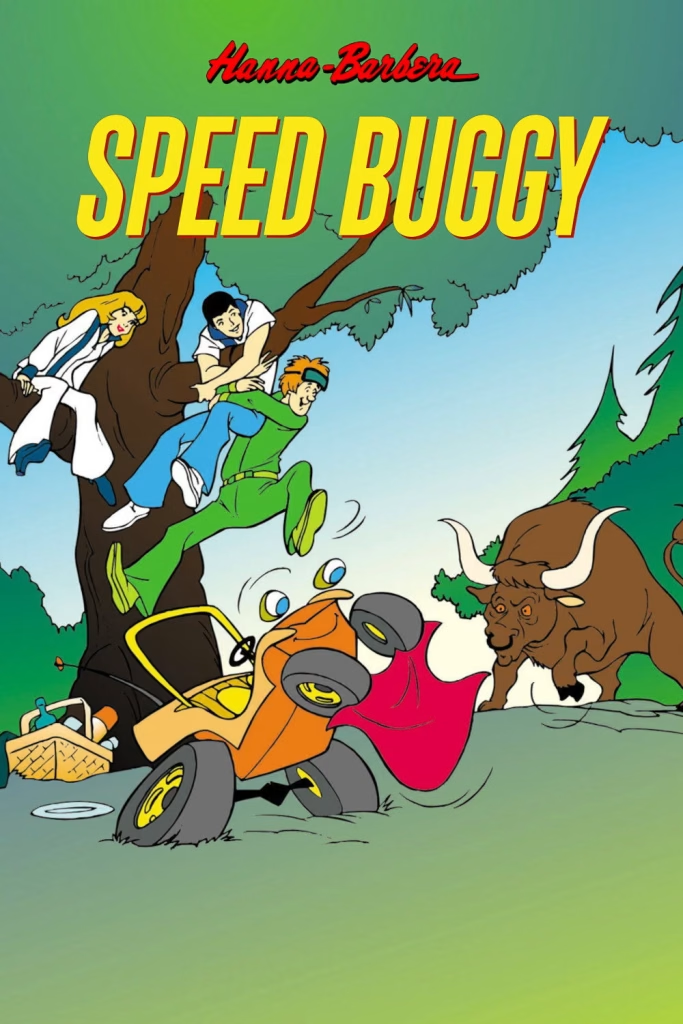
One of the traps in writing about Saturday Fun Machine is the temptation to produce a definitive list, as though RPN-9 ran the same exact sequence for a decade. It did not. Viewer recollections differ, schedules changed, programmes came and went, and some of the titles people strongly associate with the block probably belonged to different phases of it. That is why memories also include shows such as The Great Space Coaster, The Fonz and the Happy Days Gang, Wacky Races, Speed Buggy, Casper and the Angels, ThunderCats and various other cartoons that drifted through Saturday television.
This is not a problem to solve so much as part of the subject. Childhood television was experienced serially but remembered collectively. We merge years together, move programmes from one channel to another, remember a theme song as belonging to an age rather than a date, and turn a changing schedule into something that feels permanent. The phrase Saturday Fun Machine becomes bigger than the programme grid because it describes a mood as much as a broadcast block.


American cartoons, Filipino memory
None of these programmes were made with Manila in mind. Space Ghost did not know Quezon City existed, Blackstar never had to cross EDSA, and the Hall of Justice was fortunate enough to operate somewhere with considerably less traffic. Yet the way we received these shows made them Filipino memories. They arrived through a local station, surrounded by local commercials, station IDs, news, variety shows and the ordinary domestic noise of households that were very far from the worlds depicted on screen.
That local framing mattered more than I understood at the time. Streaming now presents old programmes as isolated catalogue objects, neatly separated into seasons, episodes and franchises. Saturday Fun Machine placed unrelated things next to one another, and those neighbours became part of the memory. A 1960s cartoon could be followed by something from the early 1980s with no warning and no historical context, and children accepted the arrangement because the channel had made the decision for us.




The real special effect was having to wait
The strongest difference between then and now may simply be the seven days between encounters. If an episode stayed with me, it had time to expand in memory because I could not immediately watch six more. Scenes acquired a little distance. Villains seemed more important. Opening themes became lodged in the head because they were repeated weekly rather than skipped automatically after the first episode.
This is easy to romanticise, so I try not to. Scarcity was not inherently virtuous. Sometimes you simply missed the programme and that was the end of it. Yet scarcity did create anticipation almost by accident, and anticipation altered the value of the thing being anticipated. The next episode was not another item in a queue. It occupied a specific patch of future time.
The 1990s: cable loosens the clock
By the 1990s, Manila television was beginning to change the bargain. Cable expanded through Metro Manila and channels devoted heavily or entirely to cartoons altered the idea that animation belonged to a particular morning. Cartoon Network and other cable services meant that older Hanna-Barbera shows could return in a completely different context, while newer animated series arrived without having to fit inside the old free-to-air Saturday ritual.
For a child, this was plainly an improvement. Cartoons on a weekday afternoon would have sounded like unnecessary luxury a decade earlier. But the abundance also began to erode the special status of Saturday morning. Once there were many doors into the same kind of entertainment, no single door mattered quite as much.
Manila in the 1990s was never uniform about this. Some homes had cable early, some later, and some continued to rely mainly on free television. That unevenness meant the old and new habits overlapped for years. Appointment television did not suddenly disappear; it gradually lost its monopoly on our attention.
The 2000s: television becomes just another screen
The 2000s loosened things further. VCDs and DVDs made ownership normal, computers became increasingly central to home entertainment, downloaded files circulated, internet video improved, and television programmes could be watched with less and less regard for the broadcaster’s timetable. The screen was still there, but the broadcaster no longer controlled it completely.
That shift happened in such practical increments that it was easy to miss how profound it was. First you could buy a film cheaply on VCD. Then a DVD could hold extras, commentary and better picture quality. Then entire seasons became things you could own or copy, and eventually services remembered exactly where you had stopped watching. The old instruction to be in front of the television at a specific hour began to sound quaint rather than normal.
I do not miss everything about the old system. I like pause buttons. I like being able to find an episode I missed. I like not having to consult a newspaper television guide or hope a station reruns something six months later. What I miss is the way the schedule gave entertainment a place in time, because that place became part of the memory.
What still works, and what definitely does not
The strongest quality of Saturday Fun Machine was the programming itself. By putting radically different shows beside one another, RPN-9 created variety without asking viewers to curate it. Hanna-Barbera’s stripped-down superhero graphics could sit beside Filmation’s fantasy worlds and DePatie-Freleng’s looser comedy, and children absorbed those changes in visual language without needing to know anything about studios, art directors or production histories.
There was also the communal aspect. A scheduled broadcast meant that children could see the same episode on the same morning and talk about it afterwards. That sounds almost banal until you compare it with current viewing, where one person has finished a season before another has started it, and spoilers have become an administrative problem. Shared timing gave television a social life beyond the living room.
The weaknesses are much easier to see now. Limited animation could be extremely limited, stories often relied on rigid formulas, female characters were usually given a narrower range of roles than male ones, and cultural representation was sometimes broad enough to be uncomfortable. Some programmes were better ideas than actual shows, and nostalgia can make an opening sequence feel more sophisticated than the twenty minutes that followed it.
There is also nothing automatically noble about having fewer choices. A local broadcaster selecting imported American cartoons was still a gatekeeper deciding what children in the Philippines could see. The heavy presence of American animation in our childhoods was partly cultural influence and partly simple distribution economics. Remembering the pleasure of those mornings does not require pretending the system that produced them was perfect.
Why the ending never mattered as much as the return
Most of these programmes were built to reset. Captain Caveman solved another mystery, Space Ghost defeated another cosmic threat, the Super Friends restored order, and the Robonic Stooges somehow survived the damage they had inflicted on everything around them. Even Blackstar, which had the ingredients of a continuing fantasy epic, simply ended after thirteen episodes without resolving its central conflict in the way modern serial television would probably demand.
That is probably why I remember openings, logos, theme music and transformation sequences more clearly than endings. Saturday-morning television was designed around return rather than conclusion. The meaningful promise was not that the whole story would eventually be tied up. It was that next Saturday, the television would open the door again.
Before “watch anytime”, there was “don’t miss it”
Watching these cartoons now produces an odd double exposure. I can see the programme as it actually is: held frames, reused backgrounds, broad performances, improbable plots and all. At the same time, I can still see the version preserved by memory, which includes the room around the television, the particular quality of morning light, the sounds coming from elsewhere in the house and the knowledge that the programme would disappear when the schedule moved on.
That second version is the one no streaming service can restore. A platform can remaster the image, organise the episodes and preserve the soundtrack, but it cannot recreate the conditions under which I first watched them. It cannot give me a Saturday morning in Manila when the number of channels was small, the day felt long, and missing the opening credits carried actual consequences.
I would not trade today’s access for the old inconvenience. The modern arrangement is better in almost every practical sense, and there is no reason to pretend otherwise. Still, when I think about Super Friends, Space Ghost, Blackstar, Captain Caveman, The Robonic Stooges and The Super 6, I do not first imagine a streaming menu. I imagine a Saturday that had already started, a television that was not going to wait for me, and the small urgency of getting there before I missed something.
Leave a Reply