
There was a time when Black Mirror still felt like something you had to discover in the shadows. Not obscure, exactly. It was never a show made in a basement by three people and a kettle. Charlie Brooker already had his following. Channel 4 had given it a proper platform. People were talking about it in that slightly conspiratorial way people used to talk about good British television before streaming flattened everything into a thumbnail grid. But it was not yet the giant Netflix object it would later become. It had not yet been absorbed into the global content bloodstream, sitting there beside true crime documentaries, prestige dramas, algorithm-approved teenage murder mysteries, and whatever film Netflix insists is “Number 1 in Singapore Today” because three people watched it while ironing.
I remember hearing about Black Mirror first by word of mouth, or maybe reading about it online in that half-lit, late-night way one used to discover things before recommendation engines became overeager estate agents for your attention. Someone mentioned it. Someone said it was like The Twilight Zone, but nastier. Someone said the first episode was impossible to unsee. That was enough.
I somehow found my way to the first two seasons before it moved to Netflix, and that mattered. Not because watching something early makes one morally superior, although I will admit there is a small, unpleasant gremlin in all of us that enjoys saying, “I liked it before it became popular.” But because those first Channel 4 episodes felt different when they were still slightly out of reach. They felt like transmissions from a Britain that had looked at the future, checked the wiring, and decided the whole building was probably going to burn down because someone in marketing had installed mood lighting and forgot about the exits.
I had already seen Brooker’s zombie drama miniseries Dead Set by then, and that probably helped. Dead Set took the Big Brother house, that artificial aquarium of fame-hunger and casual cruelty, and dropped a zombie outbreak around it. The joke was not just that the contestants did not know the world was ending. The joke was that, on some level, they had already been living inside a miniature apocalypse of cameras, vanity, performance, and manipulation. The undead were almost a mercy. At least they were honest about what they wanted.
So when Black Mirror came along, I was already inclined to trust Brooker’s instincts. He understood screens. More importantly, he understood what screens do to people when people are already a bit broken.
A Twilight Zone for the touchscreen age
The Twilight Zone comparison has always followed Black Mirror, and it is fair enough. Rod Serling’s anthology used fantasy, science fiction, horror, and moral irony to smuggle contemporary anxieties into American living rooms. It could talk about conformity, paranoia, prejudice, war, fear, and the cruelty of ordinary people by dressing them up as aliens, time loops, dolls, machines, and cosmic punishments.
Black Mirror does something similar, but its monsters rarely arrive from outer space. They come from app stores, newsrooms, design meetings, entertainment formats, dating systems, memory devices, surveillance tools, streaming platforms, political campaigns, and the quiet little compromises we make because the interface is smooth and the terms and conditions are boring.
This is one of the reasons the show felt sharper than a simple “technology is evil” argument. That would have been too easy, and also too boring. Technology in Black Mirror is usually not the villain by itself. It is the accelerant. The human problem is already there. The gadget just removes the friction.
Jealousy exists before the memory grain in The Entire History of You. Grief exists before the artificial resurrection service in Be Right Back. Public sadism exists before the punishment park in White Bear. Class exploitation exists before the exercise bikes and talent show economy in Fifteen Million Merits. Narcissism exists before the social rating system in Nosedive. The tech merely gives these impulses a dashboard, a subscription model, and a glowing progress bar.
That is what makes the show work at its best. It does not say, “Here is a device, and the device is bad.” It says, “Here is a device built by people, sold by people, used by people, and justified by people. Now watch what happens when everyone behaves more or less as expected.” Which is much worse.
The Channel 4 years: small, sour, and dangerous
The first two seasons of Black Mirror are still the ones I think of as the purest form of the show. That does not mean every later episode is lesser. Some of the Netflix-era episodes are extraordinary. But those early Channel 4 stories had a sour concentration to them. Three episodes per season. No sprawl. No sense that a global audience had to be served. No immediate need to balance the menu with something hopeful, something American, something meme-ready, something expensive-looking enough to justify the spend.
The early episodes felt like short, nasty films made by people who did not particularly care if you liked them afterwards.
The first episode, The National Anthem, remains one of the most hostile opening statements any series has made. It is not the most visually futuristic episode. It is barely science fiction at all. Its horror is almost entirely social and mediated. A prime minister is forced into a grotesque public dilemma after a member of the Royal Family is abducted, and the entire country becomes a live audience, moral tribunal, rumour mill, and baying crowd.
The episode is ugly by design. It understands the narcotic pull of collective outrage. It understands how quickly disgust becomes participation. It understands that people will claim to be horrified while also refreshing the feed.

What stays with me is not the central demand, which has always dominated the discussion because of course it has. What stays with me is the audience. The pubs. The living rooms. The offices. The commentators trying to keep their faces arranged into concern while ratings, gossip, and national hysteria gather around them like flies.
It was an episode about public appetite. The technology was already familiar: television, social media, mobile phones, news cycles. Nothing magical had to be invented. It was all there. We were all there. And that, really, was the warning.
Fifteen Million Merits and the prison of content
If The National Anthem was about public spectacle, Fifteen Million Merits was about being trapped inside the machine that produces it.
Daniel Kaluuya’s Bing lives in a sealed world of screens, exercise bikes, points, avatars, talent shows, forced advertising, and synthetic aspiration. Everyone pedals. Everyone earns. Everyone watches. Everyone is sold the idea of escape, but escape itself has been packaged as entertainment. You can work, consume, perform, or be humiliated. Those are the options.

The episode looked futuristic at the time, all luminous walls and gamified labour, but its emotional architecture was already familiar. It was office life, influencer culture, gig work, reality television, freemium apps, social media metrics, and karaoke-night capitalism boiled into one glowing cell.
Bing’s relationship with Abi, played by Jessica Brown Findlay, gives the episode its human bruise. She has a voice. He sees something unspoilt in her, or thinks he does. He spends his saved merits to give her a chance at the talent show, and the machinery does what machinery does. It absorbs her. It repackages her. It gives her a version of success that looks suspiciously like surrender.

Bing’s later act of rebellion is one of the show’s cruelest turns because it becomes content too. His rage is monetised. His disgust becomes a weekly slot. The system does not defeat him by silencing him. It defeats him by broadcasting him. That is a very Brooker kind of hell. Not censorship. Format development.
I watched that episode and felt the same uncomfortable recognition I felt with Dead Set. The satire was exaggerated, yes, but not by much. That was the trick. The world in Fifteen Million Merits looked absurd, but the emotional logic was already sitting in the room with us, quietly asking us to like, subscribe, rate, unlock, continue, skip ad, upgrade, and try again.
The Entire History of You: memory as evidence, memory as poison
Then came The Entire History of You, written by Jesse Armstrong, and in some ways it remains one of the most elegant Black Mirror premises: what if people could record and replay everything they saw?
It is such a clean idea that it almost feels inevitable. The “grain” implant turns memory into footage. Arguments can be reviewed. Gestures can be analysed. Lies can be challenged. Desire can be replayed. Humiliation can be preserved in high definition.
The central character, Liam, played by Toby Kebbell, becomes consumed by suspicion about his wife Ffion, played by Jodie Whittaker, and her history with another man. The device does not create his insecurity. It feeds it. It gives jealousy an editing suite.

This episode has always struck me as one of the show’s most quietly devastating because it understands that proof does not always set anyone free. Sometimes proof only gives obsession better tools. Anyone who has ever reread a message, zoomed into a photograph, replayed a conversation, checked a timestamp, or tried to extract certainty from the ambiguous sludge of human behaviour will understand Liam’s spiral. The grain is fictional. The impulse is not.
The final images are intimate and ruined. Not because the technology has crashed or exploded, but because a relationship has been converted into evidence. Love cannot survive if everything becomes admissible.
Season two: grief, punishment, and the cartoon bear
The second season widened the emotional range without softening the show. Be Right Back may be one of the most important episodes now, especially in an era when artificial intelligence has become less science fiction and more awkward dinner conversation. Martha, played by Hayley Atwell, loses her partner Ash, played by Domhnall Gleeson, and turns to a service that recreates him from his online traces. At first it is text. Then voice. Then body.

The episode is not simply about AI. It is about grief bargaining with simulation. It asks whether the dead we miss are the people themselves or the patterns they left behind. Their messages. Their jokes. Their photographs. Their little verbal tics. Their digital exhaust.
What makes the episode painful is that the artificial Ash is both impressive and insufficient. He resembles Ash, but resemblance is not presence. He can respond, but he cannot truly continue. He is the shape of a person without the irretrievable weight of one. Martha gets what she asked for, and that is exactly the problem.
White Bear, meanwhile, is one of the show’s nastiest constructions. It begins as apparent survival horror, with Victoria waking into a world where people silently film her suffering. Then it reveals itself as something else entirely: punishment as public entertainment, justice as ritual, trauma as a daily theme park.
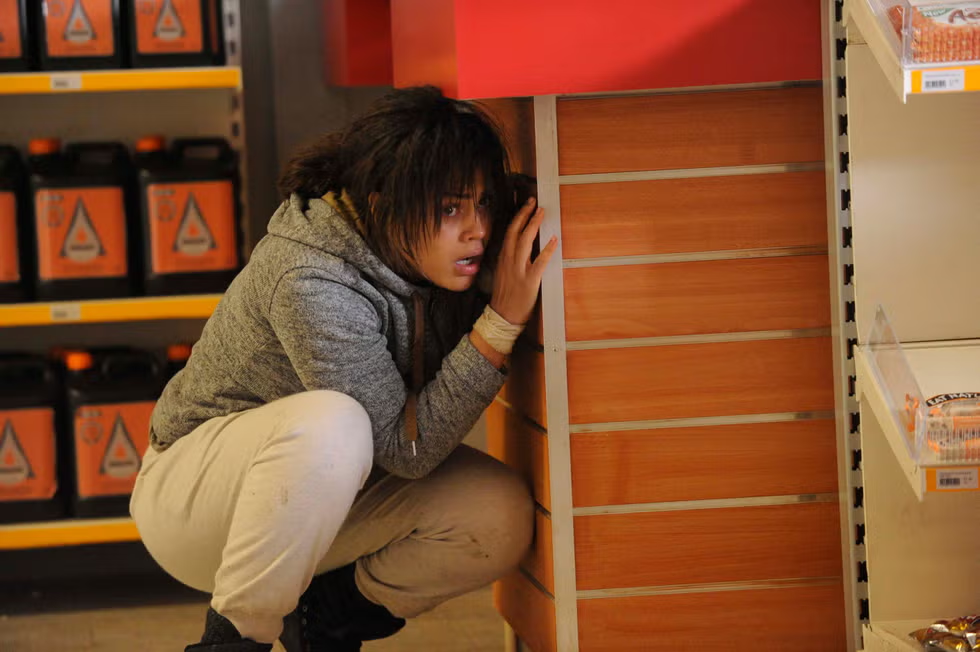
The episode is effective because it forces the viewer to examine how quickly sympathy can be withdrawn once context changes. It also understands a particularly modern appetite: the desire not only to punish, but to watch punishment, document it, and feel righteous while doing so.

Then there is The Waldo Moment, an episode that did not land for everyone when it first aired, but has aged with a grim little smirk. A vulgar cartoon bear becomes a political force because people are tired of politicians, tired of polish, tired of language that sounds rehearsed by committee. Waldo offers mockery without responsibility. He is not a programme. He is a mood.
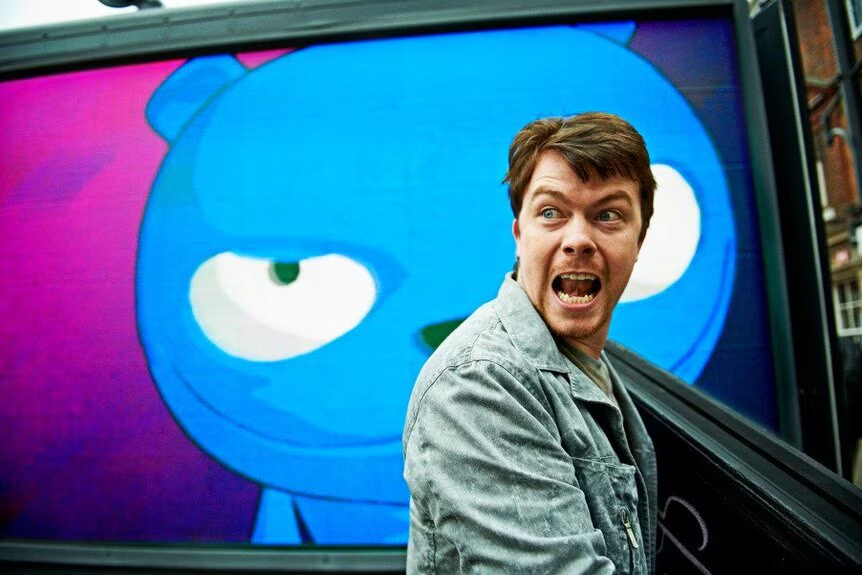
At the time, it may have seemed like one of the weaker episodes. Now it feels like Brooker accidentally left a door open and something crawled through.
White Christmas and the horror of consciousness as software
The 2014 special White Christmas feels like the bridge between the Channel 4 era and the more expansive Netflix years. It has Jon Hamm, Rafe Spall, multiple nested stories, and some of the show’s most disturbing ideas about digital consciousness.
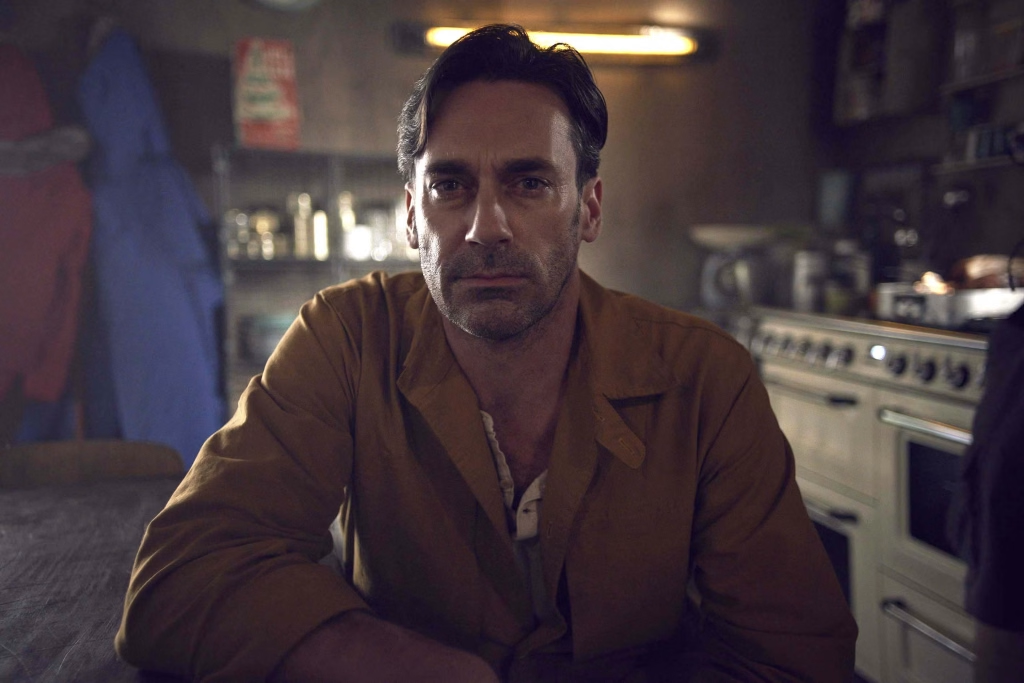
The “cookie” concept is especially horrible: a copied consciousness trapped inside a device, forced into servitude, punished by manipulated time. It is one of those Black Mirror ideas that sounds absurd for about five seconds before you realise how neatly it fits into the show’s ongoing obsession with personhood. What counts as a person? A body? A memory? A continuous self? A copy that feels pain? A simulation that begs?

The blocking technology in the episode, where one person can be rendered into a greyed-out presence in another’s perception, is also one of the show’s cleanest visual metaphors for social exile. It takes the emotional cruelty of cutting someone off and turns it into interface design.
White Christmas also confirmed something important about Black Mirror: it was not just about gadgets. It was about systems of control. Domestic control. Social control. Legal control. Commercial control. Self-control failing under pressure.
It is the sort of Christmas special one watches and then decides maybe a festive sitcom repeat would have been healthier. But there we are. Some of us were built wrong.
The move to Netflix: bigger rooms, brighter screens
When Black Mirror moved to Netflix, something changed. It had to. Scale changes texture.
The budgets grew. The casts became more internationally recognisable. The episodes varied more wildly in tone and genre. The show travelled outside Britain more often. It became less like a set of grim Channel 4 transmissions and more like a global anthology brand.
Some viewers never forgave that shift. I understand the complaint, even if I do not fully share it. There is a particular pleasure in the early British unpleasantness, that underheated-room feeling, that sense of a story made with limited resources and maximum contempt for human dignity. The Netflix era sometimes looked too polished to be as grubby as the subject demanded.
But it also gave us Nosedive, San Junipero, Shut Up and Dance, Hated in the Nation, USS Callister, Hang the DJ, Black Museum, Bandersnatch, Joan Is Awful, Loch Henry, Common People, and Eulogy. That is not a decline. That is a complicated second life.
The show became uneven, yes. Anthologies are almost always uneven. That is part of the bargain. Every episode is a new machine, and some machines hum better than others. The better question is not whether every Netflix episode matched the early Channel 4 run. The better question is whether Black Mirror remained capable of making the world feel freshly suspect. Often, it did.

Nosedive and the tyranny of the pleasant face
Nosedive is one of the most accessible Netflix-era episodes, and perhaps one of the most visually memorable. Bryce Dallas Howard plays Lacie, a woman living in a society where every interaction is rated. Politeness becomes currency. Smiles become labour. Social status becomes visible, measurable, and brutally consequential.

The pastel palette is important. Nosedive does not look like a dungeon. It looks like a lifestyle brand. Everyone is bright, clean, arranged, and dead behind the eyes. It is dystopia as wedding stationery.
Lacie is not a villain. She is needy, insecure, ambitious, and trained by her society to turn every human exchange into reputation management. Her downfall is comic, painful, and weirdly liberating. By the end, when she is finally stripped of the performance, there is something almost cleansing about watching her insult someone honestly.

The episode works because it is not really about a future social rating system. It is about the present tense of being perceived. Anyone who has posted, edited, deleted, reposted, checked the likes, wondered why that person saw but did not respond, or performed cheerfulness for professional reasons knows the emotional weather of Nosedive.
It is not subtle, but subtlety is overrated when everyone is already smiling through a hostage situation.
San Junipero: the mercy glitch
Then San Junipero arrived and did something almost scandalous for Black Mirror: it offered grace.
Yorkie and Kelly, played by Mackenzie Davis and Gugu Mbatha-Raw, meet in a simulated seaside town where the dead and dying can experience youth, pleasure, music, romance, and freedom. It is an episode full of 1980s and 1990s textures: arcade lights, club music, beach-town neon, cassette-era longing. For a blog like Mixtape for the Apocalypse, it almost feels illegally targeted. Nostalgia here is not just decoration. It is architecture. Memory becomes a place you can visit, abuse, avoid, or finally inhabit.
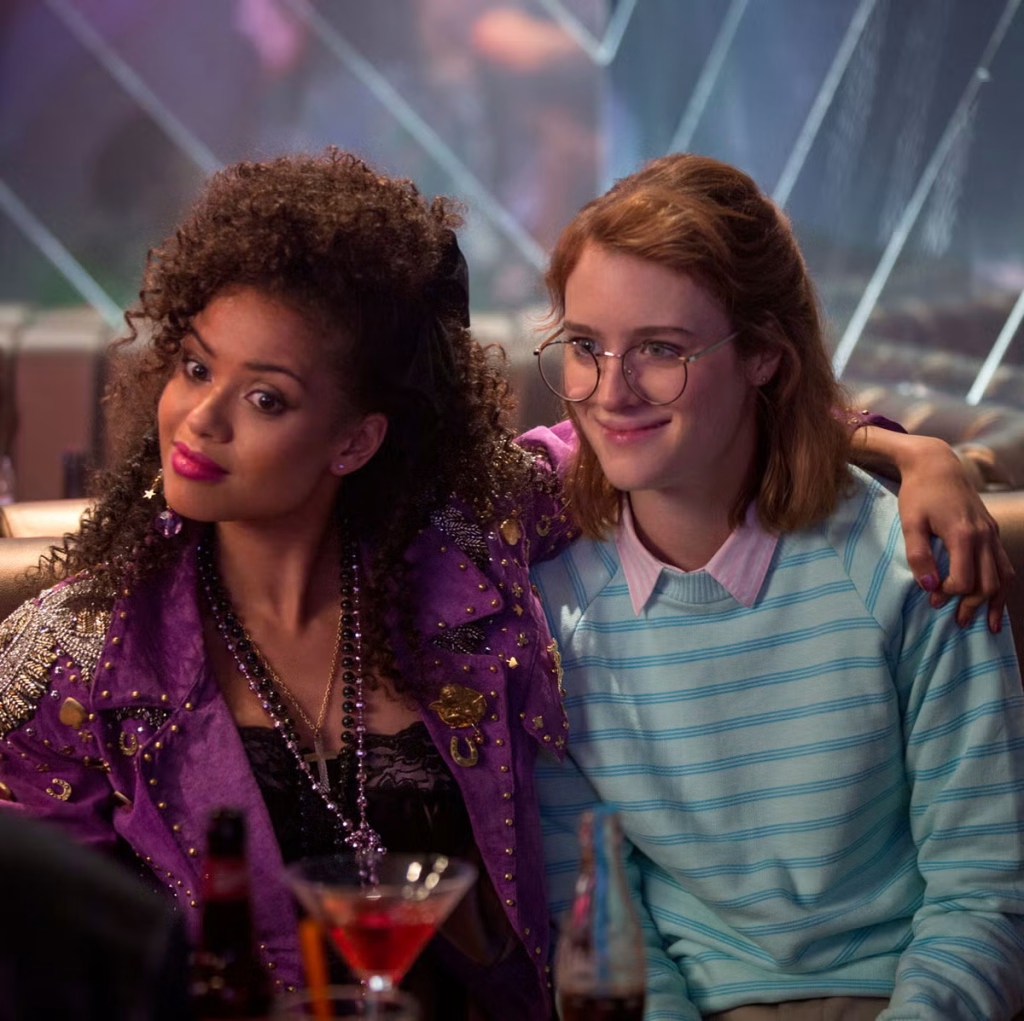

But San Junipero is not sentimental in the cheap sense. Its central question is serious: if consciousness can continue in a simulated afterlife, is that salvation, denial, or just another product? Kelly resists it because she has loved, lost, aged, and buried. Yorkie reaches for it because her life was interrupted before it could properly begin.
The episode chooses tenderness without abandoning unease. That is why it stands out. It proves that Black Mirror does not need despair to be recognisable. Its real subject is not misery. Its subject is consequence. Sometimes consequence can include mercy.
I think San Junipero also changed the way people understood the show. It made room for the ballad among the punk singles. It allowed the anthology to breathe. After all, dread becomes monotonous if it never lets in light. Even a bunker needs a small window, otherwise everyone inside starts reviewing their own doom on a five-star scale.
Shut Up and Dance, Men Against Fire, and Hated in the Nation
Some Black Mirror episodes operate like traps. Shut Up and Dance may be the most brutal example. A teenage boy is blackmailed after his laptop camera is compromised, then forced through a series of escalating tasks. The episode weaponises our fear of exposure. It also weaponises our sympathy, then asks what we do when sympathy becomes complicated.

This is one of the show’s darker moral manoeuvres. It does not let the viewer sit comfortably outside the machinery. It makes us complicit in expectation, judgement, and reversal.
Men Against Fire tackles war through perception. Soldiers are made to see enemies as monstrous “roaches”, allowing violence to be reframed as extermination. It is not the most beloved episode, but its central metaphor is old and durable: atrocities are easier when the target has first been edited out of humanity.

Hated in the Nation expands the scale to online mob justice and technological vulnerability. It is part detective story, part ecological tech nightmare, part study of how casually people join public hatred when the cost feels abstract. The episode’s mechanical bees are memorable, but the real swarm is social.

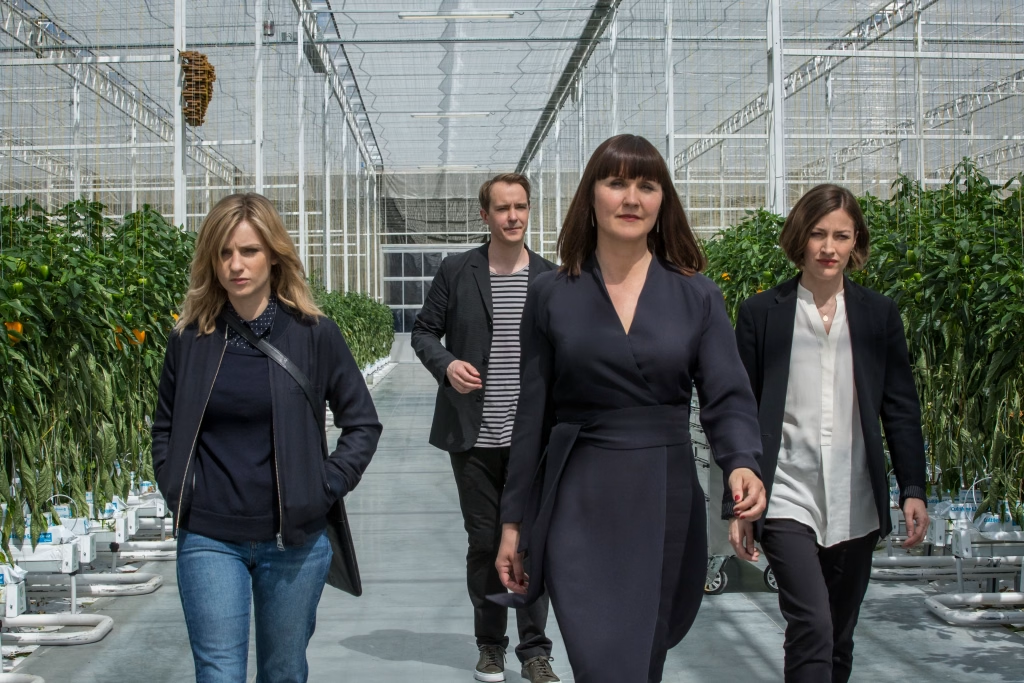
These episodes underline something the show returns to again and again: people are very good at outsourcing cruelty. To institutions. To screens. To mobs. To soldiers. To software. To plausible deniability.
USS Callister and the fake captain
USS Callister is one of the cleverest things Black Mirror has done with pop culture memory. On the surface, it parodies old-school space adventure: bright uniforms, heroic poses, retro command-deck theatrics. Beneath that is a story about entitlement, resentment, workplace power, and digital imprisonment.

Jesse Plemons plays Robert Daly, a gifted but bitter programmer who creates sentient digital copies of his co-workers and traps them inside his private game world, where he can play adored captain and petty god. Cristin Milioti’s Nanette Cole becomes the episode’s moral centre and eventual rebel leader.
The episode works because it understands a certain kind of wounded male fantasy: the desire to retreat into a world where everyone finally recognises your genius, obeys your rules, and cannot leave. It is not really attacking fandom or old science fiction. It is attacking domination disguised as escapism.
Nanette’s resistance gives the episode its charge. She refuses to accept the terms of Daly’s universe. Like many great Black Mirror characters, she is trapped inside someone else’s system and has to learn its rules well enough to break them.
The later sequel, USS Callister: Into Infinity, is notable because Black Mirror has usually resisted direct sequels. The return suggests that some of its worlds have become too rich, or too commercially resonant, to leave behind. That is not necessarily a bad thing. But it does slightly alter the anthology’s old contract. The early show felt like it would visit a nightmare, shut the door, and leave you there. The newer show occasionally checks whether the nightmare has franchise potential. There is a joke in there somewhere. Possibly on all of us.

Bandersnatch and the illusion of choice
Bandersnatch was both a Black Mirror story and a Netflix technology demonstration, which made it conceptually perfect and slightly exhausting. An interactive film about choice, control, programming, mental collapse, and branching narrative, released on the world’s most powerful streaming platform, asking viewers to choose cereal and then question free will. You could almost hear Brooker laughing into a pillow.

The story follows Stefan Butler, a young game developer adapting a choose-your-own-adventure book into a video game. His world fractures as the viewer’s choices interfere with his life. The format is not a gimmick pasted onto the story; the format is the story. Stefan is trapped inside a system of decisions that may not belong to him. The viewer becomes participant, controller, accomplice, and bored god clicking through options.
What I appreciated about Bandersnatch was less the novelty than the irritation. It made viewing less passive but not necessarily more free. Choice became labour. Curiosity became repetition. Completion became a kind of madness. In that sense, it understood games, streaming, and obsessive media consumption rather well.
It also made Netflix itself feel like part of the horror. Not as a villain, exactly. More like the house the haunting was built into.
Later seasons: when the mirror started reflecting the mirror
The later years of Black Mirror have been more divisive, partly because reality became harder to outpace. In the early 2010s, the show could still feel like a warning from tomorrow. By the 2020s, tomorrow had stopped knocking and started rearranging the furniture.
AI, deepfakes, algorithmic recommendation, platform capitalism, online shaming, subscription everything, digital grief, surveillance culture, parasocial celebrity, and personalised advertising all became less speculative. Black Mirror had to compete with the headlines, which is a miserable assignment for any writer. Imagine trying to satirise a world already committed to self-parody.
Season 6’s Joan Is Awful leaned into this by turning a woman’s life into streaming content generated and performed through layers of automation and celebrity likeness. It was broad, funny, and not exactly subtle, but the target was obvious: platforms turning private life into content while insisting the user agreed because somewhere, somehow, a box had been ticked.

Loch Henry was more grounded and, for me, more interesting: a true-crime story about memory, exploitation, and the transformation of local trauma into prestige content. It is one of the later episodes that proves Black Mirror does not need futuristic tech to be itself. The black mirror can simply be a camera pointed at suffering and edited into bingeable shape.

Season 7, meanwhile, seemed to understand that the show had to return to emotional consequence. Common People, with Rashida Jones and Chris O’Dowd, goes straight at subscription-based survival, medical technology, and the horror of having one’s own body and consciousness mediated by corporate tiers. Eulogy, with Paul Giamatti, uses memory technology for something quieter and sadder: regret, grief, and the photographs we avoid because they still know where the bodies are buried.

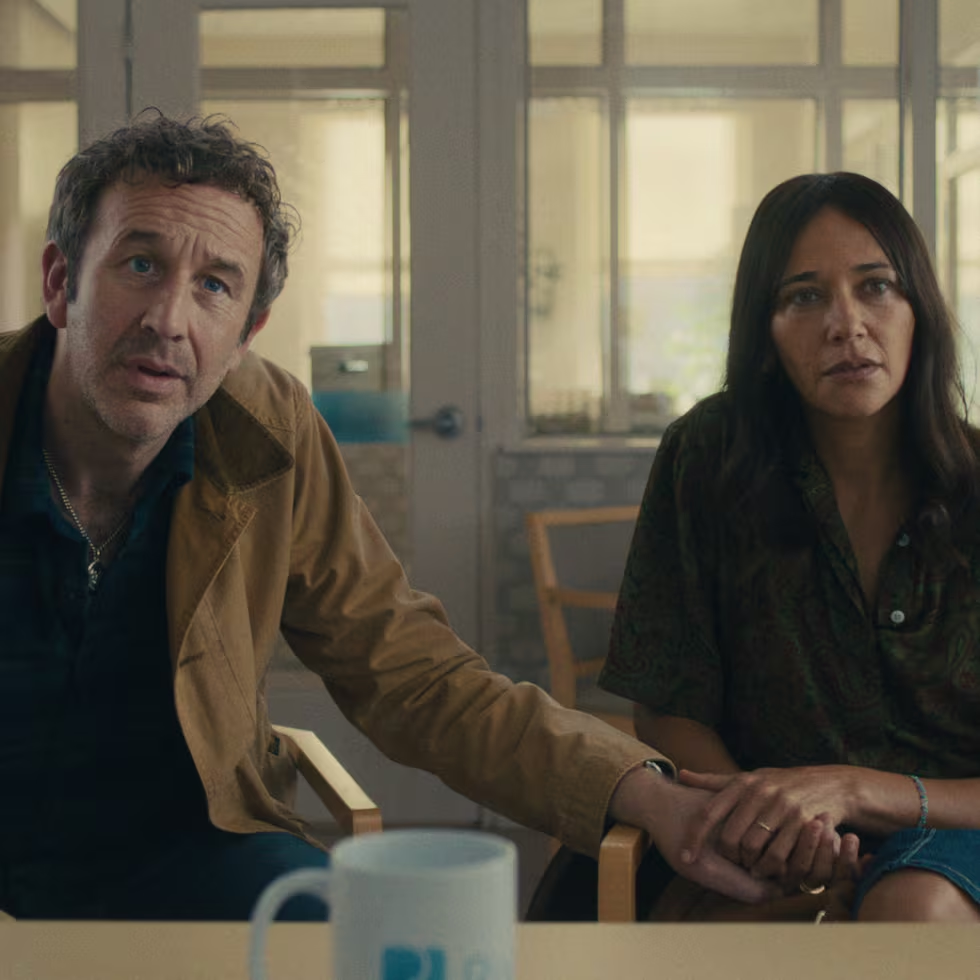
Those later episodes reminded me that the best Black Mirror stories are rarely about prediction. They are about pressure. Put a person under enough pressure, give them a beautiful interface, remove one ethical guardrail, and see what they are willing to call normal.

And the series is not finished. In January 2026, Brooker confirmed to Netflix that Black Mirror will return. That feels oddly appropriate. The show has spent years racing reality; now reality has become the troublesome co-writer it never asked for.


The “main characters” of a show that has none
Because Black Mirror is an anthology, it does not have main characters in the usual sense. No crew to return to. No family house. No precinct. No starship bridge, unless you count the fake one inside USS Callister, which is very much not a healthy workplace environment.
But the show does have recurring human types. There is the public figure trapped by spectacle: Michael Callow in The National Anthem, trying to survive a crisis that has already escaped government and entered the bloodstream of public entertainment.
There is the worker trapped by system: Bing in Fifteen Million Merits, pedalling inside a world where rebellion can be reformatted as content.
There is the jealous or grieving lover trapped by technology that promises certainty or return: Liam in The Entire History of You, Martha in Be Right Back, Phillip in Eulogy. These characters are not foolish because they use the device. They are recognisable because they use it for something painfully human: proof, comfort, apology, another chance.
There is the punished person whose punishment becomes theatre: Victoria in White Bear, Stefan in Bandersnatch, the digital crew in USS Callister. Their suffering is structured, observed, repeated, and justified by someone else’s rules.

There is the performer shaped by social approval: Abi in Fifteen Million Merits, Lacie in Nosedive, Joan in Joan Is Awful. These characters live in societies where being seen is not incidental. It is the economy.
There are the rebels who refuse the frame: Nanette in USS Callister, Yorkie and Kelly in San Junipero, Nish in Black Museum, and several others who discover that the only way to survive the system is to recognise it as a system.
And then there are the Brooker men: bitter, clever, wounded, isolated, often dangerous in their self-pity. Daly in USS Callister. Jamie in The Waldo Moment. Various hackers, shut-ins, failed creators, and resentful operators across the series. Brooker seems particularly alert to the damage caused by men who confuse humiliation with moral licence.
In that sense, Black Mirror does have a recurring cast. Not actors, but flaws.
The design of plausible nightmares
As a designer, I cannot watch Black Mirror without noticing how much of its power comes from design. Not just production design in the obvious sense, though there is plenty of that. I mean interface design, behavioural design, environmental design, and the design of social rituals.
The best Black Mirror technology looks usable. That is the horrible part. The grain interface in The Entire History of You feels clean and inevitable. The rating system in Nosedive looks frictionless. The walls in Fifteen Million Merits are bright enough to be seductive before they become oppressive. The digital afterlife of San Junipero has the emotional logic of a remembered music video. The streaming nightmare of Joan Is Awful works because the platform does not look alien. It looks like something we might already have accepted during a free trial.
Bad fictional technology often announces itself too loudly. Holograms everywhere. Blue light for no reason. Interfaces designed by people who have never met a tired user. Black Mirror is usually smarter than that. It knows that the most dangerous products do not arrive looking dangerous. They arrive convenient. Convenience is the softest door into hell.
That may be why the show lodges in the mind. It does not ask us to imagine a future of chrome skulls and laser prisons. It asks us to imagine a slightly more aggressive version of something already in our hand.
It was never only about technology
The common shorthand for Black Mirror is that it is a show about technology. Fair enough, but incomplete.
It is about media. It is about class. It is about shame. It is about grief. It is about loneliness. It is about performance. It is about work. It is about entertainment as punishment and punishment as entertainment. It is about systems that convert human need into revenue. It is about people who mistake visibility for intimacy, choice for freedom, data for truth, and simulation for repair.
That is why Brooker’s earlier work matters. Dead Set was already a prototype in spirit. It took reality television and treated it not as harmless trash but as a machine that feeds on attention. Black Mirror widened that machine until it included almost everything: politics, romance, memory, justice, death, nostalgia, labour, celebrity, war, and even heaven.
The show can be cynical, certainly. Sometimes too cynical. Sometimes it mistakes bleakness for depth, and sometimes its twist endings land with the subtlety of a filing cabinet dropped down a stairwell. But beneath the cynicism, there is often a strange moral seriousness. The show is angry because it still expects people to be better than this. That is not nihilism. That is disappointed humanism wearing a black coat.
A true nihilist would not bother designing such elaborate punishments for our failures. Brooker bothers.
Watching it now
Rewatching or remembering Black Mirror now is different from discovering it before Netflix. Back then, it felt like a set of warnings. Now it feels more like a scrapbook of anxieties we failed to outgrow.
Some episodes have dated in their surfaces, as all speculative fiction eventually does. Some once-shocking ideas have become mundane. Some newer episodes strain to keep up with a world that has become almost aggressively stupid in ways satire struggles to improve upon. But the central unease remains. The switched-off screen still looks back.
That title remains one of the great television titles because it is so simple. A black mirror is every dormant screen in the room. Phone. Laptop. Television. Tablet. Watch. The glossy rectangle that reflects your face when the content stops. The thing you stare into, waiting for it to tell you what to want, who to hate, what to buy, what you missed, whether anyone noticed you, whether the world has ended yet.
The genius of Black Mirror is that the screen is not only a window. It is also a mirror. We keep expecting it to show us the future, but it keeps showing us ourselves, with worse lighting.
Why it still matters
I do not love every episode of Black Mirror. I do not think anyone honestly does, unless they are trapped in a rating-based society and afraid of losing access to decent housing. Part of the appeal of an anthology is arguing with it. Ranking it. Revisiting the ones that hurt. Avoiding the ones that feel too close. Defending the oddball entries. Pretending you are above lists while absolutely having a list.
But as a body of work, it remains one of the most important genre series of the last decade and a half. It revived the moral anthology for the digital era. It made speculative fiction feel immediate again. It gave television permission to be nasty, elegant, funny, emotionally bruising, and formally restless in one package. It also understood something many technology stories miss: the future does not arrive as a spaceship. It arrives as a feature update.
For me, the show belongs in the same mental attic as the things that shaped my appetite for uneasy fiction: late-night reruns, dystopian paperbacks, zombie films, analogue sci-fi, public-service paranoia, and those weird bits of television you saw once as a child and then spent years wondering whether you imagined. Black Mirror feels modern, but its roots are old. Campfire stories. Ghost stories. Morality plays. Urban legends. The cautionary tale told by someone who has seen enough human behaviour to know the caution will probably be ignored.
That is the bleak joke. The show warns us, and we nod thoughtfully, then immediately check our phones.
The episode that never ends
The phrase “this feels like a Black Mirror episode” has become overused, usually applied to anything vaguely technological, dystopian, or annoying. A robot dog. A creepy advert. A politician saying something that sounds generated by a malfunctioning chatbot. A subscription fee for something that used to be a button.
But the phrase persists because the show gave us a useful language. It named a feeling: the moment when modern life becomes too absurd, too mediated, too cruelly designed, and yet still completely believable. That is the achievement. Not prediction. Recognition.
Black Mirror did not foresee everything. It did not need to. It simply understood that people, when given tools of immense power and convenience, would continue being vain, frightened, lonely, horny, greedy, grieving, bored, tribal, sentimental, punitive, and desperate to be seen. The machines changed. The wiring inside us did not.
I became a fan before the Netflix move, back when the show still felt like something whispered about by people who had stumbled out of a dark room and wanted to ruin your evening in the most thoughtful way possible. I stayed a fan because, even when uneven, it kept finding new ways to ask the same uncomfortable question: What part of ourselves did we just automate?
Not every episode answers well. Some overreach. Some repeat old tricks. Some feel like clever premises in search of a pulse. But the best ones still leave a mark. The Entire History of You makes memory feel unsafe. Be Right Back makes grief feel programmable and therefore even sadder. Fifteen Million Merits makes entertainment feel like a labour camp with better graphics. White Bear makes justice look like sadism with a ticket booth. Nosedive makes politeness curdle. San Junipero finds love inside the machine without pretending the machine is innocent. USS Callister turns nostalgia into a prison and then lets someone break the lock. Bandersnatch makes choice feel less like freedom than another form of control. Common People looks at survival and asks who gets to own the terms. That is more than enough for one anthology to have done.
The future caught up with Black Mirror in some ways. In others, the show caught up with the past: our old fears of being watched, judged, erased, replaced, exposed, trapped, commodified, and forgotten. The screens got thinner. The anxieties did not.
And when the episode ends, when the credits roll and the room goes quiet, there it is again. The black screen. Your face in it. Still watching.
Affiliate Disclosure: This post contains affiliate links. If you click through and make a purchase, I may earn a small commission—at no additional cost to you. I only recommend products I personally find useful or relevant. Thank you for your support.
Leave a Reply