
I started Posthouse at about eight in the morning with a fresh cup of coffee beside me, which in retrospect may have been the wrong setting for a film built around dim rooms, old machinery and stretches of silence that seem determined to slow your pulse rather than spike it. By the time I finally finished it at around 3:30 in the afternoon — after stopping, wandering away, coming back and rewinding the bits I had managed to doze through — the coffee was long cold and the film had somehow occupied most of my Friday.
That sounds like a complaint, and partly it is. Posthouse can be slow enough to make you wonder whether the film itself has stalled in the projector. But there is something fitting about having to go back over it, because Nikolas Red’s feature directorial debut is obsessed with that very act: looking again, reassembling fragments, deciding what a piece of film means after the people who made it are gone. Once I had finished it properly, the bits that had initially felt inert started to sit differently in my head. The quiet had done more work than I first gave it credit for.
An Editor Walks Back Into the Past
The story centres on Cyril, played by Sid Lucero, a film editor carrying around more family damage than he is willing to admit. After the death of his estranged father, he inherits an old post-production facility and becomes involved in restoring Ang Manananggal, an incomplete silent horror film tied to his family history. His daughter Rea, played by Bea Binene, is an aspiring filmmaker and becomes part of the restoration. Before long, reels disappear, old images begin to behave as though they have intentions of their own, and the creature contained in the film becomes less interested in staying inside it.
The set-up is simple enough to explain, but the film is more interested in what editing does to memory than in using the cursed-film idea as a straight supernatural mechanism. Cyril is not merely trying to reconstruct a movie. He is reconstructing his father, his mother, his childhood and his own understanding of why his family fractured. Every piece of recovered footage offers the promise of an answer, while also making the past more dangerous. It is a familiar horror bargain — knowledge for safety — dressed in film cans, splicing tape and old machinery.

One of the film’s central ideas arrives through the Kuleshov effect: place one image next to another and the audience begins creating meaning in the gap. Posthouse turns that lesson into a family problem. Cyril keeps trying to arrange the shots of his own past until they produce the version of events he can live with, but memory is a notoriously uncooperative editor. The more material he uncovers, the less stable the sequence becomes.
This is where Red’s background becomes more than trivia. Before directing this film, he was known principally as an editor and writer, with credits including Eerie, Deleter and Dead Kids. He has said that the original idea came from working alone at night in an editing room and being unsettled by something he noticed in raw footage. That origin is all over the finished film. The cutting room is not merely where the haunting happens; it is the film’s nervous system, full of machines that stop, loop and replay until repetition itself becomes threatening.


Sid Lucero and the Slow Collapse of Cyril
Lucero is the reason the film’s quieter passages remain watchable even when the pace starts testing my patience. Cyril begins as a tired man rather than an obviously unstable one, which gives Lucero somewhere to go. The changes accumulate in his face and posture before they announce themselves in dialogue. He looks increasingly like somebody who has been staring at the same few frames for too long and has stopped trusting what exists outside them.
The obvious comparison is the haunted patriarch in films such as The Shining, and other reviewers have made it, but Lucero’s performance is less about explosive madness than attrition. Work, guilt, alcohol, resentment and inherited trauma all seem to be wearing Cyril away from different directions. When the film finally pushes him into more overtly frightening territory, the performance works because there has already been a long period of watching him fray.

Rea, and the Problem of Inheriting Somebody Else’s Obsession
Bea Binene’s Rea has a different job. Cyril already belongs to the posthouse; Rea enters it from the outside. She is trying to reconnect with her father, learn the craft and understand a family mythology that has been handed down in fragments. That makes her comparatively grounded performance useful, because without somebody standing on firmer ground Cyril’s descent would have nothing to push against.
I still think the father-daughter relationship could have been sharper. The script tells us a great deal about distance, hurt and missed time, but there are places where I wanted those things to emerge more naturally from behaviour rather than explanation. Even so, Rea becomes increasingly important as the film shifts from the question of whether the old movie can be restored to whether it should be. She represents the next person in the family line who has to decide whether legacy is something to preserve, escape or simply survive.


The Real Ghost Behind the Fictional Film
The most interesting thing about Posthouse is that the lost-film premise is built on a genuine absence. José Nepomuceno’s 1927 Ang Manananggal is a real lost Filipino silent horror film, and Red used that disappearance as the starting point for the fictional work being reconstructed inside his movie. The film is therefore not pretending that Cyril has somehow discovered Nepomuceno’s actual reels. It is taking a real gap in Philippine film history and building a ghost story inside it.
Red has spoken about growing up around old silent horror films and finding their imagery eerie before he properly understood what silent cinema was. He has also described Posthouse as a kind of sad love letter to films and cinematic characters that have disappeared. That gives the supernatural material more weight. The monster is frightening, but the deeper unease comes from the idea that an entire body of work can vanish until later generations are left trying to imagine what was once there.


The Manananggal Does Not Stay in the Frame
The manananggal is one of those creatures that does not need much embellishment to work in a horror film. In Filipino folklore it is a predatory being capable of separating its upper body from its lower half and taking flight, traditionally associated with night attacks and a particularly gruesome appetite. Posthouse borrows the creature but gives it an additional quality: it can move between the world of the film and the world of the people restoring it.
That makes it a natural monster for a film about media. It is already a divided body, and here it also occupies divided realities. Red has described this version as more ethereal than a straightforward folkloric creature, and the film is strongest when it lets that quality remain uncertain. The most effective moments are not necessarily the clearest views of the monster but the half-glimpses, the wrong shapes at the edge of a room and the suspicion that the image being projected has begun looking back.

Old Machines, New Dread
I liked the mechanical side of Posthouse almost as much as the supernatural one. Rea encounters a world in which film has to be physically threaded, handled, examined and cut. There is something wonderfully inconvenient about it. An edit is not an invisible command-Z away from being reversed; it involves material, tools and a decision made with your hands. That tactile quality gives the film’s obsession with restoration a weight that a laptop screen alone would not have provided.
The old posthouse is therefore more than atmospheric production design. It is a building full of obsolete processes, and Cyril seems at home there partly because he is trying to solve an emotional problem using the same logic: if he can locate the missing piece and put everything back in the correct order, perhaps the damage can be repaired. Horror films tend to punish that sort of confidence.


Why the Silent-Film Look Works
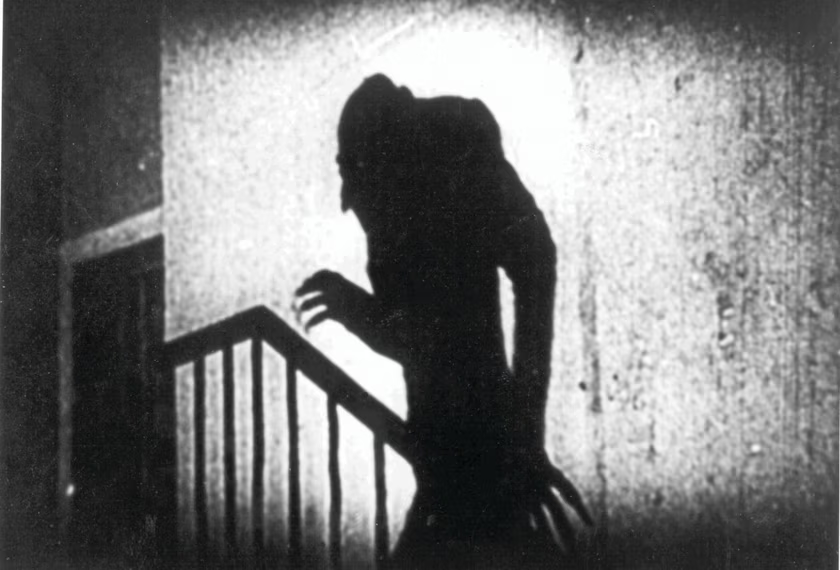
Red’s own references make sense of the film-within-the-film aesthetic. He has cited silent-era horror including Nosferatu, The Golem, Häxan and The Cabinet of Dr. Caligari, and Posthouse borrows the visual grammar of those films without turning its fake archive footage into a parody. The harsher contrast, theatrical movement and uncanny timing create the feeling of an image that belongs to another viewing culture entirely.
It also explains why the old footage can feel unnerving even before anything supernatural happens. We have become so accustomed to modern image smoothness that century-old film can seem almost alive in the wrong way: speed fluctuates, faces hold expressions too long, shadows are dense, movement feels slightly detached from ordinary time. Posthouse understands that silent cinema does not need to be made ‘scarier’ in order to be eerie to a contemporary viewer. It only needs to be allowed to look old.


The Atmosphere Works — Even When the Pace Doesn’t
This is where my morning with the film becomes impossible to separate from the film itself. I genuinely nodded off twice. The first time I blamed the early hour. The second time I had to accept that Posthouse can simply be very slow. There are extended passages in which Cyril watches, waits or searches while the soundtrack refuses to tell you when to tense up, and on a first viewing those stretches can feel less like controlled dread than dead air.
Rewinding changed my reaction, though. Once I knew where the film was heading, the stillness felt more purposeful. Empty spaces stay on screen a fraction longer than is comfortable. Machinery keeps running after a character has stopped touching it. The posthouse is photographed as a place in which darkness seems to accumulate rather than simply exist. Steven Evangelio’s cinematography gives the rooms a grubby, sealed-in quality, and the recurring pools of red, green and sickly practical light make the building feel permanently after-hours.

Where Posthouse Loses the Thread
The film has ideas to spare, but it does not always organise them as elegantly as the editing metaphor suggests it should. Some dialogue explains feelings or themes that the images have already made clear, while parts of the family history arrive in clumps of exposition. The father-daughter relationship is crucial to everything, yet there are moments when Cyril’s obsession is much more vivid than the bond that is supposedly being endangered by it.
I also think the creature becomes less frightening the more clearly the film shows it. This is an old horror problem, and Posthouse is hardly alone in having it. The manananggal is most effective when the audience is unsure where the boundary between footage, memory and physical space lies. Once that boundary becomes too explicit, the atmosphere has to compete with the mechanics of the plot.

To Restore or to Destroy
The final stretch brings the film’s central conflict into focus: preservation is not automatically virtuous. Cyril has treated restoration as a form of duty and, eventually, compulsion. Rea is forced to consider the possibility that saving an artefact and saving the people around it may be incompatible goals. For a film so preoccupied with lost cinema, that is an unexpectedly uncomfortable position to take. We usually talk about preservation as an unquestioned good because so much history has already disappeared. Posthouse asks what happens when the thing being preserved carries damage with it.
I would not push the metaphor too literally. Old movies are not curses and archives are not mausoleums full of evil. What works is the emotional version of the idea: families also preserve things they probably should not. Grudges, unfinished arguments, inherited ambitions and myths about who our parents were can survive because nobody wants to be the person who throws the reel away. Cyril mistakes repetition for repair. Rea eventually has to decide whether ending the cycle means refusing to continue the edit.

The Coffee Was Cold, but the Film Stayed With Me
By the time the credits rolled, most of the day had gone with them. I had watched the film, half-watched the film, rewound the film and watched parts of it again, which may be an unusually appropriate way to experience a movie about editing and unreliable memory. I am not going to pretend every slow section suddenly became brilliant because I revisited it. Some of them are simply too slow, and some of the dialogue needed another pass. But the film stayed with me longer than cleaner, faster horror films often do.
What lingered was not really the jump scares. It was the posthouse itself, the hum of machines in empty rooms, the film strip moving through equipment and the uncomfortable idea that images outlive the people who make them. Red’s feature debut is strongest when it treats cinema as something halfway between memory and haunting. The projector brings dead moments back to life, the editor decides the order in which we see them, and the audience supplies meaning in the gaps. That is already a little uncanny before you add a manananggal.
I would still give Posthouse 7.5/10. It is uneven, occasionally over-explained and patient to the point of testing whether the viewer is equally patient. But it is also unusually specific: a Filipino horror film about editing, lost cinema, inherited damage and the strange physical life of images. I would watch it again, though next time not at eight in the morning. Some films want popcorn. This one probably wants the lights off, the house quiet and the coffee already finished.
Leave a Reply