
There was a time when an evening in Manila came with a schedule. Outside, jeepneys carried on through the heat and the traffic while shops began to close and people headed home. Inside, there was the television, sometimes already chattering away in the background, waiting to become the centre of attention. It was not one screen among half a dozen personal devices. It was the screen we shared, whether we agreed on what to watch or not.

I spent much of my formative years watching it. By that I don’t mean every programme was a masterpiece, or even particularly good. Some were absurd, some dragged on, and some survived entirely on the goodwill of viewers who had very few alternatives. But a theme tune heard from the other room could still send you towards the living room, because missing the opening minutes mattered. There was no on-demand replay and no sensible way of asking the broadcaster to wait until you had finished whatever you were doing.

When people talk about television in the eighties, the conversation often becomes a parade of American programmes. Those were certainly part of my childhood, but the Manila version was stranger and more interesting: Philippine sitcoms and tearful dramas alongside talking cars and expensive helicopters; Sunday variety shows full of satin and spotlights; evening news that reflected a country undergoing enormous political change. The programmes belonged to different worlds, yet they all came through the same television set.
A Handful of Channels, an Entire Universe
For much of the early decade, a Manila television dial offered familiar names and numbers: BBC or City 2 on Channel 2, MBS on 4, GMA on 7, RPN on 9 and IBC on 13. Programmes shifted, reception varied, and the networks changed over the years. This wasn’t a fixed five-channel universe, but compared with the present-day abundance of streaming services, there were relatively few places to look for entertainment. If something unappealing was on one station, the other choices weren’t necessarily much better.

The sets themselves demanded a little tolerance. Depending on the equipment and location, pictures could suffer from ghosting, snow or a colour balance that bore only a passing resemblance to reality. You might have to adjust the aerial or revisit the tuning. There were advertisements we had no way of skipping and station announcements that became almost as familiar as the programmes. These imperfections were not retro aesthetics being carefully recreated for an advertisement; they were simply how television worked.
The industry’s story was also political. ABS-CBN had been taken off the air after the declaration of martial law in 1972, and Channel 2 operated under the Banahaw Broadcasting Corporation for years. After the February 1986 People Power Revolution, the balance of broadcasting began to shift, with ABS-CBN returning in September. I certainly wasn’t thinking about broadcasting ownership as a child. I wanted to know what was on that night. With hindsight, though, the programmes can’t be entirely separated from the circumstances that allowed them to reach our homes.
Flordeluna, Anna Liza and the Unlimited Supply of Misery
Philippine television understood melodrama long before streaming services discovered the value of ending an episode on a cliffhanger. Flordeluna, with Janice de Belen, and Anna Liza, with Julie Vega, were enormous parts of the early eighties television landscape. Their stories drew on a tradition of radio serial drama and revolved around young heroines subjected to a succession of cruel relatives, secrets, misunderstandings and seemingly inexhaustible disappointments. Watching them sometimes felt like being invited to observe how much suffering a child could endure before the closing credits.

I was naturally more interested in machines, heroes and science fiction, but the local dramas were too prominent to ignore. They generated conversations that carried beyond the television screen and into ordinary family life. Even viewers who were not regular followers knew who the young stars were. Julie Vega’s death in 1985, aged only sixteen, gave Anna Liza’s unfinished story a different sadness, one that no scriptwriter could neatly resolve.
It’s easy to tease these programmes for their theatrical acting and relentless manipulation of the emotions, but they also established something enduring about Philippine television: an ability to turn characters into familiar presences over months and years. That relationship between audience and programme is still recognisable today, even if modern productions have better cameras and considerably more elaborate wardrobes.
Family Arguments, Schoolroom Chaos and Local Comedy
John en Marsha gave us a different sort of family drama, one in which everybody had a grievance and most disagreements were eventually played for laughs. Dolphy’s John Puruntong and Nida Blanca’s Marsha were constantly navigating the expectations of Marsha’s formidable mother, Doña Delilah, played by Dely Atay-Atayan. Money and social status were always lurking behind the jokes. John was the ordinary man trying to get by, while his mother-in-law seemed convinced that merely being ordinary was a personal offence.

Maricel Soriano, Rolly Quizon and the rest of the family added to the chaos, and Evelyn Bontogon’s Matutina became one of the programme’s most recognisable comic figures. It was broad comedy, often repetitive and occasionally far too pleased with its own punchlines, but the underlying tensions were familiar. Few things are as universal as relatives offering unsolicited opinions about somebody else’s livelihood. The show simply gave them a studio audience and an apparently endless number of opportunities.
Iskul Bukol turned school discipline into comedy, with Tito Sotto, Vic Sotto and Joey de Leon as students who appeared determined never to behave. The fictional Wanbol University offered an excuse for practical jokes and improbable classroom situations, while Mely Tagasa’s Miss Tapia gave the boys an authority figure to torment. As a school-age viewer, that reversal was part of the attraction: the people who usually told us what to do were the ones getting the worst of it.


Champoy, associated with Subas Herrero and Noel Trinidad, was different again. Sketches, musical comedy, impersonations and satire made it more interested in recognisable Filipino behaviour than in continuing a family storyline. Some references went over my head at the time; political and social satire often does when you’re more interested in the voices and funny faces. Looking at it now, I can appreciate how the programme occasionally slipped a sharper observation into what seemed like perfectly ordinary entertainment.

When Sunday Television Dressed Up
Variety programmes supplied the glamour. The Penthouse Live!, hosted by Martin Nievera and Pops Fernandez, gave Philippine television a polished musical showcase, with carefully arranged performances, elaborate lighting and a stage that suggested television ought to look like an occasion. The performers and their personal lives gradually became part of the conversation, yet most of what viewers knew still came from scheduled broadcasts, newspapers and entertainment magazines. There was considerably less opportunity for celebrities to narrate their every waking moment.

What I find interesting now is the design. There were mirrored surfaces, bright studio colours, oversized title graphics, coordinated costumes and lighting effects that worked hard to make an ordinary television screen feel spacious and expensive. Some of it now looks magnificently overdone. But in the eighties, restraint wasn’t always the objective, and those elaborate sets offered a welcome contrast to the practical furniture and everyday routine of a Manila home.

KITT, the A-Team and Other Imported Fantasies
American television brought a different sense of scale to the screen. Knight Rider, created by Glen A. Larson, offered David Hasselhoff as Michael Knight, but I always thought the more interesting performance came from the black Pontiac Trans Am. KITT could talk, think and drive itself, and its sweeping red scanner made the car look alive even when it was parked. Its dashboard, a ridiculous abundance of buttons and digital displays, seemed like the sort of future I wanted to inhabit.


The A-Team was much less concerned with sophistication. Hannibal Smith, Face, Murdock and B.A. Baracus travelled around helping people who had run out of legitimate ways to deal with bullies and criminals. Their solutions normally involved disguises, homemade machinery, gunfire and a substantial amount of property damage. Everyone appeared remarkably resilient, considering how frequently vehicles overturned or exploded. I accepted this rather cheerful disregard for physics without much complaint.


MacGyver appealed to a slightly different sort of childhood curiosity. Richard Dean Anderson’s hero preferred improvisation and practical knowledge to firearms, creating improbable solutions from common objects. The Swiss Army knife became his signature accessory, and the programme suggested that being observant could matter more than being physically intimidating. Some of the improvised science deserved scrutiny, but the underlying belief in ingenuity was rather attractive.


There was also The Greatest American Hero, which made a fairly convincing case that being given superpowers did not automatically make you good at using them. William Katt played Ralph Hinkley, an ordinary schoolteacher who received a remarkable red suit from extraterrestrials and then promptly lost its instruction manual. Robert Culp’s exasperated FBI agent Bill Maxwell and Connie Sellecca’s lawyer Pam Davidson tried to help him make something useful of his new abilities. Ralph could fly, in theory, but actually remaining in control and landing with dignity were rather different matters. Compared with the polished confidence of Michael Knight and the A-Team, this was a superhero programme with room for embarrassment.

Created by Stephen J. Cannell, the series had a visual joke at its centre: a magnificent costume worn by a man who had very little idea how it worked. Ralph looked as though he ought to be able to save the day, until he had to take off. Joey Scarbury’s wonderfully earnest theme, Believe It or Not, somehow made that contradiction even more enjoyable. I liked the idea that a hero could be well intentioned, occasionally hopeless and still worth cheering on. That felt rather more relatable than the confident men who could fix every problem before the commercial break.
Airwolf then took the machines to the sky. Jan-Michael Vincent’s Stringfellow Hawke and Ernest Borgnine’s Dominic Santini operated a helicopter that possessed capabilities no normal helicopter was ever likely to acquire. It was fast, armed to the teeth and photographed against imposing landscapes. The electronic theme music did half the work. At home in Manila, with the road traffic still audible somewhere outside, those canyon flights might as well have been arriving from another planet.


And then there was Blue Thunder, which belonged beside Airwolf but had a rather different character. The 1984 television spin-off of the 1983 film replaced Roy Scheider’s movie character with James Farentino as police pilot Frank Chaney, supported by Dana Carvey as flight engineer Clinton Wonderlove, known as JAFO. Bubba Smith and Dick Butkus were among the ground-support crew. The helicopter looked less sleek than Airwolf and more like a flying surveillance machine, with a bulbous nose and equipment that suggested nobody beneath it would enjoy being watched.

The series survived only eleven episodes in its original American run and reused footage from the film, something more apparent when you watch it now. At the time, though, none of that necessarily diminished the excitement. From a living room in Manila, both Blue Thunder and Airwolf offered a technological fantasy far removed from the traffic outside: improbably capable aircraft, elaborate controls and the promise that the next mission would be even bigger. It is quite possible to remember a series vividly without remembering that it barely lasted a season.
Pastel Miami, Oil Money and Other Foreign Worlds
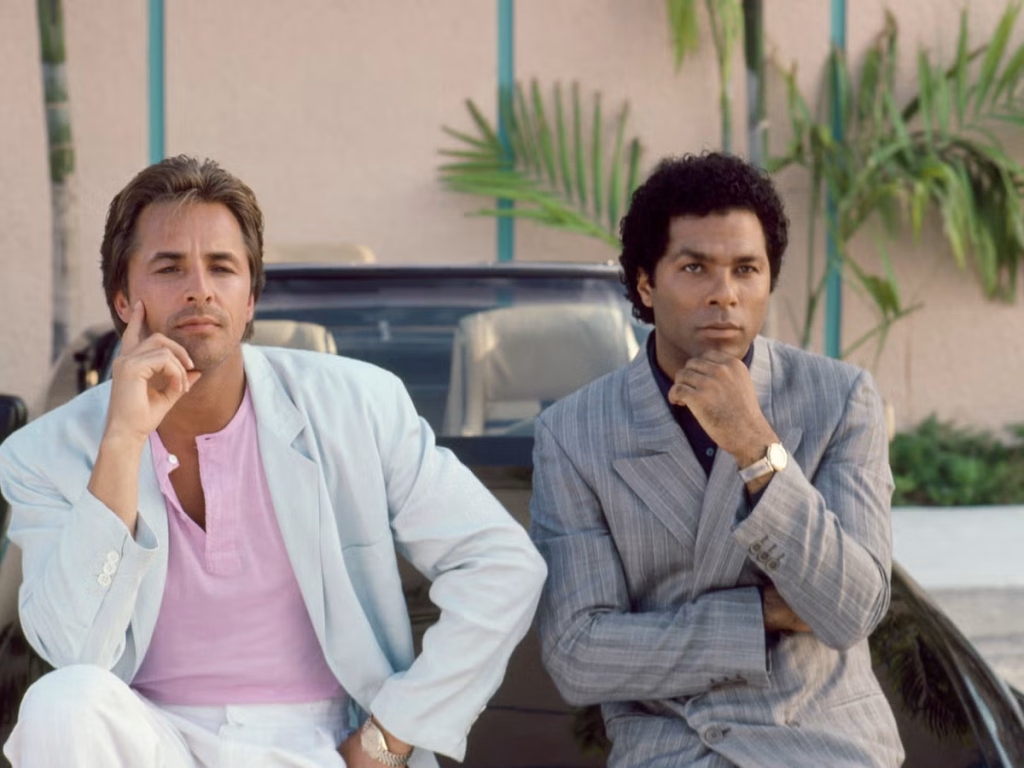
The decade’s imported shows also sold lifestyles. Miami Vice, with Don Johnson as Sonny Crockett and Philip Michael Thomas as Ricardo Tubbs, made crime television look like an art-directed music video. The pastel clothes, neon-lit nights, sports cars and conspicuous use of contemporary music were part of the storytelling. Individual plots could be fairly routine, but the look and atmosphere were so deliberate that even somebody more interested in design than police work could find plenty to enjoy.

Dynasty and Dallas went in another direction, presenting American wealth as a permanent source of romantic and financial warfare. Alexis and Krystle Carrington had their extravagant confrontations while J. R. Ewing turned business into a particularly unpleasant family sport. These characters had enormous houses and expensive wardrobes, yet often seemed incapable of enjoying a quiet afternoon. It made prosperity look rather tiring, although the lavish interiors and wardrobe decisions made compelling television.


The Love Boat and Fantasy Island were gentler forms of escapism, full of guest stars, wishes, romantic misunderstandings and problems designed to be resolved within a week’s broadcast. Mr Roarke and Tattoo offered the promise of an extraordinary visit, while Captain Stubing and his crew managed a floating collection of personal complications. If the American action shows were about saving the day, these were usually about repairing someone’s love life, family relationship or questionable decision.


Aliens, Roommates and the Sitcoms That Stayed With Me
The American shows that stayed with me weren’t all about expensive cars and improbable explosions. There were sitcoms, too, usually set in living rooms, kitchens or shared flats, with an opening theme that made the whole household feel familiar after only a few episodes. Some dealt with ordinary misunderstandings, while others built an entire comedy around the arrival of an alien or a robot. The sets were brightly lit, the laughter was often supplied for us, and the writing could be broad, but there was something comforting about returning to the same collection of characters each week.
Mork & Mindy was one of the strangest. Robin Williams played Mork, an alien from Ork who arrived on Earth and ended up sharing Mindy’s life in Boulder, Colorado. Pam Dawber’s Mindy did much of the work of keeping the situation under control while Williams made apparently ordinary exchanges veer off in several directions at once. The character had come from Happy Days, but the spin-off gave him more room to investigate human habits, ask ridiculous questions and report his findings to Orson. His Nanu-Nanu greeting was part of the attraction, although what really made the series work was how completely unpredictable Mork could be.

The comedy could be gloriously foolish, but the underlying idea was clever: human behaviour might look completely absurd to somebody seeing it for the first time. That gave the programme an excuse to question our manners and assumptions without becoming terribly serious about any of them. A few of the jokes now feel dated, yet the sheer energy of Williams’s performance survives. It’s difficult to think of many other sitcom characters whose most familiar quality was the expectation that he might say almost anything.
Three’s Company relied less on science fiction and more on people constantly misunderstanding each other. John Ritter’s Jack Tripper shared an apartment with Janet Wood and Chrissy Snow, played by Joyce DeWitt and Suzanne Somers, while the landlords were never entirely comfortable with the arrangement. Adapted from the British sitcom Man About the House, its premise had Jack pretending to be gay so that he could live with two women. From there the comedy was built on half-heard conversations, unlikely explanations, poorly timed entrances and one person believing something completely different from everybody else.

Ritter was particularly good at physical comedy, making the smallest domestic emergency look like a major catastrophe. I’m fairly sure much of the adult innuendo went straight over my head when I first encountered the series. Rewatching it would probably expose more than a few assumptions about gender and sexuality that have aged badly, but the choreography of the farce is still recognisable. It required very little more than a door, a suspicious landlord and somebody overhearing the wrong sentence.
ALF arrived later in the decade, bringing another extraterrestrial into a suburban household, this time with considerably more fur and less inclination to follow the rules. Gordon Shumway from Melmac crash-landed near the Tanner family home and became an exceptionally troublesome houseguest. Paul Fusco performed and voiced the puppet, while Max Wright’s Willie Tanner spent much of his time coping with ALF’s jokes, schemes and alarming interest in eating cats. Kate, Lynn and Brian Tanner helped keep the fiction alive that this was anything like a normal family arrangement.

The puppet was the important part of the illusion. Unlike the digital characters that turn up in modern productions, ALF appeared to occupy the room, even if his movement was restricted and the performers had to work around the practicalities of making him come alive. The jokes could be repetitive, but the character’s physical presence made him instantly recognisable. It was science fiction shrunk to the scale of ordinary domestic irritation, which is probably why it fitted so easily among the other family sitcoms.
Small Wonder took the household secret in an even odder direction. Engineer Ted Lawson, played by Dick Christie, built V.I.C.I., a little girl-shaped robot known as Vicki, portrayed by Tiffany Brissette. His wife Joan and son Jamie helped pass her off as part of the family, although that required people to overlook her mechanical speech, precise movements and distinctly unusual reactions. Their inquisitive neighbour Harriet Brindle was a reliable source of trouble whenever the secret appeared close to being exposed.

It’s a rather curious series to remember now, when talking to machines is becoming an ordinary part of life. Small Wonder wasn’t really concerned with explaining artificial intelligence; the joke was that Vicki looked like a girl but behaved like a machine. The production could be stiff, and the humour wasn’t particularly sophisticated, but to somebody growing up around the home electronics of the eighties, the robot was enough to make the programme worth watching. That monotone delivery and the familiar outfit are probably what remain clearest in my mind.
Perfect Strangers began in 1986 and continued well beyond the decade, pairing the anxious Larry Appleton, played by Mark Linn-Baker, with his distant cousin Balki Bartokomous, played by Bronson Pinchot. Balki arrived in America from the fictional Mediterranean island of Mypos, full of enthusiasm and unfamiliarity with Larry’s habits, while Larry seemed constitutionally incapable of relaxing. Their misunderstandings were generally predictable, but the two actors had enough chemistry to make the relationship feel affectionate rather than simply a joke about a foreign visitor.

They had the Dance of Joy, an absurd but rather endearing ritual of reconciliation, and an opening theme almost comically ambitious for a show about two flatmates. Nothing’s Gonna Stop Me Now, sung by David Pomeranz, belonged to an era when sitcom music didn’t mind sounding like a song about changing your life. Some of the comedy relied on very broad cultural stereotypes, but the sense of goodwill between Larry and Balki was what made the show pleasant company. After the science-fiction machines, it was refreshing to find that two people struggling to understand each other could be a complete television premise.
When the Visitors Arrived, and the Monsters Were Closer to Home
Science fiction provided some of the decade’s genuinely unsettling images. In V, extraterrestrial Visitors arrived presenting themselves as benevolent helpers, but their polished human faces concealed reptilian identities and a programme of manipulation and control. As a younger viewer, the reveal was the attraction. As an adult, the allegory of propaganda, persecution and authoritarian politics is more disturbing, particularly when viewed against the history of the Philippines during the same decade.

Local horror didn’t always need large-scale special effects. Programmes such as Regal Shocker and the later Pinoy Thriller drew on the Philippine appetite for ghost stories, strange encounters and the suspicion that familiar rooms could become dangerous after dark. The country already possessed an abundant folklore of ghosts and supernatural creatures. A creaking doorway or an unsettling figure at the end of a corridor could be enough to make a night-time programme work, even if the sets and effects were sometimes visibly economical.

There is a particular difference between imported horror and the local material. A fictional American monster usually belonged to a distant place; a Filipino haunting might occur in a house that looked disconcertingly like one in your own neighbourhood. Production values varied, and not every episode was frightening, but the proximity of the setting helped. The stories didn’t always need to persuade us that the supernatural existed. Quite a few viewers had already heard variations of them from relatives.
The Night the News Was Bigger Than the Programmes
Television was an escape, but in 1980s Manila it couldn’t remain separate from public life. The years surrounding the People Power Revolution in February 1986 showed how much control of the broadcast media mattered. Radio was central to mobilising people during the uprising, and television stations became contested and transformed spaces as the Marcos regime ended. The political changes of the decade didn’t merely interrupt the usual schedule; they altered who could produce it.

ABS-CBN returned in September 1986, and TV Patrol premiered on 2 March 1987. Its early anchors included Noli de Castro, Mel Tiangco and Robert Arevalo, with Frankie Evangelista joining later. The programme’s direct delivery, human-interest reporting and recognisable evening routine helped make it a fixture. The same set that had shown sitcoms and American action heroes could now deliver political developments, urgent news and stories from communities much closer to home.


Political satire also found room in the changed climate. Sic O’Clock News began in 1987 and showed that the habits of comedy — impersonation, exaggeration, timing — could turn towards public affairs. Looking back, I think it matters that some of our memories of eighties television involve events that weren’t scripted. The decade was full of shows with villains and dramatic reveals, but the real news was often considerably more consequential.
The Rest of the Day Was Part of the Memory Too
Memory doesn’t observe broadcasting slots with any great discipline. When I think of television in Manila, I also think of Eat Bulaga!, Student Canteen, GMA Supershow, That’s Entertainment, Coney Reyes on Camera and Lovingly Yours, Helen, even though these were not all prime-time programmes. Some belonged to afternoons, others to weekends, and they shouldn’t be quietly reassigned to evening slots for the sake of a neater essay. Their hosts and catchphrases, however, were part of the same television culture.
Basketball was another form of appointment viewing. PBA games could take command of the screen and produce arguments every bit as passionate as a soap-opera plot. Heroes, rivalries and disappointments were all present, except that the ending couldn’t be written in advance. For a country so invested in basketball, it would be odd to recall the television landscape without acknowledging how easily sport became the main event.

What Has Aged, and What Hasn’t
There is no point pretending every programme has stood the test of time. The sitcoms could repeat a joke until it was threadbare, the local dramas stretched their suffering far beyond reasonable limits, and American action television recycled villains and situations with admirable efficiency. Some comedy depended on stereotypes that feel weary now, while elaborate studio sets and videotape images have not always aged kindly. Nostalgia tends to remove the long advertisements and weaker episodes from our recollections, leaving behind a deceptively efficient greatest-hits compilation.
Yet there was a recognisable craft to those broadcasts. You could identify a programme from a few notes of music, a red light passing across a black bonnet or the first glimpse of a brightly lit studio. Title sequences and soundtracks weren’t disposable introductions; they helped build a programme’s identity. Even with limited technology, the combination of typography, music, costume, props and character design could produce images that lingered for decades.
Most of all, a limited schedule made television communal in a way that is now relatively rare. Somebody in the house would prefer another programme. Somebody would need the previous episode explained. The following day, people at school could discuss what had happened because many of them had actually watched the same broadcast. Today we have a choice of practically everything, which is convenient, but also means that two people can sit in the same room watching unrelated worlds and never once argue over the channel.
After the Closing Credits
When I remember 1980s Manila, the programmes sit alongside the ordinary details of the place: streets still warm after sunset, traffic outside, Tagalog and English flowing in and out of television dialogue, and the strange pleasure of seeing a faraway American future on a screen in the family living room. Some series gave us cars that spoke and helicopters that defied physics. Others offered Philippine families whose quarrels and difficulties were exaggerated versions of things we already recognised.
I’m not keen to return to a handful of channels, irregular reception and an evening spent waiting for something decent to begin. I like being able to find an old theme tune or episode whenever the mood strikes. But I miss the strange weight of an appointed hour, when a programme existed at a particular moment and you either watched it or asked someone the next day what you had missed.
I can summon KITT’s red scanner or the Airwolf theme in seconds now, and both still make me smile. What I cannot summon is that ordinary evening in Manila when the programme came on at exactly the right moment, the rest of the house settled around it, and there was nothing more pressing than finding out what happened next.
Leave a Reply