
Spoilers throughout.
The Film I Kept Pausing
The Death of Robin Hood had been sitting on my watch list for quite a while. It had been there long enough to become one of those films I was aware of without actually knowing very much about it: Hugh Jackman with grey hair and a thoroughly ruined face, Jodie Comer looking severe and slightly otherworldly against wet stone and coastline, and the general promise that this was not going to be the version of Robin Hood involving jaunty arrows, green tights and a rich man discovering the redistributive possibilities of archery.

When I finally got around to watching it, however, I discovered something I had not quite expected. I knew Michael Sarnoski was unlikely to make a cheerful adventure film, and I certainly was not waiting for another variation on Errol Flynn swinging through Sherwood Forest, but I was not prepared for just how slow a burn it would become. I paused it more than once, came back later, continued for a while, then stopped again. That was not because I thought the film was bad. In some ways that would have been easier. It was more that the film seemed to require a particular state of mind before I could properly sit with it.
There are films that happily meet you wherever you happen to be. You can put them on tired, distracted or half-eating dinner and they do most of the work. The Death of Robin Hood is not one of those films. It has a heaviness to it that seems almost physical, and after the savage first movement gives way to Robin’s recovery at the priory, the film deliberately begins stripping itself of conventional momentum. What follows is less an adventure than a prolonged act of waiting: waiting for a body to heal, waiting for an ageing man to admit what he has done, waiting for old violence to come looking for him, waiting for mercy, and, given the title, waiting for Robin Hood to die.
That does not automatically make it profound. Slowness is not the same thing as depth, however often serious films seem tempted to treat the two as interchangeable, and there were points where I wondered whether Sarnoski had pushed contemplation over into inertia. Yet I kept returning to it, and whenever I did, the photography pulled me back in. The landscapes are enormous and inhospitable, the interiors appear carved out of darkness, and people look very small against cliffs, sea and weather. Faces emerge from candlelight as though the film has found them in an old painting, while Hugh Jackman looks less like a movie star playing an elderly outlaw than a man who has been left outside for several winters.
By the time I finished it, I felt oddly exhausted, which was not helped by the fact that I also happened to be experiencing a hot, searing pain in the Achilles tendon of my right heel. This had nothing whatsoever to do with Robin Hood, obviously, but the timing was almost comically appropriate. After spending two hours watching an ageing body complain about the accumulated cost of living violently, mine apparently decided it wanted a speaking part.
I am not sure I could endure the film again, and I do not entirely mean that as criticism. Getting through it from beginning to end may simply be enough.

Before the Merry Men Became Merry
The clever thing about Sarnoski’s film is that it does not merely make Robin Hood old. Cinema has done that before. Richard Lester’s Robin and Marian gave us Sean Connery and Audrey Hepburn contemplating what remained after legend, while decades of screen Robins have ranged from Errol Flynn’s Technicolor confidence to Kevin Costner, Cary Elwes, Russell Crowe, Taron Egerton and, for a certain generation, Disney’s suspiciously charismatic fox. Robin Hood has always been less a fixed character than an old tune that people keep rearranging for whatever cultural moment they happen to be living through. Sarnoski goes further by asking whether the tune itself might be a lie.
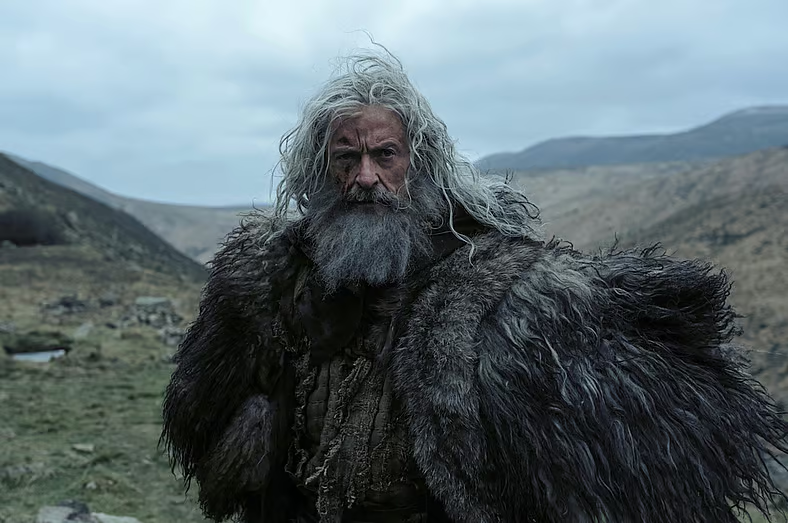
His Robin insists that the stories told about him are inventions. He was not necessarily robbing the rich out of principled solidarity with the poor. He was violent because he was good at violence, and for much of his life he seems to have enjoyed it. The heroic Robin Hood remembered by history may simply be what happened when witnesses, survivors and storytellers gradually sanded the blood off.
The film draws its central idea from the later ballad tradition surrounding Robin Hood’s death, especially the Early Modern English ballad Robin Hood’s Death, rather than from a modern novel. In surviving versions, an ailing Robin goes to a priory to be bled by a prioress who is also his kinswoman, with Little John nearby. Sarnoski takes that quiet, treacherous ending and reverses its moral geometry: the prioress is no longer simply the villain, and Robin is no longer automatically the goodly hero.

That matters because the film is really interested in the distance between a person and the story eventually told about that person. Robin Hood may be one of the safest folk heroes available to Western popular culture. The outline has become cultural shorthand: outlaw, Sherwood Forest, bow, Little John, Sheriff of Nottingham, take from the rich, give to the poor. Put the silhouette of an archer on a poster and most of us automatically provide the rest.
Sarnoski uses that familiarity against us. He does not need to show the traditional heroic Robin because we have already brought him into the cinema ourselves. Instead the film spends the next two hours dismantling him.
Thirty Days in the Cold
Sarnoski wrote and directed the film, with Hugh Jackman among the producers, and the production was completed on a roughly month-long shoot across Ireland and Northern Ireland. It works on a much more contained scale than the enormous historical action spectacle Robin Hood usually attracts. Rather than filling the screen with armies and castles for two hours, the film concentrates much of its large-scale violence near the beginning and then gradually contracts into the priory, where conversation, illness, memory and waiting become the main events.


Much of the exterior work was done in Northern Ireland, while the Rock of Cashel in the Republic of Ireland supplied some of the priory’s most expansive spaces. The landscape does an extraordinary amount of work. This is not postcard medievalism. There is very little romantic mist drifting conveniently across picturesque hills while heroic men discuss destiny. The country looks wet, cold and indifferent. Wind appears to have been invited to every scene. Mud behaves like an additional cast member. Even the light seems reluctant to commit itself.

That physical discomfort is important because Sarnoski wants the action to feel equally unpleasant. The early fights are ugly, cramped and exhausting rather than elegant. People grapple, stumble, hack, burn and hit one another without much sense that anyone will eventually look good on a commemorative poster. The farmhouse sequence in particular destroys whatever remains of the romantic idea of old companions coming together for one final adventure.


A more conventional Robin Hood film would probably have made the reunion between Robin and Little John an audience-pleasing moment. The old friends are back together, the bows come out, the music rises and the audience gets to enjoy the reassuring machinery of nostalgia. Sarnoski gives us the reunion and then poisons it. The old skills still work, but nothing good comes from using them.
This is also where the film begins playing an interesting structural trick. The violent opening teaches us to expect one kind of film, and then, once Robin is wounded and brought to the priory, that film effectively disappears. The audience’s muscle memory continues waiting for another raid, another confrontation, another burst of revenge. Instead we get beds, stone rooms, wounds being washed and people sitting beside one another trying to understand what kind of life is still possible.
Depending on your patience on a particular evening, this is either a very brave decision or a deeply irritating one. I found it to be both.
The Beginning Is the Myth, the End Is the Man
Pat Scola’s photography is the part of the film I found easiest to admire without reservation. Shot primarily on 3-perf 35mm, the film makes an unusually expressive use of format as it moves from the first act into the priory. It begins in a broad 2.39:1 frame, using anamorphic lenses for the scale we instinctively associate with historical epics, then transitions to the taller 1.66:1 frame as Robin’s world contracts. The emphasis shifts away from countryside and legend towards bodies, rooms and faces. Even the handful of aerial shots captured digitally were printed back to film so the texture would remain coherent.

Sarnoski has described the visual idea in simple terms: the beginning is the myth and the end is the man. That is almost exactly how the film feels.
The opening landscapes provide the sort of visual scale we expect from Robin Hood. Hills stretch across the screen, figures disappear into fog and the Northern Irish countryside seems ancient enough to be entirely uninterested in whether Robin Hood ever existed. As the film progresses, however, the horizontal space seems to disappear. We come closer to beds, stone walls, hands, wounds, doorways and the awkward proximity of people who can no longer escape one another. The legend loses space and the man becomes harder to avoid.

I did not consciously register every technical shift while watching, which is probably why it works so well. What I did feel was the compression. The outside world gradually becomes less important, and Robin’s final battlefield turns out not to be another forest or burning village but a collection of rooms where people talk about things he has already done. That is a much more difficult battlefield to survive with a sword.
Hugh Jackman and the Body After the Legend
Hugh Jackman is excellent here, and there is an obvious temptation to connect the performance with Logan. Both films take an actor strongly associated with a durable physical hero and ask what happens when the body can no longer support the myth. Both involve an older killer reluctantly forming a bond with a younger girl, and both are interested in violence not as fantasy fulfilment but as something that remains in the muscles after the cheering has stopped.
Robin, however, is nastier than Logan in a way that matters. He does not have the convenient mythology of reluctant violence to hide behind. The film steadily refuses him the reassurance that he was secretly a good man doing terrible things for noble reasons. His reputation may say otherwise, but he remembers what happened.
Jackman lets that knowledge sit heavily in the body. His Robin often seems uncomfortable occupying his own skin. His shoulders slump even when he is dangerous, his face looks eroded by weather and regret, and there is something almost animal in the early violence. Once he reaches the priory, that physical aggression gives way to the bewilderment of someone discovering that he has survived when death had perhaps begun to look easier.
His response to the cheerful Robin Hood stories is particularly telling. He hears people describe a heroic outlaw and reacts almost as though someone is using his name to describe another man. The myth has become so clean that it is offensive to the person who supposedly inspired it.
Yet Jackman does not play him as permanently monstrous, because the film would collapse if he did. What gradually appears during his recovery is not a sudden conversion into Saint Robin of Sherwood but something much smaller. He begins doing useful things. He hunts for food. He helps. He becomes protective of Little Margaret. He makes arrows without immediately putting them through people. He listens more than he speaks.
There is something quietly moving in the idea that redemption might begin not with grand gestures but with discovering what ordinary usefulness feels like. Robin cannot undo what he did. The film never pretends otherwise. What he can do is choose not to repeat it today. Whether that is enough remains the uncomfortable question.

Edward, Little John and the Lie of a Quiet Life
Bill Skarsgård’s character, living under the name Edward, is the film’s Little John, Robin’s old companion who has attempted to build a different life. His return pulls Robin back towards the machinery he has spent years trying to escape.

Edward has created a domestic existence with his wife Margaret and their daughter, Little Margaret. It is not grand, heroic or particularly secure, but it is his. The problem is that violence has memory. The people connected to what Edward and Robin once did have not forgotten simply because he now lives on a farm and answers to another name.
When danger catches up with him, Edward asks Robin for help defending what he has built. In another version of the story this would be the moment when the old partners rediscover themselves. Their friendship would be restored through action, the audience would be allowed the pleasure of competence and perhaps the familiar legend would finally emerge from the mud. Instead the farmhouse battle destroys almost everything.
The violence is chaotic and ugly, Margaret is killed, Robin is catastrophically wounded and Little Margaret is left carrying the consequences of decisions made long before she was born. The sequence turns the idea of a heroic reunion into something closer to an accusation. You cannot simply change your name and assume history has agreed.
The film keeps returning to the idea of blood debt, not as some grand medieval abstraction but as a practical system of damage. Every act of violence creates another witness, another survivor, another child who remembers who did what. One person calls it justice, another calls it revenge, and very soon nobody can remember where the account originally began.
Sister Brigid and the Terrible Shape of Mercy
Jodie Comer’s Sister Brigid could easily have become the film’s designated vessel for goodness, the calm spiritual woman whose purity allows a damaged man to recover his soul. Comer is far too interesting an actor for that, and the film eventually gives Brigid a much harsher connection to Robin.
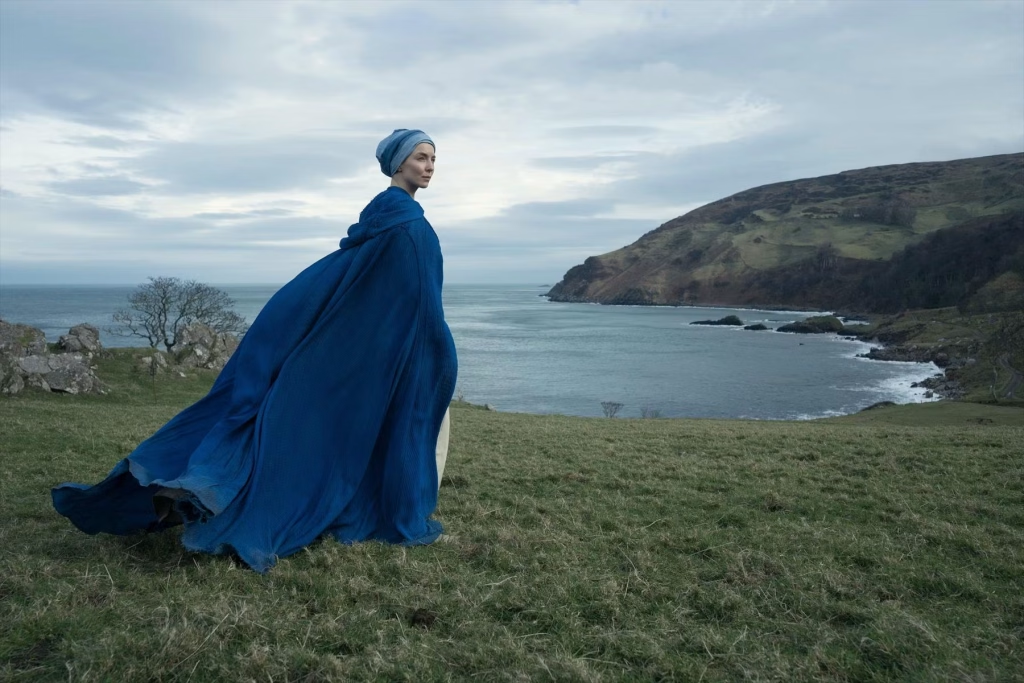
She runs the remote priory where he is taken after the farmhouse battle. She tends wounds, feeds people and looks after those whom the wider world appears to have discarded. Her blue clothing is visually striking against a film otherwise built from mud, wool, stone, brown earth and grey sky, making her seem almost separate from the landscape even before we understand why the story needs that distinction.
Comer gives Brigid a steadiness that is more interesting than simple kindness. She has compassion, but she is not soft, and her scenes with Jackman work because she does not seem particularly impressed by the gravitational pull of his misery. Robin may be the legendary man in the room, but Brigid is the person who has to wash the blood away.

There are moments when the film pushes her spiritual dimension a little too hard for me. Some of the fertility, blood and natural imagery feels as though Sarnoski is reaching for something older and more elemental than conventional Christianity without always integrating it cleanly. The seriousness occasionally becomes visible as seriousness, which is usually when a film starts losing some of its mystery.
Comer carries those moments through, and then the story reveals the connection that changes the entire meaning of their relationship. Robin was responsible for destroying Brigid’s family. The person offering him his best chance at mercy is also someone with perhaps the strongest reason to hate him.
That is the film’s real final confrontation. It is not Robin facing another sheriff, knight or band of killers. It is Robin sitting in front of someone whose life he destroyed and finally allowing her to know exactly who he is.

Little Margaret and What We Choose to Tell Children
Faith Delaney’s Little Margaret is important because she does not arrive carrying any nostalgia for Robin Hood. She is not impressed by the legend because she is living in the wreckage of it.
Her parents’ generation tried to bury the past, failed, and she inherits the consequences. Robin gradually becomes a surrogate father figure, and some of the film’s gentlest moments involve him teaching her practical skills: hunting, making arrows and understanding the landscape. What makes those scenes work is the knowledge that he is trying to pass on the useful parts of himself without passing on the part that turned those abilities into a way of life.
This creates one of the film’s more interesting contradictions. Robin spends much of the story despising the false legend built around his name, yet through Margaret he begins to understand why stories are sometimes changed. Not every softened story exists to protect a man’s reputation. Sometimes stories are altered because children do not need to inherit every brutality their parents carried. There is a difference between lying to preserve your own glory and shaping a story so that another person can continue living.
That distinction gives the film’s interest in myth a little more complexity. Robin Hood became Robin Hood because generations kept reshaping him. Songs removed details, storytellers added others and audiences held on to whichever version suited them. Sarnoski is doing exactly the same thing, only from the opposite direction. He puts the blood back in.
Arthur, Godwyn and the Chance Not to Continue
Noah Jupe’s young character, initially known as Arthur and later revealed as Godwyn, is another survivor orbiting the violence of the opening act. He represents precisely what the film has been warning us about: the next person in line.

He arrives carrying grief that has become an obligation to seek revenge. In a conventional narrative, Robin would know exactly how to solve the problem. Kill the young man, remove the threat and survive another day. That is the logic Robin has lived by, and for most of his life it probably worked. This time he refuses.
The act is not dramatic in the usual sense, but it may be Robin’s clearest moral choice in the entire film. He allows someone who hates him to remain alive, accepting the risk that comes with refusing to complete the usual cycle. The film’s earlier violence has been made deliberately unpleasant so this moment can register properly. Had those battles been exciting or heroic, Robin’s later rejection of violence would feel hollow. Instead we have already seen exactly what his old solutions produce. Violence solves the immediate problem and manufactures the next one.
The Leper and a Man From Another Life
Murray Bartlett is nearly unrecognisable as the Leper, another resident of the priory and one of the film’s quieter presences. The later revelation that he is Guy of Gisborne is less interesting to me as a piece of Robin Hood lore than as another variation on the film’s central question: can people become something other than what they once were?

Guy knows Robin and remembers the earlier life, but their reunion does not simply restore the roles they once occupied. They do not immediately revert to enemy and outlaw, hero and villain. Instead they meet as two damaged older men living in a place designed for people the outside world has already chosen not to see.
Bartlett gives the role warmth without allowing it to become sentimental. Guy can recognise what Robin did and still recognise that the man beside him now is not entirely identical to the man he knew then. The film repeatedly returns to that awkward distinction. The past remains real, but the present is also real, and human beings are not always one fixed thing from beginning to end.
The possibility of another life is perhaps the film’s most generous idea. The sadness is that Robin never seems fully capable of believing he deserves one.
Mud, Wool, Stone and Water
The design deserves almost as much praise as the photography. The medieval world here looks used rather than dressed. Clothes sag and bunch rather than falling into attractive costume silhouettes. Fur looks matted. Wood has splinters. Stone appears damp. Rooms are too dark, fires smoke as well as glow, and nobody looks as though washing their clothes is likely to happen before the end of the week.
That sense of use is important. Nothing feels as though it has been waiting in wardrobe or sitting untouched on a prop shelf.
The priory is especially effective because it is not photographed as a pristine spiritual sanctuary. It is functional. People eat there, sleep there, bleed there and die there. Wounds are treated in the same rooms where conversations happen. Its peace comes from the behaviour of the people living there rather than from decorative holiness.

Then there are the landscapes, which are probably what I will remember longest. Human figures repeatedly appear against coastlines, hills, fog and wind until the Robin Hood legend itself begins to look temporary. Nature was there before the song, and it will presumably remain after everyone has forgotten the words.
There is a kind of visual humility in that. The film may be intensely concerned with Robin’s guilt, but the landscape could not care less.
Jim Ghedi and Music Dug Out of the Ground
The music also refuses the obvious. Rather than giving Robin a heroic orchestral theme or burying the film beneath grand historical scoring, Jim Ghedi’s folk-rooted soundtrack feels as though it belongs to the same earth as the landscape.
That choice matters because Robin Hood exists through song as much as through cinema. The character is folk memory, passed from one generation to another, rearranged and reinterpreted until nobody can point confidently towards one definitive version.
Ghedi’s music sounds aware of that history without becoming museum music. Lament, repetition and older melodic shapes drift through the film without making the soundtrack feel like someone has brought a lute into the studio to remind us we are in the Middle Ages.
It also contributes to a different kind of nostalgia from the obvious one. This is not nostalgia for whichever Robin Hood film you watched as a child. There are no winking references to old costumes, no familiar heroic theme waiting for the bow to appear and no cosy celebration of Sherwood folklore. Instead the music creates the sensation of a story that has survived longer than anyone inside it. It sounds worn rather than remembered.
The Slow Burn That Nearly Lost Me
All of this makes my central problem with the film slightly awkward. I admire what it is doing, and I understand why it is doing it, but there were stretches I found genuinely difficult to sit through.
Once Robin reaches the priory, conventional narrative pressure drains away. Sarnoski lets silence, recovery, conversation and repetition take over, and even when the possibility of revenge returns, the film repeatedly refuses to become the action drama we instinctively expect.
Sometimes that patience finds something important. A face changes. A relationship becomes slightly less hostile. Robin performs an ordinary task. Brigid sits with information she does not yet know what to do with. These scenes accumulate meaning precisely because the film is willing to remain still long enough for them to happen. At other times, I felt the film was waiting for me to admire it for waiting. There is a difference.
The sombre tone barely shifts, and after a while the lack of variation becomes part of the difficulty. A little more ordinary human texture might actually have made the darkness stronger rather than weakening it. People living through terrible circumstances still joke, become irritated, get hungry, misunderstand one another and occasionally talk about something other than death. The film’s relentless gravity sometimes makes its world feel narrower than the beautifully textured production design suggests.
I paused it because eventually I stopped absorbing it, and I do not see much value in pretending otherwise. A film can require patience and still occasionally ask for too much of it.
The complication is that the slowness ultimately gives the ending its power. Had Robin moved rapidly from violence to repentance to death, I would not have believed any of it. The priory needs to feel like another possible life before he can choose whether to remain in it, and the relationships with Brigid, Margaret and the other residents need enough time to become something more than narrative functions. That takes time. I might simply have preferred the film to be a little less determined to make me feel every minute of it.
The Ending: Bloodletting, Mercy and the Last Arrow
The title removes the obvious spoiler. Robin dies. The real question is how the film chooses to get him there.
The old ballad gives Sarnoski the bloodletting and the priory, but the film reverses the moral shape of the story. Brigid is not simply a treacherous woman murdering an unsuspecting folk hero. By the time she has the opportunity to kill Robin, she knows that he was responsible for destroying her family. Robin tells her the truth.
He could have remained silent and preserved the strange peace they had built around him, but instead he places the full weight of his history in front of her. Brigid begins bleeding him, and for a moment the old machinery of vengeance appears ready to complete another cycle. Then she stops. That decision is more important than Robin’s death.
Brigid refuses to let his violence dictate what she becomes. Her mercy does not erase what happened, excuse Robin or suddenly transform him into the heroic man of the ballads. It simply refuses to create another act of violence in response to the first. Robin is given the possibility of continuing. Then he asks her to finish.
That makes the ending ethically more difficult than a straightforward act of forgiveness. Robin does not simply receive mercy and walk away into a more peaceful old age. He wants death, not as punishment imposed by Brigid but as release, and she eventually agrees to help him die. Whether he has earned that peace is not something the film solves neatly, and I am glad it does not try.
His final act requires trust rather than violence. He places his life in the hands of the person he once harmed most, knowing that she has every reason to hate him. She could kill him out of revenge, but instead she allows him to die through compassion. Then Little Margaret fires Robin’s final arrow.
That image brings the film back to the old legend while changing its meaning. Robin does not get to shoot the arrow himself. The next generation does. The story has literally passed out of his hands.
Why Robin Hood Still Needs Pulling Apart
Part of me resisted the film’s revisionism because popular culture has become extremely fond of taking reassuring heroic figures and informing us that everything was actually terrible. Superheroes are traumatised, fairy tales contain suppressed violence, childhood icons acquire psychological diagnoses and everybody’s cape eventually ends up in the mud. There is something faintly fashionable about saying: what if the hero was actually awful?
Robin Hood hardly needed another gritty reboot simply because darkness currently counts as sophistication. The character has already survived enough tonal reinventions to deserve industrial compensation. What saves Sarnoski’s film is that it has an idea beyond surface grime.
It is not really arguing that heroic stories are simply false. It is interested in what happens when a story becomes so useful that nobody any longer asks what it has omitted. Robin Hood has always been adaptable. Different periods have turned him into noble rebel, social bandit, romantic hero, patriot, outlaw, children’s character, political symbol and action figure. Sarnoski merely adds another version: the ageing killer who survives long enough to hear the sanitised story told about himself.
That feels culturally relevant without requiring the film to force modern dialogue into medieval mouths. We live surrounded by reputation management. Politicians become stories. Celebrities become stories. Brands become stories. Historical figures become stories. Eventually we become stories about ourselves, and the distance between what happened and what survives can become enormous.
Robin’s final achievement is not correcting his legend. He does not launch a campaign for historical accuracy or insist that everyone remember him properly. He simply tries to behave differently once he understands the lie. That is considerably smaller than heroism. It may also be more useful.
What Worked, and What Wore Me Down
I came away admiring The Death of Robin Hood more readily than loving it. The cinematography is exceptional. The Northern Irish landscapes and the gradual contraction of the visual frame give the film an identity that cannot be separated from its story. The physical production feels cold, muddy and genuinely worn rather than attractively distressed. Jim Ghedi’s music sounds as though it belongs to the same landscape rather than having been placed over it afterwards.
Hugh Jackman is tremendous. He makes Robin frightening without turning him into a theatrical monster and vulnerable without begging for sympathy. I believed the exhaustion in the character and the sense that this is a body carrying more years than it wants.
Jodie Comer is equally strong in a quieter role. She gives Brigid enough internal resistance that the final revelation does not reduce her to a mechanism for Robin’s redemption. Faith Delaney, Murray Bartlett, Noah Jupe and Bill Skarsgård all help create a moral world around Robin rather than simply decorating his suffering.

I also admire Sarnoski’s refusal to reward the audience with another grand climactic fight. Robin’s final battle is not about whether he can still kill somebody. It is about whether he can stop.
The weaknesses are equally difficult to ignore. The second half can become oppressively slow, some of the spiritual symbolism feels more deliberately arranged than organically discovered, and the relentlessly grave tone occasionally makes the film feel narrower than it needs to be. A little more tonal variation might have made the sadness land harder.
There are also times when the film’s ideas about violence, guilt, myth and redemption are more interesting than the scenes carrying them. The photography trusts the audience more consistently than the screenplay does. Even so, I cannot dismiss the experience.
This is not a film I expect to put on casually again, and possibly not a film I will ever watch a second time. That sounds more damning than I intend it to. Some films earn their place in memory by becoming comfortable objects. You revisit them, learn the rhythms, know where the favourite scenes are and eventually carry bits of dialogue around without thinking. The Death of Robin Hood feels more like somewhere I went once.

I remember the cold coastline and wet grass, the burning house, Jackman’s battered face and Jodie Comer in blue against all that grey. I remember the stone rooms, the child with the bow and the quiet moment when revenge could have happened but did not. I remember the film reducing a legend until there was only a tired man left underneath it. And, rather less poetically, I remember sitting there near the end with a hot, searing pain running through the Achilles tendon of my right heel, shifting around while a film about an ageing body finally reaching its limit continued towards the death promised in the title.
I do not know whether I could endure it again, but I do not think I need to. I watched Robin Hood die, watched the legend pass into somebody else’s hands, and saw the film through to the end. Once may be enough.
Affiliate Disclosure: This post contains affiliate links. If you click through and make a purchase, I may earn a small commission—at no additional cost to you. I only recommend products I personally find useful or relevant. Thank you for your support.
Leave a Reply