
There are shows you watch, and there are shows you somehow enlist in.
The Last Kingdom was one of those for me. Not in the way one joins a fandom with banners, memes, theories, and online arguments about armour accuracy. I mean something quieter and more stubborn. I followed it because, somewhere along the line, Uhtred of Bebbanburg became one of those television characters I wanted to keep checking on. He was always somewhere in the mud, making enemies, disappointing kings, choosing the worst possible moment to be honourable, and insisting that destiny had arranged the whole mess.
Which, to be fair, is exactly the kind of excuse you would expect from a man who has spent his life surrounded by swords, politics, and people who keep changing sides before breakfast.
Spoiler note: This piece discusses the full five-season run of The Last Kingdom and the ending of Seven Kings Must Die.
I followed The Last Kingdom through all its seasons and stayed with it right up to the film, Seven Kings Must Die. By that point, I was no longer watching only for plot. I was watching because I had developed an attachment to the whole ridiculous, bloody, earnest machinery of it: the battles, the betrayals, the power struggles, the impossible oaths, the weary priests, the scheming royals, the Danes with better hair, the Saxons with worse timing, and Uhtred’s lifelong need to reclaim Bebbanburg while somehow constantly being dragged into everyone else’s national project.

That is the odd trick of the show. It begins as one man’s revenge story and turns, almost despite itself, into a rough, mud-splattered argument about identity, loyalty, faith, and the making of England. It is historical drama as action epic, but with enough emotional bruising to keep the swordplay from becoming cosplay. It has the old pleasures: fortresses, shield walls, torches, horses, vows, betrayals, and men staring gravely across fields before ruining each other’s week. But it also has a more interesting question underneath all that noise.
What are you, when history keeps demanding that you choose only one thing?
Video: The Last Kingdom — original Series 1 trailer (official series channel). It sets up the Saxon-Dane divide and Uhtred’s stolen inheritance.
A Kingdom Before It Knew It Was One

The setting is one of the show’s great strengths. We are not in the clean, settled England of schoolbooks and tourist brochures. We are in a place still being argued into existence. Northumbria, Mercia, East Anglia, Wessex — names that sound firm now because maps and textbooks have done the tidying up afterwards. In the show, they feel provisional, vulnerable, and permanently up for grabs.
That uncertainty gives The Last Kingdom its pulse. This is not a story about a country defending itself. It is about several kingdoms, clans, armies, faiths, and families colliding before the idea of England becomes unavoidable. Everyone is trying to survive long enough to define the future in their own image.
The Danes arrive not simply as raiders but as settlers, rivals, fathers, brothers, lovers, and enemies. The Saxons are not simply victims or heroes. They are ambitious, pious, frightened, calculating, divided, and occasionally just as brutal as the people they claim to oppose. The show is not subtle in every respect — no one tunes in to The Last Kingdom expecting quiet chamber drama with tasteful lute music — but it understands that history is rarely a matter of good people on one side and bad people on the other. More often, it is geography plus hunger plus inheritance plus religion plus someone with a sword and a grievance.
Into that steps Uhtred, born Saxon, raised Dane, claimed by both and trusted fully by neither.
He is the perfect fictional witness to this historical mess because he belongs everywhere and nowhere. He has a birthright in Bebbanburg, a Danish childhood, a Saxon destiny, and a personality that makes long-term employment with kings rather difficult. He is useful to power but never quite absorbed by it. He fights for Alfred, Edward, Aethelflaed, and the idea of England, but he never becomes a neat servant of that idea.
That tension is what kept me watching. Uhtred is not a modern man dropped into the past. He is very much a creature of his world: violent, proud, impulsive, superstitious, often selfish, sometimes maddening. But the show gives him a recognisable inner fracture. He keeps being asked to simplify himself for other people’s convenience. Saxon or Dane. Pagan or Christian. Lord or outlaw. Father or warrior. Friend or weapon. He refuses, sometimes nobly, sometimes foolishly.
That refusal becomes the show’s engine.
The Great Appeal of Uhtred Being Slightly Impossible

Uhtred could have been unbearable.
On paper, he has all the ingredients: the chosen warrior, the dispossessed heir, the man women love and kings require, the fighter who turns up at the decisive battle with heroic hair and a suspiciously good chance of surviving. He is exactly the kind of character who could collapse under his own legend.
But Alexander Dreymon plays him with just enough humour, impatience, vanity, and vulnerability to keep him human. Uhtred is heroic, yes, but he is also frequently a pain. He makes reckless choices. He ignores advice. He insults powerful people who could make his life easier. He chooses loyalty in ways that create fresh disasters. He is capable of tenderness but often expresses it only after causing emotional damage that would require at least three modern apologies and possibly therapy.
In other words, he works because he is not only admirable. He is compelling.
What I liked most about him over the years was not that he always won. It was that he kept being altered by loss. Many action heroes accumulate dead friends like accessories. Uhtred carries them. Ragnar. Brida, in a far more complicated way. Gisela. Beocca. Aethelflaed. Osferth. Finan’s scars. Sihtric’s quiet loyalty. The people around him become part of his weather. The swagger remains, but the boy taken from Bebbanburg does not stay untouched beneath it.
His famous line, “Destiny is all,” can sound like grand television nonsense if you are not in the mood. But over time, it becomes less like a boast and more like a coping mechanism. Uhtred says it because the alternative is admitting that everything may simply be chaos. His life is too full of arbitrary cruelty to be tolerated without some larger pattern. Destiny gives shape to damage. It gives the dead somewhere to stand.
There is something deeply television-friendly about that. Every season throws Uhtred into a new knot of politics, war, and personal obligation, and every time he seems to be nearing Bebbanburg, history grabs him by the collar and says, not yet. Wessex needs him. Mercia needs him. Alfred needs him. Aethelflaed needs him. Edward needs him. England, that unfinished thing, keeps needing him.
The joke, if you can call it a joke, is that Uhtred spends the whole story trying to go home, while the world keeps insisting that his real purpose lies elsewhere.
Alfred: The King Who Makes Uhtred Useful

If Uhtred is the show’s wild heart, Alfred is its stern, feverish brain.
David Dawson’s Alfred is one of the reasons the early seasons work as well as they do. He is not played as a simple great man. He is brilliant, devout, sickly, manipulative, visionary, petty, and often infuriating. He sees the possibility of a united England before most people around him can imagine it, but vision does not make him pleasant. If anything, it makes him more dangerous.
Alfred understands Uhtred before Uhtred understands Alfred. He sees him as both threat and instrument. A pagan-raised warrior with Saxon blood is a useful contradiction. He can fight Danes because he knows them. He can serve Wessex because he was born Saxon. He can be denied full acceptance because he is not properly Christian, not properly obedient, not properly domesticated.
Their relationship is one of the best in the series because neither man is entirely wrong about the other. Alfred sees Uhtred’s arrogance and volatility clearly. Uhtred sees Alfred’s hypocrisy and coldness clearly. They need each other and resent that need. There is a kind of grudging intimacy in their conflict, the intimacy of two men trapped inside the same historical machine.
Alfred wants permanence. Uhtred wants restoration. Alfred thinks in generations. Uhtred thinks in wounds. Alfred believes in God and law. Uhtred believes in gods, blades, friendship, and the stubborn claim of blood. Their partnership is never comfortable, which is why it feels alive.
The show becomes less sharply balanced after Alfred exits, not because it collapses, but because he was the rare character who could truly restrain Uhtred without diminishing him. Alfred’s authority forces Uhtred into moral and political complexity. Without him, later rulers sometimes feel like variations on the problem of power rather than full equals in the drama. Still, Alfred’s shadow remains. He is the ghost in the architecture. Every later battle over England is, in some sense, happening inside the house Alfred imagined.
Brida: The Wound That Learns to Bite

Brida may be the show’s most tragic mirror.
She begins as Uhtred’s companion in displacement, another person pulled into the Danish world and remade by it. In the beginning, she and Uhtred feel like survivors of the same storm. They share language, memory, rage, and a sense of being misfiled by fate. But where Uhtred moves between worlds, Brida hardens into one. For her, the Danish world is not a phase or a foster home. It is the place where she becomes herself.
That difference becomes fatal.
Brida is not always easy to watch, especially in the later seasons when grief and vengeance burn away much of what once made her lively. But I understood the emotional logic of her descent. The world keeps taking from her. Men make promises. Kings make war. Gods remain silent. Uhtred survives by adapting, compromising, and forming new loyalties. Brida experiences those compromises as betrayals. Every time he chooses a Saxon cause, even reluctantly, she sees confirmation that the boy she loved has abandoned the only truth they shared.
Her bitterness can become repetitive, but it is not random. It is the bitterness of someone who cannot forgive survival when it takes a different shape from her own.
The show uses Brida to expose the cost of Uhtred’s flexibility. We admire him because he can cross borders. Brida reminds us that crossing borders can look, from the other side, like desertion. Their story is not simply love turned sour. It is identity turned into a battlefield. By the time they become enemies, there is no clean victory left. Only recognition, regret, and too much history between them.
Finan, Sihtric, Osferth: The Found Family in the Mud

Every epic needs its fellowship. The Last Kingdom gives Uhtred one that feels battered, funny, and lived-in.
Finan is the great gift here. Mark Rowley brings him a warmth and quickness that cuts through the show’s heavy weather. He is loyal without being dull, brave without being stupid, and funny in the way men become funny when humour is the only affordable medicine left. Finan gives Uhtred something kings cannot: companionship without an agenda. He will question him, mock him, follow him, and bleed beside him. That sort of loyalty is rare in a show where everyone else is busy making succession plans or hiding knives behind prayers.
Sihtric, quieter but essential, carries a different kind of loyalty. Born of complicated bloodlines and divided worlds himself, he fits naturally into Uhtred’s circle. He is often understated, but the show needs his steadiness. Not every character has to burn loudly. Some hold the frame in place.
Osferth begins almost as a joke — the awkward monkish bastard son trying to become a warrior — but grows into one of the emotional anchors of the group. His presence matters because he brings innocence into a world that eats innocence quickly. Watching him earn his place is one of the show’s quieter pleasures. His fate lands because he is not merely a sidekick; he is part of the accumulated family Uhtred builds while chasing the family name he lost.

That is one of the contradictions I liked most. Uhtred speaks constantly of Bebbanburg, blood, and birthright, but the life he actually lives is held together by chosen kin. Finan, Sihtric, Osferth, Hild, Beocca, Pyrlig — these people become his real hall long before he reclaims the stone one.
Beocca, Hild, and Pyrlig: Faith With Dirt Under Its Nails
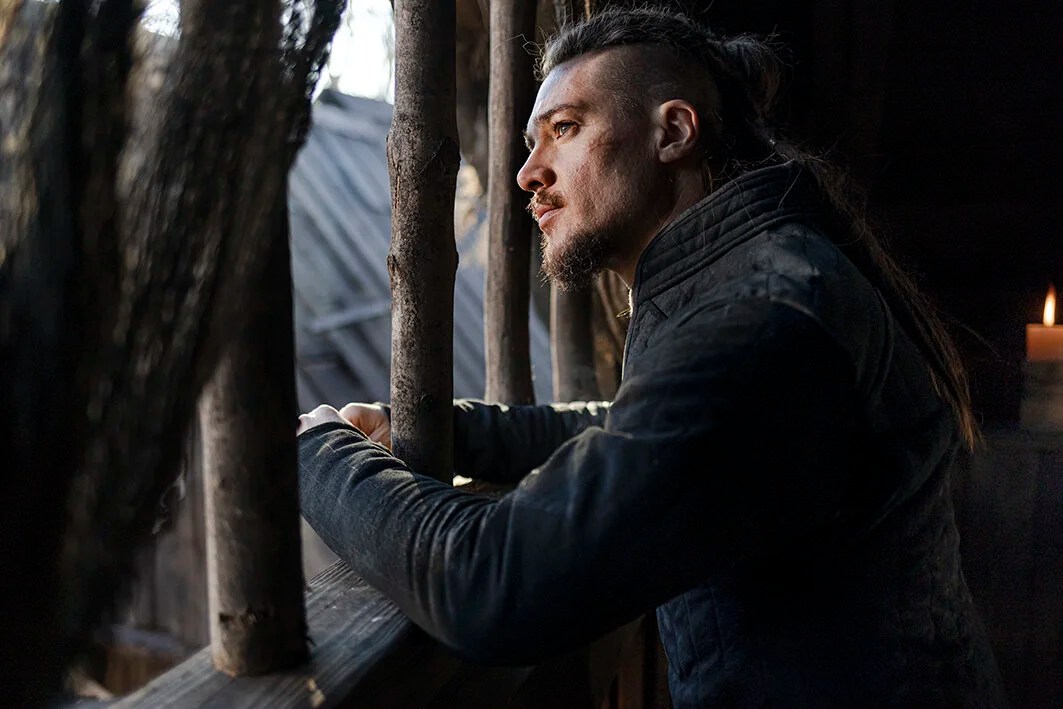
For a show full of warriors, The Last Kingdom is often at its best with priests.
That sounds wrong, but it is true. The series understands that faith in this period is not just decoration. Christianity is political, cultural, emotional, and deeply practical. It legitimises kings. It organises communities. It creates moral language. It also produces hypocrites, fanatics, sincere servants, and people who are simply trying to make sense of suffering.
Father Beocca is central to that balance. He is one of the few people who loves Uhtred without needing him to be useful. His faith is not weak, but it has room for affection. He can scold Uhtred, defend him, worry over him, and see the boy beneath the warrior. Their relationship gives the early seasons a tenderness they would badly miss without him.
Hild is another of the show’s best moral presences. Her journey from trauma to spiritual resilience, and then into a harder kind of grace, gives the series one of its more quietly powerful arcs. She does not need to become a permanent warrior to be strong. She has already seen what violence does. Her strength lies in surviving without letting brutality define the whole of her.
Father Pyrlig, meanwhile, brings the rare pleasure of a holy man who looks as though he could still break your nose if the theology went badly. He is practical, humane, and funny. He gives the later seasons a lived-in religious intelligence that keeps the Christian world from becoming a flat wall of judgement.
Together, these characters keep the show from becoming merely pagan swagger versus Christian stiffness. They remind us that faith, like identity, is complicated by people actually having to live with it.
Aethelflaed and the Burden of Being Useful

Aethelflaed’s arc is one of the show’s strongest treatments of power and sacrifice.
She enters the story within the royal machinery, but she becomes much more than a political daughter or symbolic bride. Her growth into the Lady of Mercia gives the series a different kind of leadership from Alfred’s cerebral severity or Uhtred’s instinctive courage. Aethelflaed learns to rule through pain, calculation, duty, and self-denial. She understands that power for women in this world is rarely granted without conditions, and those conditions are usually cruel.
Her relationship with Uhtred works because it is both romantic and impossible. The show does not treat love as an escape from history. History sits at the foot of the bed, fully armed, waiting to interrupt. Aethelflaed and Uhtred may want each other, but wanting is a small thing compared with Mercia, Wessex, succession, reputation, and the fragile architecture of power.
There is a melancholy in that which feels more adult than many television romances. They are not separated by misunderstanding or lazy plotting. They are separated by the fact that the world they inhabit cannot accommodate their happiness without charging someone else for it.
Aethelflaed’s strength lies in understanding the bill.
Edward, Aelswith, and the Problem With Inheriting a Vision

Edward is not Alfred, and that is the point.
He inherits the dream of England without fully inheriting the mind that conceived it. That makes him interesting, even when he is frustrating. Edward has authority but not always judgement. He wants to be decisive, but decisiveness without wisdom can look a lot like panic in armour. He is often caught between his father’s legacy, his mother’s influence, the demands of Wessex, and the inconvenient fact that Uhtred is usually right at the worst possible time.
Aelswith, meanwhile, becomes more compelling as the series goes on. Early on, she can seem like a narrow embodiment of religious disapproval, forever looking at Uhtred as though he has tracked mud into civilisation. But later seasons give her more texture: regret, humour, political instinct, and a stubborn survival impulse. She becomes one of those characters who improves with age, partly because age in this world strips away certain illusions.

The generational shift after Alfred is important. The Last Kingdom becomes a story about what happens when vision turns into inheritance. The children of great projects rarely experience them as revelation. They experience them as obligation. Alfred dreamt of England. Edward must govern the mess of getting there. Aethelstan must carry it further still, and by the time Seven Kings Must Die arrives, the dream has become both sacred mission and dangerous obsession.
That is where the show’s politics remain useful. Unity is desirable, perhaps necessary, but the road to it is soaked. The birth of a nation is not presented as clean destiny. It is a long negotiation between ambition, violence, compromise, and memory.
The Danes: More Than the Enemy Across the Field

One of the reasons The Last Kingdom works better than a simpler Saxons-versus-Vikings story is that the Danes are allowed personality, humour, honour, cruelty, and contradiction.
Ragnar the Younger, Ubba, Guthrum, Haesten, Cnut, Sigtryggr — they are not all the same flavour of threat. Some are terrifying. Some are charismatic. Some are almost likeable despite the body count. Some become family. Some become the kind of enemy you enjoy watching because the actor seems to understand exactly how much theatrical pleasure the role can hold.
Haesten, in particular, becomes one of the show’s durable delights. He is slippery, self-interested, amused by his own survival, and somehow hard to hate completely. He understands the game because he has no illusions about it. While other characters speak in oaths and destiny, Haesten often seems to be asking the more practical question: how do I remain alive and preferably comfortable by nightfall?

Sigtryggr brings a more thoughtful energy. His relationship with Stiorra creates one of the more interesting later-season bridges between Saxon and Dane. Through him, the show imagines a possibility beyond endless conquest: coexistence, settlement, negotiated peace. Naturally, because this is The Last Kingdom, that possibility comes under immediate threat from politics, fear, pride, and people who cannot leave well enough alone.
The Danes matter because they are not simply obstacles to England. They are part of England’s making. The show’s world is not purified by victory. It is mixed by contact. Bloodlines, languages, customs, grudges, and gods rub against each other until something new begins to form.
That is far more interesting than a simple invasion narrative.
Battles, Betrayals, and the Comfort of a Good Shield Wall

Let us be honest: part of the pleasure is the violence.
Not violence in the empty, weightless sense. The appeal of The Last Kingdom is not gore for its own sake. It is the rhythm of an action drama that knows how to build towards confrontation. The show understands the old satisfaction of seeing political tension become physical. People scheme in halls, whisper in churches, make bad marriages, send messengers, break oaths, and then eventually everyone ends up in a field with shields, axes, mud, and terrible visibility.
There is something almost analogue about its battle scenes. They are not always enormous by modern fantasy standards, but they feel grounded. Men push. Lines buckle. Horses panic. Someone important gets separated. Someone loyal dies badly. Someone makes a decision that will become a legend if enough people survive to repeat it.
The shield wall becomes one of the show’s recurring images of community under pressure. You survive because the person beside you holds. You die when the line breaks. That is a useful metaphor in a series obsessed with loyalty. The politics may be grand, but the battle reduces everything to bodies, breath, and trust.
The betrayals work the same way. In The Last Kingdom, betrayal is almost a weather system. It rolls in every few episodes. Someone wants land. Someone wants revenge. Someone wants God’s favour. Someone wants to be king. Someone wants not to be ignored. The show can sometimes lean heavily on this rhythm, but it is also part of the genre’s appeal. Power attracts betrayal because power is never only held; it is watched, measured, envied, and plotted against.
By the later seasons, I came to expect that any peaceful scene was merely a place where future damage was being quietly arranged.
Bebbanburg: The Home That Becomes a Myth

Uhtred’s quest to reclaim Bebbanburg is the spine running through the whole story.
At first, it feels straightforward. A boy loses his ancestral home. He grows into a warrior. One day, surely, he will return and take what is his. It is the kind of clean narrative promise that historical epics are built for.
But the show is smarter than that. It keeps delaying the return until Bebbanburg becomes more than land. It becomes childhood, identity, legitimacy, grief, and unfinished business. It becomes the place Uhtred thinks will solve the ache of being divided. If he can stand again in that fortress as its lord, perhaps the scattered pieces of his life will finally arrange themselves.
Of course, places rarely do that for us.

By the time Uhtred gets close to reclaiming Bebbanburg, he is no longer the boy who lost it. He has loved, killed, fathered children, buried friends, served kings, broken vows, and become a legend in everyone else’s story. The home he wants is real stone, yes, but it is also an idea he has been carrying for decades. That is why the eventual return feels satisfying but not simple. He can reclaim the fortress. He cannot reclaim the life that was interrupted.
That distinction gives the show emotional weight. Bebbanburg matters, but it does not erase the road. Homecoming is not restoration. It is reckoning.
The Women Who See Through the Men

One of the pleasures of watching the whole series is seeing how often the women understand the emotional and political reality faster than the men around them.
Aelswith sees danger, even when her judgement is harsh. Aethelflaed understands the price of rule. Hild understands the cost of violence. Brida understands betrayal too deeply and lets it poison her. Stiorra inherits Uhtred’s stubbornness and carries it into her own divided world. Gisela, though gone too soon, gives Uhtred a vision of domestic peace that the show knows cannot last but lets us feel anyway.

The series is still very much built around male warfare and succession, but its women are not merely decorative witnesses. They often carry the consequences. They are married into strategy, used as symbols, traded as alliances, endangered by men’s pride, and then expected to remain composed while the kingdom rearranges itself around their pain.
Aethelflaed in particular is the clearest example of the show’s interest in constrained power. She becomes formidable not because the world suddenly becomes fair, but because she learns how to operate within its unfairness. That is a more interesting version of strength than simply handing her a sword and pretending the problem is solved.
Why It Worked for Me When Other Epics Became Homework

There are historical dramas and fantasy epics that eventually begin to feel like homework. Too many houses, too many claims, too many prophecies, too many people named something similar while standing in dim rooms discussing trade routes.
The Last Kingdom had complexity, but it rarely forgot momentum.
It knew the value of a clear emotional through-line. Uhtred wants Bebbanburg. Alfred wants England. Brida wants belonging and vengeance. Aethelflaed wants to protect Mercia without losing herself entirely. Finan wants to stand by his friend and somehow remain sane. These are understandable drives, even when the politics around them become tangled.

The show also benefits from being earnest without being pompous. It has big speeches, yes. It has destiny, oaths, gods, crowns, and men shouting things before charging. But it also has humour. Uhtred can be ridiculous. Finan knows it. Haesten definitely knows it. Even the show seems to know it. That self-awareness keeps the whole thing from turning into a museum display with stabbing.
There is a certain old-school television satisfaction in that. It is serial storytelling with forward motion. Each season has its conflicts and villains, but the larger arc remains visible. You can feel the years passing. You can feel characters ageing, hardening, softening, or breaking. The show is not reinventing itself every season in desperation. It knows what it is: a muscular historical adventure about identity, loyalty, war, and the long, unpleasant birth of a nation.
Sometimes that is enough. Sometimes that is more than enough.
The Netflix Shift and the Bigger Canvas

The first two seasons were made for BBC Two, with Netflix joining as co-producer on the second; from Season 3, Netflix became the series’ home. The change gave the show a broader reach and, eventually, a larger feel. The later seasons look more expansive, with more polished action and a clearer sense that the series had found its global audience. But the shift also changed the rhythm slightly. The BBC-era seasons have a rougher, tighter quality. They feel leaner, perhaps because they have to. The Netflix seasons have more room, more scale, and sometimes more sprawl.
I do not necessarily see that as a decline. More like ageing. The show changes as Uhtred changes. Early The Last Kingdom is all hunger and raw edges. Later The Last Kingdom is legacy, consequence, and the sadness of surviving too many people.
By Season 5, the series is carrying a lot of accumulated grief. Every reunion has ghosts in it. Every victory feels provisional. Uhtred’s band has become older, more scarred, more aware that not everyone gets to the final hill. There is still adventure, but also fatigue. Not boredom. Fatigue. The kind that comes from living too long in history.

That is why the final stretch worked for me even when some plot turns felt compressed or convenient. I was invested enough in the people to accept a few narrative shortcuts. After a certain point, with long-running shows, the question is not only “Is this perfectly written?” It becomes “Do I still believe in the emotional contract?”
With The Last Kingdom, I did.
Video: The Last Kingdom — Season 5 trailer (official series channel). Uhtred’s personal destiny has become tangled with the future of England.
Seven Kings Must Die: A Farewell With Too Much to Carry

Seven Kings Must Die had a difficult job.
It had to conclude a five-season series, adapt the final movement of a long book saga, serve existing fans, remain accessible enough as a film, honour Uhtred’s journey, deal with Aethelstan and the idea of England, stage a major final conflict, and say goodbye. That is a lot to ask of one feature-length film. Frankly, it is the sort of assignment that looks doomed from the planning meeting.
The result is imperfect but emotionally necessary.
The film moves quickly. Too quickly at times. Characters who mattered across the series are absent or reduced, and you can feel the compression. Some developments that might have breathed over a full season arrive with the blunt efficiency of a summary. After years of slow attachment, that can be jarring. We are used to sitting with these people beside fires, in halls, on roads, before and after battles. The film has less patience for lingering.
And yet, I was glad it existed.

Because Seven Kings Must Die gives Uhtred an ending shaped by the central tension of his life. He has spent decades between worlds, and the film turns that in-betweenness into legacy. His final choices are not simply about land, loyalty, or one more battle. They are about what kind of future can be built from everything he has lost.
The Battle of Brunanburh, as presented in the film, becomes the last great argument over whether England will remain dream, project, or fact. Uhtred, inevitably, is there at the hinge. Not because history would know what to do without him, but because this fictional version of history has always needed him in the doorway between personal desire and national consequence.
The film’s ending has a fitting ambiguity. It gives Uhtred grandeur without making it too tidy. The hall of the dead, the possibility of Valhalla, the question of whether he survives, the faces of those gone before — it is sentimental, certainly, but earned. After all that mud and blood, a little myth feels appropriate.
Besides, after five seasons of people telling us destiny is all, the show was hardly going to end with Uhtred filling out land documents and complaining about coastal maintenance at Bebbanburg.

Video: Seven Kings Must Die — official Netflix trailer. The final film compresses the last movement of the story into a single, decisive conflict.
The Appeal of Historical Dirt

Part of what made The Last Kingdom stick with me is that it looked lived in.
Not always perfectly accurate, perhaps, and certainly shaped for drama, but texturally persuasive. The mud mattered. The worn leather mattered. The smoky halls, rough settlements, damp fields, and battered faces mattered. This was not the gleaming medieval past of clean banners and polite pageantry. It was a world where travel took effort, news arrived late, wounds became infected, and a king’s command could ruin lives miles away.
That sort of design does a lot of storytelling. You believe in a world when the surfaces seem to have memory. The show’s production design, costumes, locations, and battle staging create a sense of place that helps carry the larger fiction. Even when characters speak in heightened dramatic rhythms, the world around them feels practical. People are cold. They are hungry. They are tired. Their clothes have weight. Their weapons look unpleasant to carry.

As someone who has spent a life looking at visual surfaces professionally, I appreciate that. Good world-building is not just scale. It is wear. It is the difference between a prop and an object that appears to have survived other scenes before the one you are watching. The Last Kingdom often gets that right.
It understands that history should not look freshly unboxed.
Uhtred as a Gen X Kind of Hero, Somehow
This may be a strange reading, but Uhtred has something of the Gen X hero about him.
Not in any literal sense, obviously. He is not sitting around with a mixtape, a battered Walkman, and a vague distrust of corporate restructuring. But emotionally, there is something familiar in his refusal to belong cleanly to one system. He is raised by one culture, claimed by another, used by institutions, suspicious of authority, loyal to chosen family, and permanently aware that the people in charge are often making it up with confidence.
That speaks to me.
Uhtred spends most of his life dealing with powerful men who need his labour, skill, and loyalty, but rarely want to give him full respect until they are desperate. There is a certain grim recognisability there. He keeps being told to wait. Wait for land. Wait for recognition. Wait for kings to become wiser. Wait for destiny to stop taking the scenic route.
And like many of us, he learns that the official reward is not always the real reward. The real reward may be the people who stood with you. The work you did even when the credit went elsewhere. The stubborn sense that you remained yourself despite being useful to systems that never fully understood you.
That might be stretching the shield wall a bit far, but not by much.
The Show’s Limits

I liked The Last Kingdom a great deal, but not blindly.
It has repetitions. Uhtred is pulled into royal politics again. Someone betrays someone. A new ambitious warrior or ruler emerges. A fragile alliance forms. A woman connected to power suffers because men are playing kingdom-sized chess. Bebbanburg recedes again. The structure can become familiar.

Some villains are richer than others. Some political manoeuvres arrive because the season needs the board rearranged. Some characters disappear too quickly or are not given enough room, especially as the story grows larger. And like many adaptations moving through a long book series, it sometimes has to compress, combine, or rush emotional beats that might have landed harder with more space.
The film suffers most from that compression. As a finale, Seven Kings Must Die is moving. As a standalone film, it is overburdened. As a continuation of the series, it is satisfying enough if you bring your own accumulated affection with you. Without that affection, I suspect it might feel like being pushed into the last chapter of a book while someone whispers family trees in your ear.
But those limits did not undo the experience for me. In some cases, they are part of the charm. The Last Kingdom is not pristine television. It is sturdy, emotional, occasionally blunt, and carried by conviction. It believes in its story. That counts for a lot.
Why I Stayed Until the End
I stayed because I cared where Uhtred ended up.
Not just physically, though Bebbanburg mattered. I cared whether he would find some kind of peace with the divided self he had carried since childhood. I cared whether he would remain only a weapon or become something more like a witness. I cared about Finan and Sihtric riding beside him. I cared about the dead who seemed to gather around him with every season.
Long-running shows ask something of us. They ask for time, patience, and a willingness to let characters age alongside our own lives. When they work, they become less like content and more like weather patterns from particular years. You remember where you were when you watched them. You remember waiting for the next season. You remember returning after a gap and realising, with some surprise, that you still care.

That was The Last Kingdom for me.
It was not the flashiest epic. It was not always the most refined. But it had a strong spine, a memorable lead, a gallery of characters worth following, and a world that felt shaped by mud, faith, hunger, and ambition. It took the old ingredients — lost heir, warrior bands, clashing kingdoms, doomed loves, great battles — and gave them enough human wear to matter.
By the end, Uhtred had become less a man chasing destiny than a man worn smooth and sharp by it. He began as a stolen boy trying to reclaim a fortress. He ended as one of those half-mythic figures standing at the edge of history, not quite belonging to the world he helped create.
There are worse ways for a television hero to leave us.
Destiny is all, apparently.
But so are loyalty, bad decisions, difficult friendships, impossible homes, and the strange attachment we develop to fictional men who spend several seasons refusing to take sensible advice.
Affiliate Disclosure: This post contains affiliate links. If you click through and make a purchase, I may earn a small commission—at no additional cost to you. I only recommend products I personally find useful or relevant. Thank you for your support.
Leave a Reply